
As you’ll discover during Egypt & the Eternal Nile by Private, Classic River-Yacht, cats featured heavily in ancient culture and customs—including ritual mummification.
Leonardo da Vinci once said, “the smallest feline is a masterpiece,” and cat lovers everywhere agree. Even the tiniest paws deserve praise. Across history, felines have received the adoration they deserve from us humble humans, and never more famously than in Egyptian culture. Though the house cat we know and love today actually originated and was domesticated close by in the Near East, ancient Egyptians quickly saw the merits in their cultivation and actively bred and shaped the lineage of today’s modern domestic cat. From deities to daily companions, there is no denying the cat has left its eternal paw-prints on Egypt.
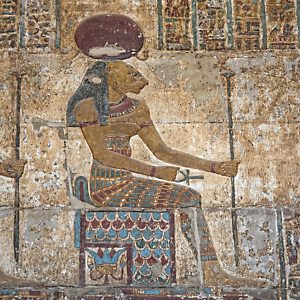
A hieroglyphic scene in Esna depicting the warrior goddess Sekhmet—the more fearsome of ancient Egypt’s two feline deities.
There is no more famous Egyptian symbol of feline power than the gentle goddess Bastet, the evolved form of the fierce lioness goddess, Sekhmet. This symbol of quiet strength has stood the test of time as not only one of the most recognizable Egyptian goddesses, but also as one of the most famous cats anywhere. She’s not alone either: Up to ten deities were either outright cats, or described as having cat-like features. Good thing there weren’t any mice gods!
So, what was it about the cat which Egyptians revered enough to lend its features to their most sacred protectors? Referred to as the “Mau,” the popular pets were considered magical creatures known to give their owners good luck, and so sheltering one was an honor and a blessing. “Mau” also meant “sun,” and the sun god Ra was believed to take the form of a “Great Tomcat” when visiting the underworld. It was also believed that Bastet could shift into the form of an ordinary cat when she so chose—so it was possible that any cat a person came across could be the goddess herself.
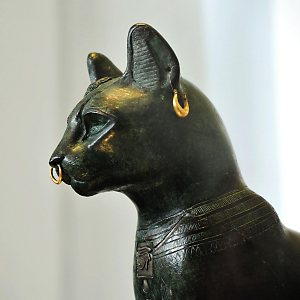
In contrast to Sekhmet, Bastet appears more like a housecat—with a gentler nature to match.
It is speculated, though, that this reverence was originally rooted in a more practical application that inevitably inspired a divine love: More than just being beautiful and amusing, cats are helpful. Cats can see in low-lighting and crawl into small spaces, so when rats and poisonous reptiles posed a threat to both bodily harm and crop harvest, who else but a cat would come to the rescue? Likewise, a cat’s purr vibrates between 25-150 hertz, which not only generates healing in the cat’s body, but also in anyone who happens to have one sitting on their lap. Is it any surprise these protective purrs won over ancient Egyptians?
The only negative quality of a beloved Egyptian cat was its short lifespan. So when a family cat passed away, it was treated with full respect and often mummified as any being leaving loved ones behind might be. It was buried with jewels, favorite toys, and all manner of trinkets appropriate to its standing in the family. After all, what if their cat had been one of Bastet’s incarnations? As a profound act of respect, those humans left behind in mourning would even shave their eyebrows, a reverent act reserved exclusively for the death of a cat due to their close association with Bastet. The time of mourning was considered complete once the eyebrows grew back.
Although the killing of a cat was forbidden in ancient Egypt, there was a dark exception: sacrificial mummification. Catteries run by temple priests were common and a large-scale religious industry was formed to meet the high demand for these sacrifices. Often left at temples or sold to pilgrims devoted to Bastet, these mummified cats were considered messengers between the material and spiritual worlds. Devotees sought not only strong harvests, personal health, and financial stability while they were still alive, but also divine favor for the afterlife. Similarly, if a cat were to outlive their owner, it was often not for very long, as they were expected to accompany their caretaker to the world beyond.
So, if Egyptians didn’t specifically worship cats, where did this idea come from? Ultimately, the lines were furry—uh, blurry!—between adoration and complete devotion. The inclusion of cat gods in the Egyptian pantheon inevitably led to parallels between the divine will of Bastet, and ordinary house cats just going about their lives. Don’t all cat owners believe their cat is special enough to be deemed divine? At once both an offering and a protected friend, there is no discussing ancient Egypt without also mentioning its most curious companion, the cat.
Delve into the rich symbolism of ancient Egyptian mythology with the help of an Egyptologist Trip Experience Leader during Egypt & the Eternal Nile by Private, Classic River-Yacht.
Mystery Solved in Egypt: First New Kingdom Royal Tomb Since Tutankhamun
After a century-long wait, archaeologists have uncovered the lost tomb of pharaoh Thutmose II.
Mysteries of the Great Pyramids … It Just Never Gets Old
After 4,500 years, no one has figured out how the pyramids were built—but they’re getting close.
The Woman Who Would Be King
Hatshepsut managed to rule over Egypt during a time when it was extremely rare for a woman to rule the kingdom—and simply unheard of for a woman to boldly assume the exalted title of "pharaoh."
Get The Inside Scoop On...
Like what you see here? Receive weekly updates right in your inbox.
inside-scoopArticles In This Edition

Animal Planet: 10 Beloved National Animals

Istanbul: "Cat Capital" of the World

Nchi Ya Simba ("Lion Country")

Nine Lives along the Nile: Cats in Ancient Egypt

Purr-adise Found

Where in the World?