Civilizations may come and go, but the stars above have remained pretty much unchanged for thousands of years. When ancient civilizations gazed up at the night sky, almost all of them believed the distant stars were the key to unlocking life’s mysteries. The legendary figures and godlike animals they observed by connecting the astral dots in a grouping of stars served as a living map of the cosmos. They relied on the stories and symbolism they attached to these “constellations” for everything from keeping track of time, predicting the weather, and navigation to foretelling the future and communing with their gods.
It's easy to understand how different civilizations would attach different myths and culture-specific meanings to constellations. But what continues to baffle scholars is the number of civilizations—of different eras and vast distances from each other—who interpreted the night sky in remarkably similar ways.
Let’s take a look at the cultural interpretations of some of the more familiar constellations and asterisms …
Wait, what the heck is an asterism?
It’s a bit confusing, but the differences between constellations and asterisms are kind of important—astronomically speaking, anyway. Basically, constellations are “regions” of the sky. And there are 88 officially recognized constellations covering the entire spectrum of the celestial sky. Asterisms, on the other hand, are recognizable patterns of stars, usually star groupings that fall within a constellation.
Think of a constellation as a big section of the sky (like a “country”) and think of an asterism as a “city” inside that “country.” Orion is a good example of a constellation, but Orion’s Belt (those three bright stars in a row) is an asterism. The familiar grouping of stars we know as the Big Dipper is an asterism, which is part of the Ursa Major constellation.
Before we get too hung up in the weeds, let’s look at what a few of the constellations and asterisms meant to several ancient civilizations that managed to connect those astral dots.
Taurus wasn’t just a lot of bull …
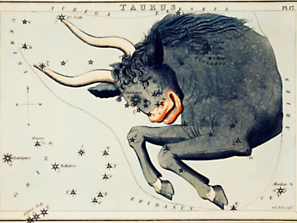
A 19th-century astrological chart shows an artist’s depiction of Taurus.
Considered the oldest named constellation, Taurus the Bull can be viewed in the Northern Hemisphere during the winter and early spring. Factoring in the variety of different animals often found in other star groupings, it’s surprising how many ancient cultures interpreted this collection of stars the exact same way—as a bull. Some researchers even believe that the bull constellation is depicted in cave paintings in France dating back 17,000 years.
The ancient Greeks believed the constellation recalls the myth of Europa, daughter of a Phoenician king. Europa is said to have climbed on the back of an imposing bull, which turned out to be Zeus, who then flew off to Crete with her on his back. Similarly, other older Middle East cultures like ancient Babylon and Egypt worshipped bulls. It is thought that the ancient Sumerians also linked the constellation to the Epic of Gilgamesh, where the hero Gilgamesh fights a bull that comes from the sky called the Bull of Heaven.
Win one for the dipper
The Big Dipper is an asterism that is almost always seen above the horizon at night—as long as the viewer is located north of the 35th parallel. Because of its location, for millennia seafarers relied on it to determine which way is north—as the front lip of the Dipper points towards Polaris, the North Star, which is also the end of the handle of the Little Dipper.
As far back as ancient Greece and other civilizations in the Middle East, the stars of the Big Dipper were recognized as being part of the larger constellation Ursa Major, or the Great Bear. While the Big Dipper itself has been interpreted in many different ways (cultures see everything from a plow and a wagon to a coffin and a canoe), civilizations are remarkably consistent with stories and myths associated with Ursa Major—which appear in the Old Testament, Homer’s Iliad, and in many Indigenous cultures in North America.
The recurring theme about the relationship between bears and humans is likely due to the alignment of the stars of Ursa Major. The bear appears to be on all fours when it’s nearest the horizon and then rises to its hind legs and gestures with its front paws as it makes its ascent into the sky.
Hunter, take a bow
Because Orion “the Hunter” can be seen in both the Northern and Southern Hemispheres and is home to some of the largest and brightest stars in the night, it holds a special place in almost every ancient civilization.
Depicted as a hunter with a bow, Orion comes to us from Greek mythology. The story goes that Orion was a hunter who boasted he could kill anything. To teach him a lesson, the gods had him step on a scorpion, which ended up killing him. Feeling a bit sorry for him, the gods decided to send Orion into the sky as a constellation—accompanied by his faithful dogs, Canis Major and Canis Minor. They also surrounded him with other celestial animals, including Lepus the rabbit and Taurus the bull, so he could continue hunting—but they made sure to place Scorpius the scorpion in the opposite part of the sky so they wouldn’t run into each other again.
Orion is also supposedly in love with one of the seven sisters that make up a star cluster called Pleiades, an asterism in the Taurus the Bull constellation. The gods positioned Orion in the sky so that he is forever chasing Pleiades, but never able to reach them. What makes this sidebar so interesting is that much older Aboriginal cultures offer a strikingly similar account of the relationship between Orion and Pleiades. More on that later.
Guardians of the Galaxy
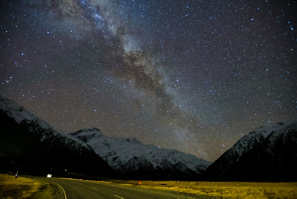
The Milky Way, visible above the Southern Alps in New Zealand.
The Milky Way is neither a constellation nor an asterism, of course. But this stretch of our home galaxy visible in the night sky has been interpreted in surprisingly similar ways across different cultures for millennia.
The most common theme is that the Milky Way represented some type of celestial river—although none of them seemed to flow with water. The name itself, Milky Way, comes from the ancient Greeks. Via Lactea, Latin for Milky Road or Milky Way, hearkens back to a Greek myth about the goddess Hera. After pushing the baby Hercules away from her breast, a stream of her glowing breast milk is said to have gushed across the sky.
Ancient Egyptians believed it flowed with life-giving wheat from the god Isis; the Incas saw it as a stream of gold dust; Inuit of the Arctic had it flowing with snow; Polynesians called it a cloud-eating shark. But no matter what it was filled with, the celestial river known as the Milky Way was an important fixture in the lives of countless ancient civilizations.
The golden girls—minus one
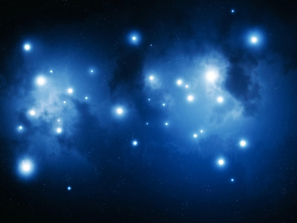
While the Pleiades cluster contains more than 1,000 stars, only six of them represent the "seven" sisters.
If you look in the northern sky in December, you can make out a beautiful cluster of stars known as the Pleiades, or the “seven sisters.” But no matter how careful you look, you’ll only count six stars, not seven. Yet many cultures around the world refer to the Pleiades as the seven sisters and have woven very similar stories about them.
In Greek mythology, the Pleiades were the seven daughters of Atlas, a Titan who was forced to hold up the sky for eternity. Because he never got a work break, Atlas was unable to protect his daughters from being sexually assaulted by the hunter Orion (remember him?!). To safeguard the innocent maidens, Zeus turned them into stars. But one of the sisters fell in love with a mortal and decided to go into hiding—which is supposed to explain why we only see six stars.
Aboriginal groups across Australia also refer to the Pleiades are a group of young girls. And they regarded Orion as a “hunter of women,” specifically those seven lasses in the Pleiades. But then they came up with all kinds of stories about how one of the sisters died, or was in hiding, or was abducted—to explain why only six are visible.
But with little or no contact between most Australian Aboriginal cultures and the rest of the world for some 50,000 years, how could they possibly share the same stories? And how is it that so many ancient cultures call the cluster “seven sisters” even though we can only see six stars? Even as far back as the 3rd century B.C., the Greek poet Aratus commented on the missing star, writing: “Their number seven, though the myths oft say, and poets feign, that one has passed away.”
One mind-blowing possibility that is currently being explored is that the stories of the “seven sisters” and Orion are much, much older than first thought. The thinking goes that humans may have heard these stories around campfires in Africa some 100,000 years ago and then carried the stories with them when they began their long migrations to the far corners of the globe. And 100,000 years ago, that seventh star would have been easily visible to the naked eye. If all that’s true, it would make the Pleiades the oldest story in the world.
Ancient humans from around the world used the night sky to navigate, keep time, create origin myths, and to learn and teach traditions. Since the sky they observed hasn’t changed all that much, does that mean modern-day humans can connect to the stars in the same way as our ancestors did? Since it is estimated that 80% of the world’s population has a far diminished view of the night sky due to light and air pollution, it doesn’t seem likely.
10 more fascinating facts about the Pleiades star cluster
- We’re gonna need a bigger scope—Galileo was the first person to look at the Pleiades with a telescope. While he was only able to see six stars with his naked eyes, when he observed the cluster through his telescope in 1610, he was able to make out thirty-six stars, which he sketched in his notebook. With much more powerful telescopes today, we know the star cluster contains over a thousand stars.
- I told you we weren’t adopted—Modern science has confirmed that the Pleiades are indeed sibling stars. Known as an “open star cluster,” they were born from the same cloud of gas and dust some 100 million years ago. Drifting through space together at about 25 miles per second, many shine hundreds of times more brightly than our sun.
- The Pleiades go trick or treating—Our modern-day festival of Halloween has its origins in an old Druid rite that coincided with the midnight “culmination” of the Pleiades cluster. They believed that the veil dividing the living from the dead was at its thinnest when the Pleiades culminates (reaches its highest point in the sky), which occurred at midnight.
- Typical star vanity—An ancient Polynesian myth refers to the Pleiades as a single star, the brightest in the entire night sky. But when the Polynesian god Tane tired of the star bragging about its beauty, it smashed it into pieces, creating the Pleiades star cluster.
- It’s what makes a Subaru a Pleiades—In Japan, the cluster of stars we know as the Pleiades was called subaru, which means unity. And yes, just like the Subaru car company, whose name was chosen when five smaller firms merged into a larger sixth firm, Fuji Heavy Industries.
- Time to hoist up the sails—The Pleiades star cluster took its name from pleiad, the ancient Greek word for “sail,” since its appearance in the morning spring sky marked the beginning of sailing season in the Mediterranean.
- Well, it was the Vikings after all—Several medieval northern European cultures, including the Vikings, referred to the Pleiades as the “Hen and her Chicks.”
- Pretty maidens all in a row—Plains Tribes like the Kiowa and Cheyenne interpreted the Pleiades as seven maidens who were placed into the sky and would be protected from harm by Devil’s Tower, a sacred monument in present-day Wyoming.
- Those ‘taters aren’t going to pick themselves—South American cultures in the Andes called the Pleiades the “Storehouse” since their appearance in the morning sky every May coincided with harvest time.
- A wolf in a chief’s clothing?—The Blackfoot First Nation in present-day Canada referred to the Pleiades as the “Orphan Boys,” a group of fatherless boys rejected by their tribe and befriended by a pack of wolves. When the sad boys asked the Great Spirit to let them live and play together in the sky, he placed them there as a small cluster of stars. The sounds of wolves howling at night is said to reveal how much they miss their human friends.
Walk in the footsteps of the ancients and learn about their rich mythology during our New! The Greek Islands: From Athens to the Cyclades & Crete adventure.


