How did someone who didn’t author a single text go on to become the most iconic philosopher to have ever lived? Not just that; Socrates single-handedly laid the foundation of Western Philosophy and whose novel teaching method to stimulate critical thinking has endured for more than 2,000 years. The way he lived his life certainly has a lot to do with it. But mostly, it’s because of the way he died.
Socrates was born around 470 BC, in Athens, Greece, just as the city-state was entering its Golden Age under the leadership of Pericles. It was an era marked by remarkable advancements in art, architecture, philosophy, and democracy—and would see Athens emerge as the dominate power in the Greek world.
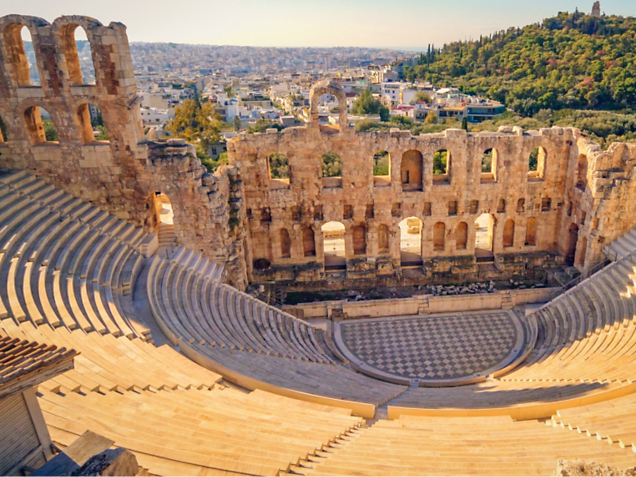
When Socrates was born around 470 BC, Athens was entering its Golden Age—an era marked by remarkable advancements in art, architecture, philosophy, and democracy—which travelers can see the ruins of during our The Aegean Islands, Athens & Istanbul adventure.
So, these were heady times in the world where Socrates made his bones. Not much is known about his early life. We do know that his father was a stonecutter, and his mother was a midwife. Athenian law required all able-bodied males between the ages of 18 and 60 serve as citizen soldiers. And according to Plato, Socrates did his duty as a foot soldier—called a hoplite—in three military campaigns during the Peloponnesian War. Plato said he was known for his fearlessness in battle and even saved the life of a popular Athenian general.
Robe Scholar
There’s no getting around it—Socrates was a strange man. A very strange man. In a society with elevated standards of beauty, the long-haired philosopher roamed the streets of Athens barefoot wearing just a shabby robe. He rarely bathed and was completely indifferent to material possessions or his physical appearance—and his famously crooked nose and bulging eyes didn’t help things. Nor was he interested in fame and power, something Athenians at the time were expected to strive for.
With a wife and three sons to provide for, he didn’t fare too well in that department either. This was even remarked upon in a contemporaneous play, which included this zinger: "Yes, and I loathe that poverty-stricken windbag Socrates, who contemplates everything in the world but does not know where his next meal is coming from."
A controversial and polarizing figure, Socrates had both his detractors and dedicated fan boys—especially a young Plato, who would later pass along the philosophical teachings of his mentor to a young Aristotle at The Academy in Athens.
The cornerstone of Socrates’ philosophy was his belief that true wisdom lay in recognizing one’s own ignorance. This belief in the limits of human knowledge is best encapsulated in his famous paradoxical phrase, "I know only one thing: that I know nothing."
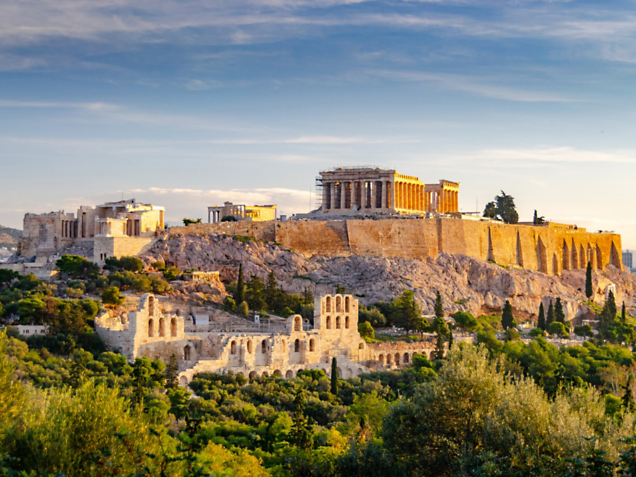
Socrates would have walked past the towering Acropolis daily as he roamed Athens questioning fellow citizens.
And he was no fan of democracy, either. Socrates was skeptical of the Athenian democracy of the day, which he saw as being driven by rhetorical tricks and persuasion rather than truth and wisdom (remember, the Greek word philosophia means "the love of wisdom"). Instead, he thought the most knowledgeable people should be in charge, not the ones who knew how to sway a crowd.
Here’s why Socrates was so polarizing: When he encountered people from Athenian society, he would pose a series of questions to them that he wanted answered with a simple "yes" or "no." Without ever counter-arguing, Socrates continued this line of questioning until a contradiction was revealed—along with an increasingly frustrated opponent. The logical flaws and inconsistencies pointed out by Socrates’ questions were often critical of the Athenian political establishment or of an individual’s moral shortcomings.
Socrates never claimed to have the answers to the questions he was investigating. What he was doing was pointing out that they didn’t have them either—basically, using his own ignorance to expose the ignorance of others. Not surprisingly, this didn’t endear him to the rich and powerful of Athenian society—who in 399 BC decided that enough was enough.
Trial in Error?
At 70 years old, Socrates was probably going to die in a few years anyway. But with anxiety about the future of Athenian democracy swirling around the current government, it was decided that Socrates was spreading dangerous ideas. So, he was arrested and brought up on two charges: "not believing in the gods of the city" and "corrupting the youth of Athens." So much for the idea of free speech in the world’s first democracy.
During the trial by jury, Socrates, to no one’s surprise, chose to defend himself. Instead of apologizing for his actions and promising to change his behavior, right off the bat Socrates says that under no circumstances will he stop engaging in philosophical inquiry. As for the charge of corrupting the city's youth, the old philosopher was unrepentant. Far from corrupting them, he argued, his life of questioning had done it nothing but good. Now, even in ancient Greece, one should be careful when addressing a jury who holds your fate in their hands. As written down by a young Plato, who was present at the trial, Socrates goes on to say: "To put it bluntly I've been assigned to this city as if to a large horse which is inclined to be lazy and is in need of some great stinging fly and all day long I'll never cease to settle here, there, everywhere, rousing and reproving every one of you." Not surprisingly, this infuriated the 500-member jury, who found Socrates guilty. But it was close—281 to 220.
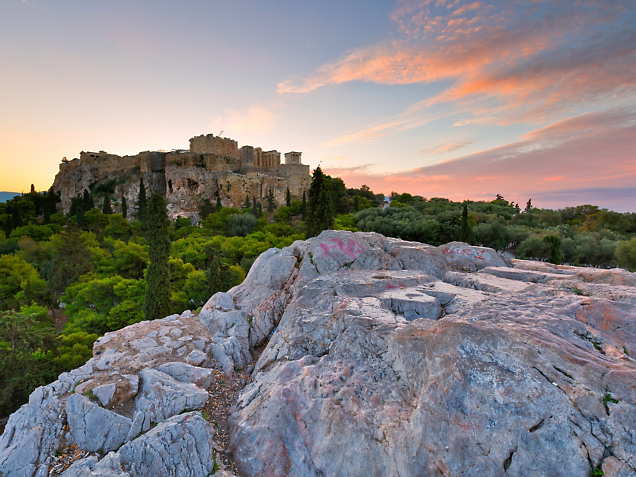
Next door to Athens' famed Acropolis stands the Areopagus, a historic rock where gods and mortals faced trial—though Socrates himself would meet his fate at the Stoa Basileios.
After the guilty verdict, Socrates is given the opportunity to suggest an appropriate punishment. Normally, this would entail suggesting a fine or even exile to avoid a death sentence. But again, Socrates sticks to his guns. Since he has done nothing wrong, he argues, he would be complicit in injustice if he suggested an unjust punishment. Therefore, the only appropriate "punishment" is that he deserves to be given free room and board for life (this was an award that was given to victors in the Olympic Games, and presumably not meant to be serious). Socrates then suggested a small fine as an appropriate punishment. But the jury failed to see the humor in any of this and voted—by a greater majority than for his conviction—for the death penalty.
Pick Your Poison
When the sentence was read, the citizenry of Athens fully expected Socrates to flee the city. His distraught friends even volunteered to bribe the appropriate officials to facilitate his escape. But Socrates would have none of it. Calmly accepting the verdict of the court, he claimed that "he owed it to the city under whose laws he had been raised to honor those laws to the letter." Say what you will, but man stuck to his principles.
Plato, writing about the death of his teacher, said that he "appeared both happy in manner and words as he died nobly and without fear." After drinking a cup of brewed hemlock handed to him by his executioner, Socrates is said to have walked around until his legs grew numb and then lay down, surrounded by his friends, and waited for the poison to reach his heart. "Such was the end of our comrade," Plato writes, "… a man who, we would say, was of all those we have known the best, and also the wisest and the most just."
Socrates maintained that living true to his convictions was more valuable than life itself. And the stoic manner in which he met his death immortalized him as a martyr for truth and intellectual inquiry. Still, whenever Socrates is mentioned, it’s difficult not to think about that scene in the movie "Bill & Ted’s Excellent Adventure" when the boys meet the legendary Greek philosopher for the first time. Not knowing what to do, Bill says to Ted, "Philosophize with him!" So, Ted turns to Socrates, clears his throat, and says: "All we are is dust in the wind, dude." SO-crates would have loved it.
Explore Athens and walk in the footsteps of Socrates during our The Aegean Islands, Athens & Istanbul.


