Sure, Oxford and Cambridge have been around for a while. But the distinction of being the oldest university in continuous operation in the world goes to the University of Bologna. It was founded in 1088 as a corporation of students (universitas scholarium)—unlike the usual corporation of professors (universitas magistrorum)—and the study of Roman law was its primary focus. Referred to as the Studium of Bologna, the school’s reputation for excellence quickly spread.
The University of Bologna came into being because a group of law students banded together to form a school where they would get to decide which teachers would be hired. Novel as that was, there was something even more revolutionary about the school. Before the 11th century, formal education in Europe almost exclusively took place in monasteries—where doctrinal teachings of the Catholic Church were strictly adhered to. But the University of Bologna operated independently of the church.
The school was founded as an institution devoted to freedom of thought and the pursuit of truth. It was also the first institution to establish academic requirements and award degrees. The principle of academic freedom was born at the University of Bologna.
The school’s reputation only continued to grow, and by the end of the 12th century, it was renowned as the premier center for higher learning in Europe. As a result, Bologna quickly became known as La Dotta, "The Learned" city—and also La Grassa, "The Fat" city due to the new influx of wealth. It soon began drawing teachers and students from all over Europe. And not just to study law, but in other disciplines like medicine, theology, philosophy, and the liberal arts.
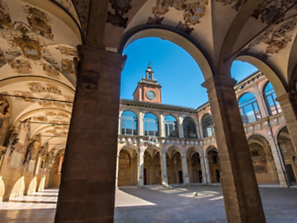
The Archiginnasio atrium at Bologna University houses the Municipal Library and Anatomical Theater.
Notable alumni of the University of Bologna
Because the Holy Roman Emperor Frederick I granted special protection to Bologna’s foreign scholars, the school attracted some of the most radical minds of the Middle Ages as well—including Dante Alighieri, Francesco Petrarca, and Erasmus of Rotterdam, who all studied at the University of Bologna. As did Pope Alexander VI and astronomer Nicolaus Copernicus.
Another illustrious student at the University of Bologna had an easy commute. Shortly after the Institute of Physics was inaugurated at the university by Augusto Righi in 1907, Righi’s lectures were attended by Guglielmo Marconi, who was born in Bologna in 1874. Marconi, who had made the first transoceanic radio broadcast in 1901, would go on to win the Nobel Prize for Physics in 1909 when he was just 35.
More recent alumni include the former Italian Prime Minister Romano Prodi. World-renowned Italian medievalist, philosopher, and novelist Umberto Eco not only studied here but taught at the University of Bologna as well, creating and presiding over two advanced degree programs up until his death in 2016.
Women with class
No one would be expected to recognize the name of another student who attended of the University of Bologna—Bettisia Gozzadini. She was a noblewoman who studied philosophy and law at the school in 1237. What makes her so special is that Gozzadini was the first woman in history to be awarded a university degree and allowed to teach at the university level. Quite an achievement in an era that took a dim view of education for women. Another woman who attended the University of Bologna, Laura Bassi, was the first woman to receive a doctorate in science.
But progressive ideas were nothing new for the University of Bologna. During the turbulent years of the Protestant Reformation, the school kept its doors open and did everything it could to protect Protestant students from prosecution by the Inquisition.
Student housing? We’ve got you covered …
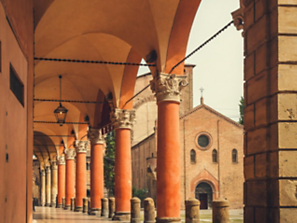
An example of a portico in Bologna’s medieval old town.
At the time of the university’s founding, Bologna was a very small city. As more and more students and academics from across Europe made their way to the city to attend school, Bologna experienced something that is all too familiar with university towns even to the present day: Where are all the students going to live? There simply wasn’t enough housing in Bologna to accommodate them. The solution the city came up with was genius.
Another nickname for Bologna is the "City of Porticoes," due to the extensive network of these covered walkways all through the city. There are more than 24 miles of these arcades in Bologna’s medieval core alone, more than in any other city in the world (they’re also a UNESCO World Heritage Site).
Well, they were built as student housing for the University of Bologna. By allowing the upper part of buildings to be extended—along with offering shade and shelter from the weather—porticoes expanded the living space available for their burgeoning student population. Because they didn’t take away public land, infringe on important city spaces, or necessitate the construction of new buildings, porticoes were the perfect solution to Bologna’s housing emergency. They even became regulated beginning in 1288, with a proclamation requiring the addition of porticoes to existing homes in Bologna and the inclusion of a portico in all new buildings—and no more panic for incoming freshmen worried about looking for a dorm.
University grades begin to slip in the 16th century
In the middle of the 16th century, the University of Bologna’s days as the bastion of free-thinking and knowledge came to a screeching halt. In response to the Protestant Reformation (and to get away from hostile imperial territories), Pope Paul III brought the Council of Trent to Bologna. With the church in turmoil, the university was forcibly reorganized and was to focus on the church’s efforts in the Counter-Reformation. Students, who also lost control of their guilds, were now obligated to profess their faith—which meant all the Protestant students and faculty up and left the university.
The reorganization also resulted in the hiring of less qualified teachers, and the quality of education began to deteriorate. The decline continued through the 17th century, with plagues and famine only adding to Bologna’s woes. It wasn’t until the 18th century that the university turned it all around and regained its prestige as the pinnacle of educational excellence. And with the 19th-century unification of Italy, the University of Bologna was back on top to stay, also growing into one of the largest universities in the modern world.
Although the school did have to endure one more speed bump. During the fascist regime of Mussolini, the school’s faculty had to swear allegiance to Il Duce. Racial laws passed in 1938 also prohibited Jewish people from teaching—even though the University of Bologna had been one of the first schools in Europe to establish a department dedicated to the research of the Jewish language, culture, and religion. But after the fall of the regime, things returned to normal.
Today, the University of Bologna stands as a testament to the enduring legacy of intellectual pursuit.
A few more fascinating facts about Bologna
- Psst, heard about the "whispering walls"?—In the Palazzo del Podestà there is an arched vault that manages to transmit sounds from one corner of a building to another as clearly as though you were yakking away on your cell phone. Even with noisy crowds around, this quirky architectural feature lets one converse in barely a whisper to someone quite a distance away. Discovered by accident in the 14th century, legend has it that lepers used this acoustic anomaly to confess their sins without risking contact with priests.
- No shrinkage problem for the sea god Neptune—In the square just before Piazza Maggiore, there is a magnificent statue of Neptune by the 16th-century Flemish sculptor Giambologna. If you stand at a certain spot behind the iconic statue and look at Neptune’s outstretched thumb, the sea god appears to be excited to see you—and it is believed that the clever Giambologna designed it that way. When he was constructing the fountain, Pope Pius IV became concerned by the size of Neptune’s, let’s say, "package" and ordered it to be made smaller. (The fountain itself was commissioned to symbolize the Pope’s power, as he ruled the land like Neptune ruled the water.) The locals affectionately refer to the Neptune fountain as "Il Gigante."
- An arrow escape—At the entrance to Corte Isolani (located at number 26 along Strada Maggiori), you’ll want to look up at the wooden ceiling. Legend has it that three assassins were hired to kill a Bolognese nobleman who was living there. As the trio approached the house, they were distracted by a young lady standing by the window naked and shot their arrows wildly. The arrows all landed on the beamed roof of the portico—and two of them are still visible sticking into the wood.
- No gondolas, but … —Beneath the bustling streets of Bologna is an extensive network of canals. Built in the 12th century to power the city’s silk mills and transport goods, most of them remain hidden. But if you peek through a small window in a wall along Via Piella, you’ll be transported back in time when Bologna resembled "Little Venice."
- Still, it’s a devil of a walk—If you like combining exercise with a little spiritual enlightenment, follow the pathway from Bologna’s city gates to the hilltop Sanctuary of San Luca. About two-and-a-half miles long, it’s the longest porticoed walkway in the world. It was built between 1674 and 1793 by the citizens of Bologna to protect the sacred icon of the Virgin of San Luca as it was carried to and from the sanctuary during an annual pilgrimage, and passes through 666 covered archways along the way. Wait, 666?! Some say it was to turn the devil’s number into a path of righteousness. Others say it is just a coincidence …
- Typical construction delays … —The 16th-century San Petronio Basilica, one of Bologna’s most iconic buildings, has been waiting 500 years for its planned facelift and expansion. The tenth-largest church in the world, it was meant to be even bigger than St. Peter’s Basilica in Rome. But the pope, not wanting to be upstaged, got in the way. That’s why the basilica’s façade sports a quirky mix of elegant marble along the base and bare brick at the top.
Visit the University of Bologna during the History & Culinary Delights of Bologna & Parma, Italy pre-trip extension to Tuscany & Umbria: Rustic Beauty in the Italian Heartland.


