In this cinematic YouTube video, get a reconstructed glimpse into how ancient Rome looked—and see the ruins of the "Eternal City" for yourself on our Italy’s Western Coast & Islands: A Voyage from Rome to Valletta adventure.
Walking through modern-day Rome, with its bustling streets and Renaissance architecture, it can be difficult to envision the grandeur of the ancient city that once stood as the capital of the world's greatest empire. For centuries, travelers have marveled at the Colosseum and Roman Forum ruins, trying to piece together mental images of what these structures looked like in their prime.
But what did ancient Rome actually look like during its height in the first and second centuries AD, when the city was home to over a million residents and the heart of an empire spanning three continents?
Home, sweet Rome
As they say, Rome certainly was not built in a day—and it certainly wasn't built uniformly. The "Eternal City" evolved over centuries, transforming from a collection of humble villages on seven hills into a sprawling metropolis.
By the second century AD, Rome had become an architectural wonder unlike anything the world had seen before. At the heart of the city lay the Roman Forum, the political and commercial center where citizens gathered for public speeches, criminal trials, and religious ceremonies. Surrounding this hub were the Imperial Forums, added by successive emperors eager to leave their mark. These spaces were adorned with gleaming marble facades, elaborate colonnades, and towering statues of gods and emperors that were often painted in vibrant colors—and, in some elite or religious spaces, even accompanied by fragrant incense —unlike the pristine white ruins travelers on our Italy’s Western Coast & Islands: A Voyage from Rome to Valletta adventure can see today.
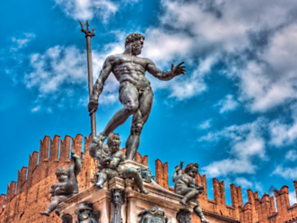
In ancient times, this statue of Neptune likely would have been painted with lifelike colors and even scented with pungent fragrances.
Indeed, color dominated the visual landscape of ancient Rome. While many often picture a city of white marble, archaeological evidence reveals that buildings were painted in bright hues of red, blue, and gold. As we mentioned, statues were not the bleached figures we see in museums today but were painted with lifelike colors. Meanwhile, streets teemed with people wearing clothing that signaled their social status—from the purple-trimmed togas of senators to the multicolored tunics of ordinary citizens.
Here come the waterworks!
If you traveled back in time to ancient Rome (perhaps dressed in a colorful toga or tunic of your own?), you'd be immersed in a bustling metropolis alive with sensory experiences. The streets would echo with the calls of vendors, the rumbling of wooden cartwheels on stone, and the constant hum of a million inhabitants—creating an urban soundscape dramatically different from the quieter countryside beyond the city walls. Your nose would detect a complex mixture of aromas: exotic spices and sizzling food from countless stalls, unfortunately mingling with less pleasant odors from tanneries, public latrines, and temple sacrifices.
What truly made Rome wondrous, however, was its remarkable built environment. While we can easily imagine Rome's sights and sounds, its urban planning and infrastructure set precedents that have lasted up to the modern era. Archaeological evidence confirms the city featured an impressive network of paved streets arranged in a grid pattern—similar to modern New York City—with major avenues spanning up to 30 feet wide to accommodate both vehicular and pedestrian traffic.
Interestingly, Rome itself isn’t built near potable water. The Romans managed to support a modern-size metropolis via 11 major aqueducts—literally "roads for water" that brought in clean stuff from nearby mountains and rivers—feeding hundreds of public fountains, bathhouses, and wealthy private homes. These aqueducts were nothing short of engineering marvels, delivering as much as 200 million gallons of water daily (according to some estimates)—the equivalent of what modern American cities were using in the early 20th century.
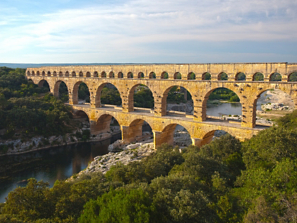
The magnificent Pont du Gard aqueduct bridge was built by ancient Romans, its three tiers of perfectly stacked arches spanning the Gardon River in southern France for nearly two millennia.
To put this in perspective, while the average person today uses about 100 gallons of water per day (mostly for flushing toilets), ancient Romans had about 200 gallons of water per person per day, plus an additional million gallons daily for their baths, fountains, and landscaping. As if that’s not impressive enough, some of these aqueducts still function today and provide modern-day Rome with water. For example, the Aqua Virgo (constructed in 19 BC), continues to supply water to Rome's famous Trevi Fountain.
Lofty ambitions
While the emperor and aristocratic families enjoyed spacious villas with interior gardens, private baths, and intricate mosaics, the majority of Romans lived in insulae—multi-story apartment buildings that could reach up to seven stories tall. These ancient high-rises were the world's first apartment complexes, housing dozens of families in cramped conditions.
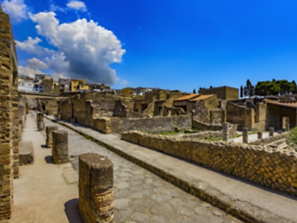
People can walk amongst the remains of ancient houses, or insulae, at UNESCO World Heritage Sites like the Ruins of Herculaneum.
The typical insula was built with a timber frame and brick-faced concrete, with shops and taverns occupying the ground floor. Upper floors became progressively smaller and less desirable, with the poorest residents confined to dark, windowless rooms at the very top. Without modern amenities like indoor plumbing or heating systems, daily life for average Romans involved collecting water from public fountains and using public latrines and bathhouses for hygiene.
Of course, with wooden structures packed tightly along narrow streets, fire was a constant danger in ancient Rome. In fact, it was the catastrophic fire of 64 AD that inspired Emperor Vespasian to strategically commission the Flavian Amphitheater on the site of Nero's private lake. If that doesn’t sound familiar, you might now know it today as the "Colosseum" (a name that emerged in the Middle Ages, referencing the colossal statue of Nero that once stood nearby). Currently considered one of the new "Seven Wonders of the World," the Colosseum was deliberately presented as a public gift to the Roman people. Emperor Vespasian wanted to win their favor by starkly contrasting Nero's self-indulgent use of land for his personal Domus Aurea complex.
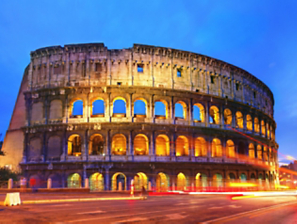
The Colosseum was built in the late first century—hosting gladiatorial contests and public spectacles for nearly four centuries.
Travelers who behold the Colosseum today are often blown away by its magnificent scale; a 2,000-year-old wonder that seated 50,000 spectators when modern NFL stadiums like Soldier Field in Chicago barely fit 61,500 fans with today's technology. But, to ancient Romans, it likely wasn’t anything too special. The Circus Maximus—Rome's chariot racing stadium, constructed hundreds of years before the Colosseum in the sixth century BC—could hold an astonishing 250,000 people. Meanwhile, massive bath complexes like those built by Emperors Caracalla and Diocletian covered areas equivalent to several modern city blocks, featuring soaring concrete domes that would not be surpassed in scale for over a millennium.
This sort of flashy architecture was intentionally grandiose, designed to awe both Roman citizens and foreign visitors to reinforce the message that Rome was the center of civilization—and its emperor a living god.
Rome's Got Talent
While other cities of the ancient world had their own grandeur—Alexandria with its famous library and lighthouse, Athens with its philosophical legacy, and Babylon with its legendary Hanging Gardens—none matched the sheer scale, population, or engineering prowess of Rome at its height.
At a time when most cities boasted populations in the tens or hundreds of thousands, Rome surged past the one-million mark, a feat not replicated in Europe until London in the 19th century. By contrast, ancient Athens likely peaked at around 250,000 residents—including slaves and non-citizens—and Alexandria around 500,000. These were significant numbers, but still only a fraction of Rome’s enormous population.
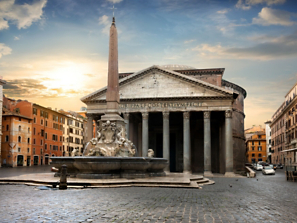
The Pantheon stands as the largest unreinforced concrete dome in the world—even today.
As you now know, Rome also stood in a league of its own in terms of infrastructure. While other cities might rely on local wells or rudimentary water systems, Rome’s aqueducts stretched for miles, delivering water with remarkable consistency and efficiency. Public bathhouses were present in other cultures, but nowhere were they as extensive—or as central to daily life—as in Rome. And while Athens had the Acropolis and Babylon had its fabled ziggurats, no city of the era could rival the scale of the Colosseum or the engineering sophistication of the Pantheon’s massive unreinforced dome.
Rome was not just a city, but a statement. Its streets, monuments, and institutions were designed to impress, to project dominance, and to embody the idea that all roads truly did lead there.
Experience the majesty of ancient Rome firsthand as you explore the remarkably preserved ruins of the Forum, Colosseum, and Pantheon during our Italy’s Western Coast & Islands: A Voyage from Rome to Valletta adventure.


