
Travelers on our New! Alpine Europe: France, Italy's Dolomites, Switzerland & Austria adventure can witness firsthand how the Alps posed a double-edged sword for the great Carthaginian general Hannibal Barca.
In the annals of military history, few tales capture the imagination quite like Hannibal Barca's crossing of the Alps in 218 BCE. With an army of 70,000 infantry, 20,000 cavalry, and—most famously—37 elephants, this legendary Carthaginian general attempted what many deemed impossible: traversing the fearsome Alpine Mountain range to launch a surprise attack on Roman soil.

Today, Hannibal Barca is mostly known as the great Carthaginian general who led his forces on a daring trek across the Alpine Mountains to confront the Romans on their home turf.
Master plan aside, Hannibal's reputation—built on cunning, unconventional military thinking, and an ability to inspire steadfast loyalty in his troops—was well-earned. However, these lauded qualities would soon face their ultimate test in the icy crucible of the Alps. The perilous journey ahead would challenge not only Hannibal's strategic brilliance but also push the boundaries of human endurance and military logistics to their breaking point.
Flipping the script
As one might expect, Hannibal's decision to cross the Alps was born out of necessity. The Second Punic War had pitted the Roman Republic against Carthage, the other great power in the Mediterranean. Rome hoped to use its naval dominance to invade Carthage's territory and force its rival to accept Roman terms for peace. To thwart this threat, Hannibal devised a bold plan that might just flip the script: He would strike first by invading Italy and forcing the Romans to defend their own territory.
However, to reach Italy, Hannibal couldn't rely on sea transport—he simply didn’t have enough allied ports to support that kind of maritime expedition. Additionally, Hannibal aimed to rally support from the population in Northern Italy, who were already hostile to the Romans.
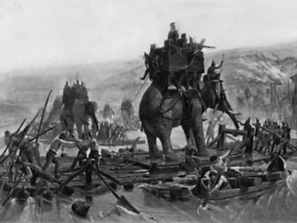
On the way to the Alps, Hannibal innovatively transported his war elephants across the Rhône River—a historic waterway that travelers can explore during Grand Circle's Cruising the Rhône: Lyon to Provence & the South of France River Cruise.
Thus, Hannibal's army set out from New Carthage (modern-day Cartagena, Spain) in the spring of 218 BC. They marched along the Mediterranean coast, crossing the Pyrenees and the Rhône River before reaching the foothills of the Alps in late September or early October. The timing was crucial—and perilous. Hannibal needed to cross before winter made the journey impossible, but late enough that the Romans wouldn't expect an invasion that year.
Battling both nature and man
As the Carthaginian army began its ascent into the Alps, they faced not only daunting natural obstacles but also fierce resistance from local tribes. In particular, the Allobroges and other Gallic peoples viewed Hannibal's forces as invaders—and they were determined to defend their mountain homes.
The Roman historian Livy vividly described the scene of first encountering these tribesmen: "The dreadful vision was now before their eyes. The towering peaks, the snow-clad pinnacles soaring to the sky, the rude huts clinging to the rocks, beasts and cattle shriveled and parched with cold, the people with their wild and ragged hair, all nature, animate and inanimate, stiff with frost: all this, and other sights the horror of which words cannot express, gave a fresh edge to their apprehension."
Hannibal's military genius shone even in these dire circumstances. He quickly adapted his tactics, using his light troops to scale the heights and outflank the tribesmen as a precaution. As Livy recounts, Hannibal sent his bravest, most determined light infantrymen to stealthily secure the highest spots along the route. When the locals showed up the next day, "they saw the Carthaginian assault troops right above their heads."
Unfortunately, the locals weren’t fazed. One of the most harrowing episodes occurred soon after as Hannibal's army navigated a narrow mountain pass. Taking advantage of their knowledge of the terrain, the local tribesmen began rolling boulders down the mountainside, crushing soldiers and pack animals alike. The narrow path left Hannibal's forces with little room to maneuver or defend themselves, resulting in significant casualties. As Greek historian Polybius wrote, "The road leading up to the pass was not only narrow and uneven but flanked with precipices, and so the least movement or disorder in the line caused many of the animals to be forced over the edge with their loads."
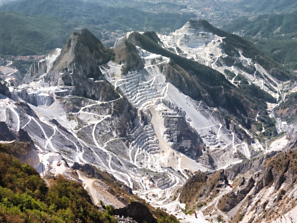
Just imagine traversing this treacherous terrain with an army of 70,000 infantry, 20,000 cavalry, and 37 elephants—all while hostile tribesmen try to crush you with giant, rolling boulders.
However, Hannibal's force of elephants—believed to be an extinct subspecies from the Atlas Mountains in Morocco and Algeria—proved a valuable asset. According to Polybius, "The enemy were terrified by their strange appearance, and never dared approach the part of the column in which they were stationed." Hannibal and his men managed to inflict heavy casualties upon their attackers, and after driving them off, attacked and captured the enemy’s nearby town, where they recovered some soldiers, mules, and horses who had been captured, and seized enough food to last several days. Rejecting defeat, the tribesmen continued to attack throughout the Alpine crossing, constantly taking advantage of the difficult terrain.
"Are we there yet!?"
By the ninth day, Hannibal’s army had reached the highest point of the route, but the men felt exhausted and hopeless. Seeing their despair, Hannibal rode on his horse to the front. He halted the army and exhorted them to gaze down into northern Italy’s Po Valley. "Henceforward all will be easy going—no more hills to climb," the general told his men.
Alas, to their surprise, the descent proved to be as treacherous as the ascent. Polybius described the chaos: "It was impossible for a man to keep his feet. The least stumble meant a fall, and a fall a slide, so that there was indescribable confusion, men and beasts stumbling and slipping on top of each other."
After sixteen brutal days of Alpine traversal, Hannibal's battered but unbroken army finally descended into the Po Valley. The force that emerged was a shadow of the one that had begun the journey: Historical sources suggest that Hannibal lost as much as half of his infantry and cavalry—along with many of his prized elephants (some accounts claim he lost all but one)—to the combined threats of harsh weather, treacherous terrain, and hostile tribesmen.
Yet, the impact of this crossing cannot be overstated. The Romans were caught completely off guard, forced to recall armies from other theaters of war. Hannibal's invasion sparked a prolonged conflict that would bring Rome to the brink of defeat. At the battle of Cannae in 216 BC, Hannibal’s forces surrounded and practically annihilated a much larger Roman and Italian army composed of more than 85,000 troops.
Great minds—and generals—think alike."
The exact route of Hannibal's crossing has been hotly debated for centuries. Recent research, analyzing ancient animal deposits, suggests the Carthaginians may have used the Col de la Traversette, a 7,700-foot pass between France and Italy.
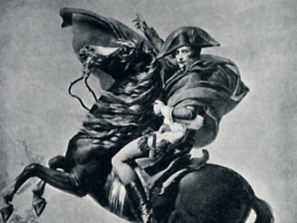
In 1800, Napoleon Bonaparte crossed the Alps via the Great St. Bernard Pass as a tribute to Hannibal's Alpine adventure—an event immortalized in Jacques-Louis David's famous painting.
This mystery has captivated not just historians, but also later military leaders seeking to emulate Hannibal's feat. Napoleon Bonaparte, in particular, was inspired by the Carthaginian general. In 1800, he led his own army across the Alps via the Great St. Bernard Pass, deliberately echoing Hannibal's journey.
Napoleon's crossing was as much propaganda as military strategy, immortalized in Jacques-Louis David's famous (if fictitious) painting of the emperor astride a rearing horse. Indeed, by invoking Hannibal's legacy, Napoleon sought to cement his own image as a great conqueror.
Safely traverse the stunningly beautiful Alps during our New! Alpine Europe: France, Italy's Dolomites, Switzerland & Austria adventure.
Starchy Stranglers
If you ask the waiter to substitute twins for your priest strangler and he apologizes that tonight they only have butterflies and ears, what are you eating—and where?
Where in the World?
Where in the world can you find this "ghost village," intentionally left uninhabited as a reminder of a bloody massacre that took place during WWII?
Get The Inside Scoop On...
Like what you see here? Receive weekly updates right in your inbox.
inside-scoopArticles In This Edition


