The longest-serving female ruler in Egyptian history, Hatshepsut’s tomb was unearthed at the Valley of Kings in 1903—a site travelers can explore during our Ancient Egypt & the Nile River adventure.
The longest-serving female ruler in Egyptian history, Hatshepsut’s tomb was unearthed at the Valley of Kings in 1903—a site travelers can explore during our Ancient Egypt & the Nile River adventure.
Certainly, there have been many extraordinary women rulers throughout history. But long before such powerful figures as Indira Ghandi or Catherine the Great appeared on the world stage—and some 1,500 years before Cleopatra drifted down the Nile—there was Hatshepsut. As a full-fledged pharaoh of Egypt, Hatshepsut ushered in an era of peace and prosperity, and just may have been the first truly great woman ruler in all of recorded history.
A woman’s place is … on the throne
At the time of Hatshepsut’s reign, Egypt was well into the 18th Dynasty of the New Kingdom period, so called after the reunification of the country’s northern and southern lands. This is also often referred to as the "Golden Age" of Egypt, a time when military conquests of a succession of pharaohs had turned it into the most powerful empire the world had ever known.
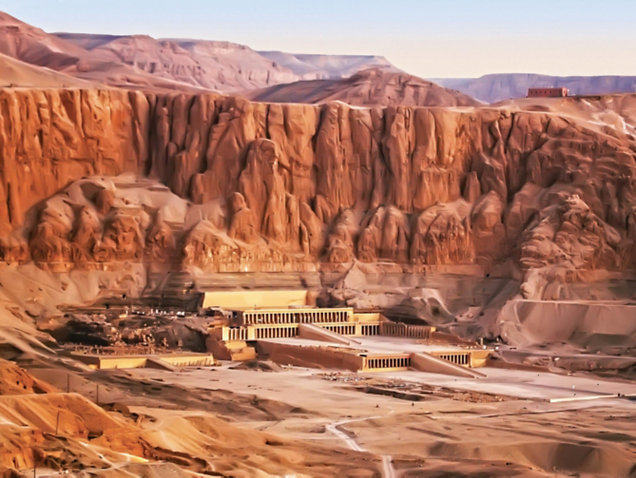
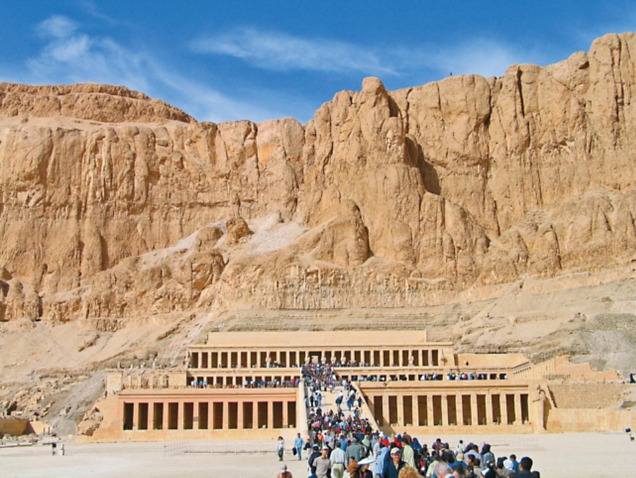
An aerial view of Queen Hatshepsut mortuary temple at the Valley of the Kings.
Politics and power were not the only arenas where Egypt excelled during this period. It could also boast civic and social advancements that were thousands of years ahead of their time, especially with regards to women. Unlike their contemporaries in Mesopotamia and Greece, Egyptian women enjoyed the same legal and social rights that Egyptian men did. They could own property, hold official positions, and even inherit land and money from parents or husbands. They could even divorce their husbands and live alone if they chose to.
Still, there were certain things they couldn’t do, such as carry or use weapons and metal tools. And some jobs for women were outright forbidden, such as that of administrator or scribe. After all, Egypt was still a male-dominated society. Just as in most early civilizations, a woman’s place was dominated by a need to produce and nurture healthy children to ensure a family’s future welfare. So the primary role of women in ancient Egypt, as in throughout the ancient world, was as wife, mother, and child-bearer.
But even with many clearly defined roles for men and women, the social climate of ancient Egypt didn’t preclude the rise of powerful women. Long before Hatshepsut’s day, there had been several strong and influential queens who proved that women were just as capable in maintaining stability and order in the empire as men. So Egypt was familiar with having a woman as a ruler—but as a pharaoh? Pharaohs were considered the living version of the god Horus. To have a woman pharaoh would go against all social and religious norms. What Hatshepsut had in mind was unprecedented.
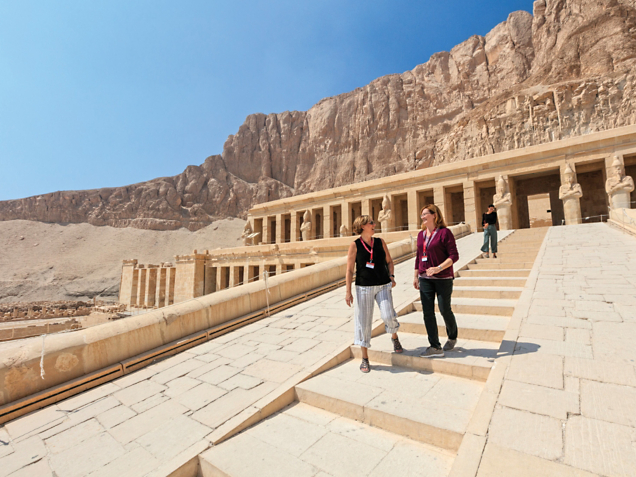
O.A.T. travelers explore Hatshepsut’s temple in the Valley of the Kings during our Ancient Egypt & the Nile River adventure.
Hatshepsut was the eldest daughter of the popular pharaoh Thuthmose I and his Royal Wife, Queen Ahmos. In order to strengthen the royal lineage, Hatshepsut—about 12 at the time—was married to Thutmose II, her half-brother. Hatshepsut and Thutmose II had one daughter, and when Hatshepsut was apparently unable to produce a male heir, Thutmose II turned to a minor wife, Isis, who did give him a son: Thutmose III.
Walk like a man, talk like a man—and plot like a man
As queen and the "Great Royal Wife" of Thutmose II, Hatshepsut reigned over Egypt together with her husband for 14 years, until he was carried off, presumably by illness. She then became regent for her seven-year-old stepson, ruling the kingdom on his behalf. As Thutmose III approached age 21, however, it became clear that Hatshepsut was in no hurry to relinquish the reins of power to the rightful heir. She wanted to rule in her own right. So, in 1473 BC, she took the bold step of proclaiming herself pharaoh. Thutmose III was not pleased—but more on that later.
To strengthen her claim to the title of pharaoh, Hatshepsut began blurring the gender line. She changed her name to its male form, Hatshepsu, and began referring to herself in writing as both "he" and "she." She took to dressing in men’s clothing, had herself depicted as wearing a king’s royal headdress, and even donned a false beard! This, too, was not exactly conventional behavior for a woman in ancient Egypt.
At the time of her death, Hatshepsut was not only the longest-serving female ruler in Egyptian history—she was also one of the most effective. During her 22-year reign (including her term as regent for Thutmose III), she was a prolific builder of magnificent temples and monuments—including one dedicated to herself. And though hers was generally a peaceful rule, she oversaw several successful military campaigns. Not only did she have her nephew, Thutmose III, lead an army into Nubia to fight several wars, but she personally led armies onto the battlefield. This, in itself, was unprecedented in Egyptian history.
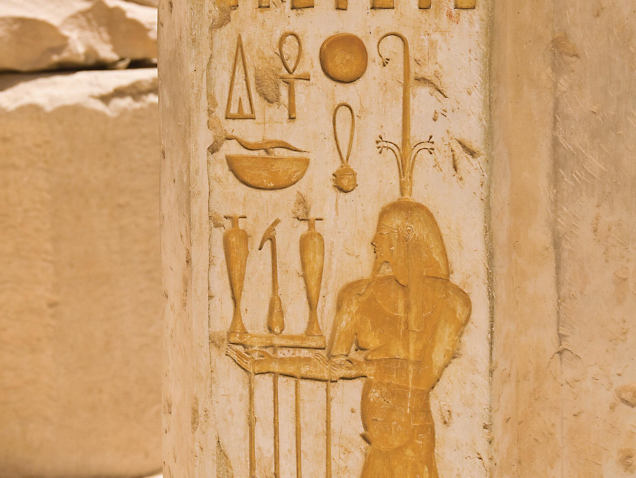
Like all great Egyptian Pharoah’s, the walls of Queen Hatshepsut’s temple tell her legendary story.
Another great achievement of this remarkable woman was in opening up trade routes. In the summer of 1493 BC, she sent a fleet of five ships to Punt (thought to be modern day Somalia). Hatshepsut herself tells us about the success of the voyage in inscriptions on the walls of her temple at Deir el-Bahri. "The ships were laden with the costly products of the Land of Punt and with its many valuable woods," she says, "with very much sweet-smelling resin and frankincense, with quantities of ebony and ivory . . ." Never before in Egyptian history had such an expedition been launched, and traders returned with splendor and riches that helped establish the 18th Dynasty as an era of prosperity.
A dish served cold: Thutmose III's revenge
As conspicuous as Hatshepsut was in life, in death she was the opposite. She simply disappeared. Her imposing mortuary temple stood empty. And Thutmose III set about erasing any trace that she had ever existed. He had royal documents revised to make it appear that he had inherited the throne directly from his father. He had statues of his stepmother smashed and her cartouches and images erased from all monuments.
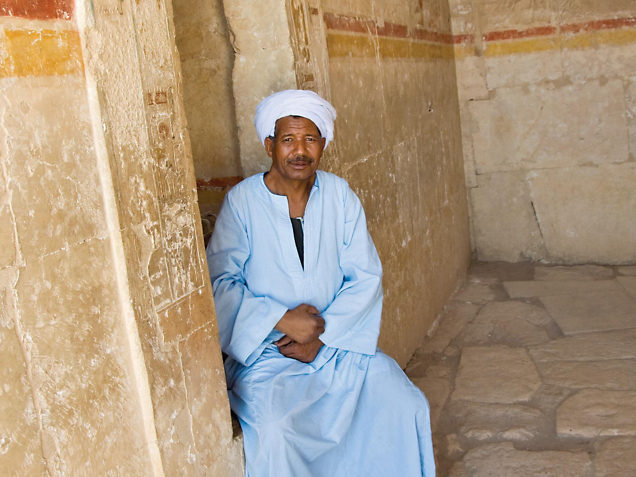
Temple guards now protect Queen Hatshepsut’s temple from the likes of Thutmose III.
Did they hate each other? Well, that’s a mystery. Ancient Egyptians believed that the obliteration of all traces of a person’s life led to a horrendous and permanent death ever afterward—and the belief was that that was Thutmose III’s intent toward his stepmother. More recently, though, Egyptologists have begun exploring the possibility that Thutmose III’s true motivation was a desire to reestablish Hatshepsut as queen regent rather than king. After all, he was the head of the army, a position granted to him by Hatshepsut herself—and one from which he could have launched a coup, if he had wished it.
Regardless of his intention, the upshot of his actions was that Hatshepsut languished in obscurity until the 19th century, when scholars began deciphering the hieroglyphics on the walls of her mortuary temple. As her story began to emerge, she was portrayed at first as an evil stepmother, wickedly stealing the throne out from under a helpless lad. Fortunately, today she is recognized as the ruler she was: a strong leader, tough but fair, who led her kingdom into an era of peace, prosperity, and artistic flowering. In fact, with her combination of successful military campaigns, great building achievements, and important expansion of trade, Hatshepsut’s reign is considered one of the most successful in Egyptian history—not for a woman, for anyone.
As the saying goes, you just can’t keep a good woman—or a great one—down.
Chipped tooth finally cracks mummy mystery
When archaeologist Howard Carter unearthed Hatshepsut’s tomb in (appropriately for this female king) the Valley of the Kings in 1903, he was disappointed to find no mummies inside the grand burial site—though perhaps not surprised, given Thutmose III’s depredations of his stepmother’s memory. As Carter continued his excavations at the site, however, he did unearth another tomb, which came to be known as KV60, almost directly beneath Hatshepsut’s mortuary temple.
Hatshepsut’s mortuary temple is a popular tourist attraction these days.
In KV60, among the coffins of mummified geese, Carter found the mummies of two female humans. One of them was of a small, dainty woman with long, curly white hair comfortably ensconced in a sarcophagus. The other was of a much larger, more buxom woman, found lying ingloriously on the floor. Because the mummies were assumed not to be ‘Royal,’ they were left where they were until 1989, when the tomb was reopened by Egyptologist Donald Ryan.
It was Dr. Zahi Hawass, Egypt’s foremost archaeologist, who decided to investigate the possibility that Hatshepsut herself was one of the mummies. But if so, which one was she? And who was the other one?
Not surprisingly, an assumption was made that, if one of the mummies was indeed Hatshepsut, it must be the smaller, more elegant one—especially since she was arranged in a royal pose, with one arm across her breast. That mummy was removed to a third-floor storeroom of the Egyptian Museum; the larger mummy was left behind in the tomb.
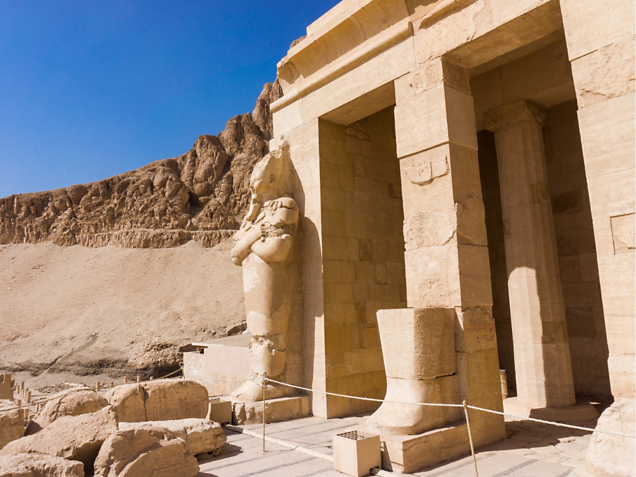
Statues on the facade of Hatshepsut’s palace in the Valley of the Kings.
Fortunately, science came to the rescue with sophisticated detection tools such as CT scans and DNA testing. The identification process began in 2007 with CT scans of both mummies, for comparison with known relatives of Hatshepsut, as well as artifacts known to belong to the female pharaoh.
The clincher, however, was found in a small wooden box containing Hatshepsut’s liver (removing internal organs was standard procedure for mummification at the time). This box bearing her cartouche, or seal, also contained a single chipped molar that was a perfect match for a gap in the upper jaw of the larger corpse. DNA testing then proved that that mummy was related to Amos Nefreteri, Hatshepsut’s grandmother. The lost king/queen at last was found. The discovery has been touted as the greatest archaeological find in Egypt since the identification of Tutankhamen in 1922.
Explore the Valley of Kings—where Hatshepsut’s tomb was unearthed—during our Ancient Egypt & the Nile River adventure.
Where in the World?
Where in the world was a falcon-headed god honored in a temple buried for centuries?
Days are Numbered
How many days of your year should you credit to the ancient Egyptians?
Odd Job
What new discovery in Giza revealed an unusual job title that has Egyptologists royally stumped?
Get The Inside Scoop On...
Like what you see here? Receive weekly updates right in your inbox.
inside-scoopArticles In This Edition

A House Full of Hope

Educating Girls in Kenya

Peace Crane

The Woman Who Would Be King

Top 15: Trending Adventure for Solo Travelers