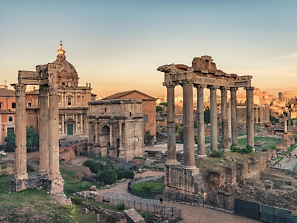
There was no more highly anticipated holiday on the ancient Roman calendar than the debaucherous holiday of Saturnalia. Gambling, singing, and feasting lasted from December 17th through the 23rd and members of all social classes were encouraged to unwind and celebrate the season. What began as a singular day to sacrifice pigs to honor Saturn, the Roman god of time and agriculture, quickly grew to represent the unleashing of repressed desires and subverting of the rules and expectations of typically tight Roman society.
No single document lays out the precise rituals and rites of Saturnalia, so much of what is known is anecdotal from philosophers living at the time. Catullus famously described Saturnalia as "the best of days." In Saturnalia, the poet Lucian gives voice to Saturn by stating, "During my week the serious is barred; no business allowed. Drinking, noise and games and dice, appointing of kings and feasting of slaves, singing naked, clapping of frenzied hands, an occasional ducking of corked faces in icy water—such are the functions over which I preside."
Similarly unscrupulous, the exact dates of the holiday shifted over the years, with Saturn’s consort Ops being incorporated on the second day of the festivities as her holiday Opalia was already occurring around that time in December. Soon the entire week was taken over with merriment. The loose dates corresponded to the loose rules and anything-goes mentality of the holiday commencing with the untying of the great captive Saturn statue in his temple—which remained bound at the feet throughout the rest of the year (for reasons lost to history)—unleashing chaos upon the city.
Io, Saturnalia!
Though Saturnalia celebrations have been overtaken by Christmas, one can still picture themselves among the festivities walking the streets of Rome—which rang with the call of "Io, Saturnalia!" in the voice of the Saturnalicius princeps, or Lord of Misrule. Households would randomly choose one of their lowest status slaves and declare them head mischief maker for the week. Not only was this individual, man or woman, allowed to taunt, jeer, and play tricks on their masters, but their lead was followed by all members of the house. Occasionally, slaves were even allowed to make decisions for the household.
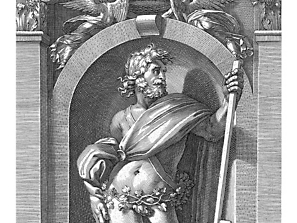
Saturn—the Roman god of time and agriculture—came to represent the unleashing of repressed desires.
Some households subverted the roles entirely, with slaves eating before the family. Or, occasionally, the masters even served their slaves while they were permitted to wear their masters’ clothing. Commonly seen on members of all social castes was the pileus, a hat associated with free slaves. This allowed the slaves the illusion of freedom, and the masters the humility of equality. Instead of the usual togas, colorful synthesis dress allowed partiers a fun excuse to further alter their usual appearance and match the lights, wreathes, and decorations which illuminated the observance. The deep green leaves and bright red berries of holly were particularly associated with the holiday as the sacred flora of Saturn, which are known today as "Christmas colors."
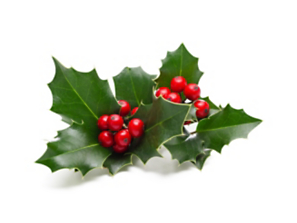
We might know of Holly for its "Christmas colors" today, but Romans associated it with their holiday of Saturnalia—seen as the sacred flora of Saturn.
Gifts, Games, and Gluttony
Gambling was the biggest appeal to Saturnalia, as it was outlawed for slaves at all other times in the year. Most of the noise and fervor came from the hurried excitement of these games, traditionally using nuts rather than actual money, to decrease the chance one would lose their life savings. Gambling had such a hold on the holiday that even when Christianity had overtaken the Roman Empire, it could be seen in art associated with the month of December.
Delicacies included sausage from the pig sacrifices, fruit and nuts, fried root vegetables which may have resembled the modern potato chip, and of course, wine. Mulsum was a drink made from wine and honey, and the spiced mulled wine still associated with winter holidays today was hot and plentiful.
On Sigillaria, the final day of Saturnalia, gifts were exchanged between family and friends, including signillaria, little wax, wood, or terracotta figurines commemorating the human sacrifices which were once a traditional closing of ceremonies. The statue of Saturn in the temple was once again bound by his ankles, and all was set right… until next year.
Reminisce about the Rome of old on the Rome: Highlights of the Eternal City pre-trip extension to O.A.T.’s New! Amalfi Coast: Naples, Sorrento & Pompeii adventure.