
Alan and Harriet thoroughly enjoyed their time in Peru—from uncovering the mysteries of Machu Picchu to connecting with friendly locals.
By Harriet Lewis, Vice Chair, Overseas Adventure Travel
In 2019, my late husband Alan and I traveled to Peru, Bolivia, and Chile—following in the footsteps of O.A.T. travelers along the way. These were all new destinations for us, and we were both blown away by the natural beauty we witnessed in Peru’s Sacred Valley, Bolivia’s Uyuni Salt Flats, and Chile’s Atacama Desert. Of course, we also got close to local culture, meeting local people and experiencing their way of life.
I have so many memories from this trip, I decided to share them one country at a time—beginning with Peru. Stay tuned to future editions of The Inside Scoop for stories from Bolivia and Chile!
The Mysteries of Machu Picchu:
Believe it or not, this was my first time at Machu Picchu, and I fell in love with the Sacred Valley and the Andes Mountains—the lush green, the white clouds, the impossibly blue sky. My daughter, Charlotte, hiked the entire Inca Trail with a friend in 2008, and as soon as I saw the scenery I got jealous.
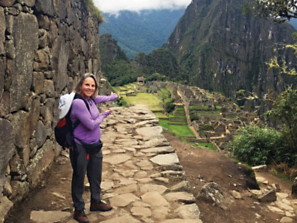
Harriet proudly posed at Machu Picchu, taking in the view she had dreamed of seeing for years.
When we were planning our trip, Alan was a bit wary of the crowds at Machu Picchu. We both prefer to be off the beaten path whenever possible, but I reminded him that some places in the world attract crowds for a reason. Well, it may have been our first time at Machu Picchu, but our guide, Percy—who is also a Trip Experience Leader for O.A.T.—has been doing this for years. The trick is to stay overnight and visit twice: first after the day trippers have taken off, and then again the next morning before they arrive. That’s exactly what we did, and crowds were not a problem.
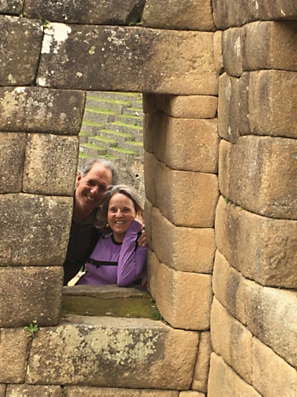
Alan and Harriet marveled at Machu Picchu’s flawless stonework.
I am so glad I convinced Alan to come, because as soon as we set foot in Machu Picchu, our jaws just dropped. The stonework was unbelievable: they used no mortar, and they had to transport these huge stones a long distance from their quarries … in the middle of the 15th century. I took photos to send to a friend who’s a stonemason—he needs to step up his game a bit! The entire construction is so connected to nature: altars and sundials that align perfectly with the movement of the sun and moon, terraces and channels that adapted the steep terrain to irrigate farmland. I thought to myself, "We think we’re so advanced?"
Percy told us that after all that work, the Inca only lived at Machu Picchu for about 80 years before the city was abandoned. No one knows exactly why—possibly due to disease. But we know it happened suddenly, because the dead were left behind.
Another mystery: exactly what was the purpose of Machu Picchu? A defensive stronghold? A royal recreational retreat? Archaeologists are still working on it, but we may never know … and I actually think it’s nice that there’s still some mystery in the world.
We hiked up to the Sun Gate and Percy led us in an Inca ritual to Pachamama: Mother Earth. It felt fitting in a place so sacred, so connected to nature and the environment.
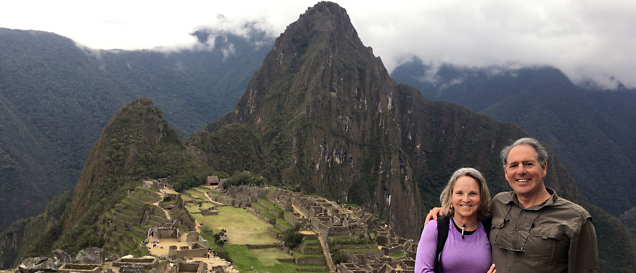
All of the hiking was worth the payoff for these two as they stood above the ancient city.
Timeless Traditions
We were lucky that we didn’t have problems with the altitude on this trip—I didn’t like the coca tea, so I just used it for currency! Still, I wondered how the conquistadors managed to breathe when they got here. (Or how Charlotte did on the Inca Trail, for that matter.) I was amazed by the women in farming communities who climbed up terraced fields at 15,000 feet, often with babies strapped to their backs. Their average height is around 4’6". I may have felt tall compared to them (which was great), but I definitely didn’t feel strong!
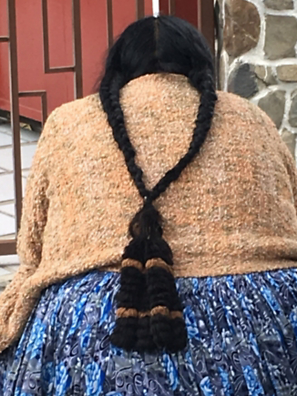
Harriet learned the meaning behind braided hair, a longstanding Quechua tradition.
In all of our interactions with the people of Peru, I could feel their connection to their Inca heritage. I loved the market culture—and not just for the shopping. One in particular gave us the opportunity to learn about Quechua courtship traditions. Every week, young people get all dressed up and go to the market to see and be seen. For those looking for love, there’s a system to determine who’s available: a woman wearing two braids tied together is married, whereas one or many braids means she’s single. The more braids you have, the more healthy and attractive you are—and the women have beautiful, thick hair, so some of them have quite a few.
As for the men, if the top of his hat hangs toward the back, he’s married; toward the front, he’s single. If a man sees a woman he likes, he’ll toss a pebble in her direction. If she returns his interest, she’ll toss it back. Or—and I think this is much nicer—he’ll use a small mirror to reflect a sunbeam in her direction.
When two people decide they really like each other, and are ready to consider marriage, they must live together for two full years before the wedding. If they’re not happy by the end, no marriage—but they’ve had plenty of time to figure it out. The one caveat: As soon as a woman gets pregnant, marriage is nonnegotiable. I think that’s fair enough.
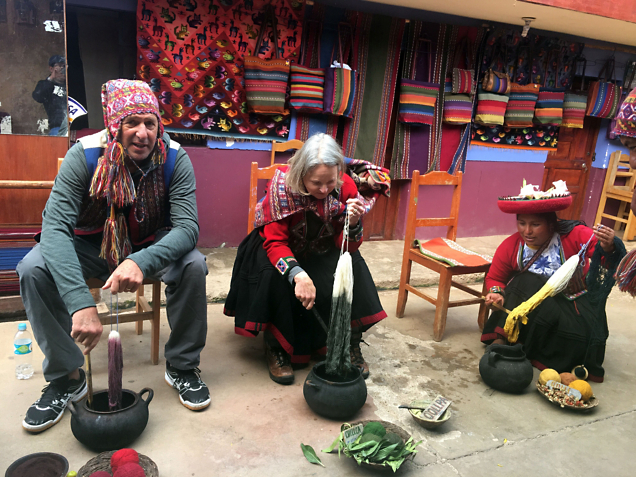
Alan and Harriet donned traditional garb while they pitched in to help some local weavers.
In the Urubamba region, we also made a surprise visit to Chequerec School, which is supported by Grand Circle Foundation. They didn’t even know we were coming, but they happened to be putting on a play. In it, the main character was a tree, and a farmer came with an ax to cut it down for more land. One by one, protectors came to save it. Without the tree, the birds would have no home. Without the tree, apples would not grow. Of course, the farmer decided to let the tree stand. In a land where there is pressure against nature to clear more and more land to grow crops, it’s a powerful message for these children, who are aged between kindergarten and the fourth grade.
Local Specialties
Have you ever seen a potato the size of a peanut M&M? In the Andes, they grow around four thousand different types of potatoes: white, red, yellow, purple, tiny, huge, smooth, knobby … literally every texture and color you can imagine, and some you probably can’t. Like the tiny ones, which were pinkish-yellow and speckled. If I don’t see another potato for the next four months, I’ll be fine—but they were really delicious!
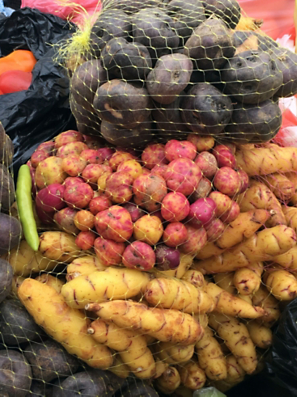
Harriet became quite familiar with Peru’s wide variety of potatoes during her trip.
Before we departed, I warned my guides that I don’t eat meat—which proved to be a smart move when I saw what was on the menu at our Home-Hosted Dinner. I know it’s an honor to be served guinea pig, but I would have had trouble making an exception for this—not just because it’s a pet here in the U.S., but because it’s a rodent! Every home has designated places to raise them—like guinea pig condos, although in this house, they were just running around upstairs. I let Alan have the guinea pig; I was much more interested in spending time with the family who hosted us. Three generations lived in the home, and one of the daughters was in college studying hospitality. Hosting O.A.T. travelers gives her the opportunity to practice her skills and her English, which was nice for me to see firsthand.
I’m always proud to see firsthand what our travelers get to experience on our adventures—and we owe so much to the associates in our local offices and, of course, our wonderful Trip Experience Leaders. Percy was really exceptional! I’m looking forward to telling you about the rest of my trip in Bolivia and Chile—which were equally enjoyable but so different from Peru. Stay tuned!
Experience Harriet’s Peruvian highlights—including an overnight stay near Machu Picchu—when you join O.A.T. for Machu Picchu & the Galápagos .
Get The Inside Scoop On...
Like what you see here? Receive weekly updates right in your inbox.
inside-scoopArticles In This Edition

Grand Circle Foundation Update: Saving Abandoned Babies in South Korea

Harriet on the Road: Perspectives on Peru

Sanitizing the Past

The Pyramids: An In-Depth Look

What Did Ancient Rome Look Like?

Where in the World?