Almost everyone is familiar with the violent eruption of Mount Vesuvius in 79 A.D.—and how it destroyed the Roman cities of Pompeii and Herculaneum lying in its foothills. When the dangerous stratovolcano first exploded, it sent a massive column of ash and volcanic rock about 12 miles into the atmosphere before raining down for some 18 hours on nearby towns, collapsing roofs and suffocating residents. But the real damage occurred when a series of fast-moving pyroclastic flows swept down the slopes of Vesuvius, incinerating everything in its path and burying inhabitants in a tomb of ash.
Pompeii was covered by about 20 feet of volcanic material following the eruption. What isn’t well known is that shortly after the disaster, when people from nearby towns came to look for the buried city, there was a big problem—they couldn’t find it.
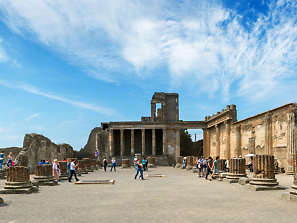
Pompeii is an ancient Roman city that was destroyed by the eruption of Mount Vesuvius in 79 AD.
Searching near the sea, they didn’t realize that the eruption had filled Pompeii’s harbor, pushing the coastline out—which meant that the city now lay farther inland. That’s why Pompeii’s location remained a mystery for more than a thousand years. It wasn’t until 1594 that Pompeii would finally be accidentally "rediscovered" when an architect digging a canal stumbled upon the ruins of the ancient city. Serious excavations began in 1748 and are still ongoing.
Something else that isn’t very well known about the Vesuvius eruption is that not everyone died. In fact, the vast majority of the inhabitants survived the catastrophic eruption of Vesuvius. While about 2,000 people were killed, there were an estimated 15,000 to 20,000 people living in Pompeii and Herculaneum at the time of the eruption.
The following are just a few of the exciting new discoveries that have been unearthed in recent years at the longest continually-excavated site in the world …
Heartbreaking evidence of a family’s last-ditch survival efforts—During a very recent excavation of a small house in Pompeii, archaeologists discovered the remains of three adults and a child—alongside a bed that had been moved to block their bedroom door. All indications are that it was the family's futile attempt to escape the rush of searing hot ash and volcanic debris that enveloped the city and their home.
Would you like fries with that?—Archaeologists have been unearthing the partial remains of dozens of thermopolia—a name which literally translates to a "hot drinks counter"—scattered throughout Pompeii over the years. One of the most recent discoveries of these Roman equivalents of fast-food restaurants, however, was found completely intact. Known as the thermopolium of Regio V, the structure features beautifully preserved frescoes depicting mallards, roosters, and other fowl that would have been on the menu. Along with jugs of wine, earthenware cooking vessels at the site contained remnants of ducks, goats, chickens, pigs, and snails. No drive through, though.
Or would you like a frieze with that?—A magnificent new frieze depicting the wilder side of Roman life was just unveiled in Pompeii. Located in a spacious banqueting hall with bright red columns, the frieze (known as a "megalography" because of its life-sized figures) depicts the procession of Dionysus, the ancient Greek god of wine. Intended to delight guests while they dine, the scene is filled with priests and priestesses portrayed as dancers, along with musicians, hunters, and huntresses with slaughtered animals slung on their shoulders. A woman is also shown being initiated into the mysteries of Dionysus, an ancient ritual where intoxicants are used to lessen inhibitions (we’ll have to assume she was a willing participant).
Under house arrest—While excavating a private home just over a year ago, archaeologists discovered a chamber containing three bodies in an ancient bakery. The room had high windows that were barred and no doors, just an exit leading to the home’s atrium. Marks on a millstone indicated it was operated by a donkey and an enslaved person. Experts have labeled it a "prison bakery" because of the brutal work conditions the "donkey driver" would have been expected to endure, and it remains a shocking aspect of ancient slavery.
Who wants the last slice?—The atrium of the same house where the "prison bakery" was found contains a detailed still-life fresco of a silver plate featuring food items that would have been served to guests. Along with a vessel containing soup or wine and assorted vegetables, a doughy object with assorted toppings that appears in the fresco looks uncannily like a modern-day pizza. The problem is that the key ingredients that make up Italy’s iconic dish—tomatoes and mozzarella—were not available some 2,000 years ago when the fresco was painted. Experts now believe that the image is likely a focaccia covered with pomegranate and possibly dates. Purists are glad they didn’t find any pineapples.
That’s a very tall order—Excavations in the sewer drains have revealed a wide variety of animals that are thought to have been eaten by the inhabitants of ancient Pompeii—including the leg bone of a giraffe.
Which one of you is responsible for this?—Recent excavations on a cluster of homes in Pompeii have revealed graffiti believed to have been sketched by children. Some of the charcoal drawings feature depictions of Roman gladiators thought to have been inspired by watching battles at Pompeii’s amphitheater. Others include two figures playing with a ball, the outline of three small hands, and a pair of boxers lying on the ground. You know, typical kid stuff.
If these scrolls could talk—Eighteenth-century researchers discovered more than 800 scrolls—known as the Herculaneum papyri—that were carbonized by the eruption of Vesuvius. As the name would indicate, the scrolls were unearthed in Herculaneum, the other Roman city buried in ash in 79 A.D., in a villa thought to have been owned by the father-in-law of Julius Caesar (yep, the very same guy).
Unfortunately, all attempts to read the scrolls—described as "the only intact library known from the classical world, an unprecedented cache of ancient knowledge"—proved futile, as they were impossible to unroll without falling apart.
In 2023, something called the "Vesuvius Challenge" was launched, an international competition to find a way to somehow decipher scans of one of the scrolls without physically touching them—and it worked. Using artificial intelligence and a bunch of "trained machine-learning algorithms" that we can’t begin to understand, the prize-winning team were able to decode sections of the text. So, what have they revealed so far? The 2,000-year-old scrolls appear to be a philosophical discussion of how to enjoy life’s pleasures—which somehow seems right.
Everybody in the pool!—One of the most exciting discoveries just revealed a few months ago is a private spa complex on the grounds of a large villa belonging to a wealthy Pompeii family. Nothing like some modern-day home jacuzzi—this was truly worthy of the "one-percenters" of ancient Pompeii.
The sumptuous baths began with a place where guests could undress—a large changing room containing vibrant red walls and a mosaic floor inlaid with the best marble from across the Roman Empire. This led to the "hot room," where guests could take a dip in a warm pool and enjoy the sauna-like warmth that circulated under a suspended floor and behind the walls. Next, it’s on the frigidarium—the cold room. Surrounded by red columns and colorful frescoes of Roman athletes, 20 to 30 people could cool off in a three-foot-deep plunge pool, enjoy a cup of wine with friends, or discuss politics.
New research at Pompeii is also correcting misconceptions of the past
What sets Pompeii apart from archaeological sites around the world, of course, is the discovery of human remains that appear to be frozen in time following the eruption of Mount Vesuvius. While more than 1,000 bodies have been uncovered in Pompeii through the years, only a small percentage have been set in casts by archaeologists—made by pouring plaster material into the shapes left in the hardened ash to reveal the last moments of the dead.
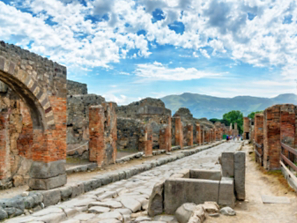
A cobbled street in Pompeii.
Perhaps Pompeii’s most famous victims are a family of four huddled under the staircase of their lavish three-story home. Uncovered in 1974, the scene reveals a mother wearing an ornate golden bracelet holding her four-year-old child on her lap, while the father and son sit nearby. Seeing them gathered around preparing for their last moments together is a very emotional experience.
Except now we know it’s not true.
For the past fifty years, that’s the story Pompeii visitors have been told about the family buried in what’s called "The House of the Golden Bracelet"—so named because of the solid gold bracelet found on the arm of the mother. But just this past January, scientists analyzed ancient DNA extracted from small bone fragments preserved in 14 casts that are undergoing restoration. And the results tell a different story entirely. Instead of a mother, father, and two children, genetic analysis shows that all four individuals were male—and they were all unrelated. Tragic nonetheless, the scene does not depict a traditional nuclear family. And it turns out that the "mother" wearing the golden bracelet was actually a dark-haired, dark-skinned man.
That’s not the only story that will have to be rewritten, either. In a different area of the same home, two casts that have long been assumed to be either sisters or a mother and daughter were also determined to include one genetic male.
About two-thirds of Pompeii have been excavated thus far. When excavations were halted in 1960, it was assumed that the remaining third of the city would be buried forever. But in 2018, after limited excavation work was allowed to begin again in certain areas of Pompeii’s perimeter for site conservation purposes, exciting new discoveries are being unearthed all the time. Which is good, because it appears that the dead still have many new stories to tell about everyday life in ancient Pompeii.
"Darkness fell, not the dark of a moonless or cloudy night, but as if the lamp had been put out in a dark room."
—Pliny the Younger, witnessing the eruption of Vesuvius from across the Bay of Naples
Explore Pompeii during O.A.T.’s New! Amalfi Coast: Naples, Sorrento & Pompeii Small Ship Adventure.


