
As you’ll discover during Japan’s Cultural Treasures, a fascination with cats is prevalent throughout the country—but on so-called “cat islands” like Aoshima and Tashirojima, felines literally reign supreme.
As you’ll discover during Japan’s Cultural Treasures, a fascination with cats is prevalent throughout the country—but on so-called “cat islands” like Aoshima and Tashirojima, felines literally reign supreme.
Question: Where in the world can cat fanciers find islands populated with more felines than people?
Answer: Japan
From temples boasting thousands of feline figurines, to shops filled with cutesy Hello Kitty merch, and cafés serving up kitten companionship, cats prowl through almost every facet of Japanese culture. But nowhere do neko (cats) reign more supreme than on Japan’s so-called “cat islands”—small inhabited or semi-inhabited islands where the feline population is unusually high compared to the human headcount.
In most cases, cats were originally brought to these islands to work: In fishing communities, the felines fended off rodents that were prone to chew through nets, and on silkworm farms, they hunted the mice that would feast on the worms. Over time, most of the humans who toiled alongside the tabbies passed away or moved to the mainland for better economic opportunities. Without humans or natural predators to keep the cat populations under control, huge colonies flourished.
Today, cat islands are a hit with tourists. The most popular island, Tashirojima, attracts nearly 40,000 visitors annually—and the landscape and local customs have adapted to cater to the famous felines, which are believed to number in the hundreds.
The 80 people who share Tashirojima with the cats are prohibited from owning dogs, and many take it upon themselves to feed the kitties, believing that doing so brings good luck. A cat shrine stands proudly in the middle of the island, and locals often leave cat-related offerings at its base. Cat-shaped lodges are even available to diehard fans who wish to spend the night.
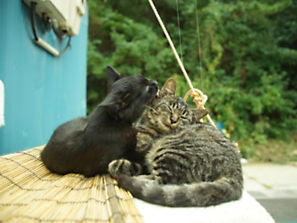
These Tashirojima residents seem blissfully oblivious to the challenges of island living.
While cat islands may seem idyllic on the surface, it’s not all sunbathing and chin scritches; the four-legged residents face some real hardships. Years of isolation have led to inbreeding, resulting in a host of health problems, from respiratory issues to blindness. Veterinarians are known to make house calls on popular islands like Tashirojima every few months, but they’re not readily available for emergencies.
The islands’ two-legged inhabitants are also a concern. They’re generally older, and as their numbers decrease, so does their ability to care for their furry neighbors. On the cat island of Aoshima, just four human residents remain, compared to an estimated 80 cats. Fortunately, authorities implemented a successful spay-and-neuter program in 2018 to ensure the populations of the island would decrease in tandem.
The cat, the myth, the legend
Cat islands are part of a larger feline phenomenon in Japan called “nekonomics” or “cat economics”—a term used to describe cat-related consumption. From feline tourism to cat imagery in advertising and products marketed to cat lovers, cats’ value continues to increase in Land of the Rising Sun.
How have cats managed to sink their claws so deeply into Japanese culture? The answer could lie in their supernatural appeal. Their silent, stealth-like movements; ability to contort their bodies; and large, glowing eyes make them perfect fodder for folklore—they’ve been appearing in Japanese legends since at least the 12th century.
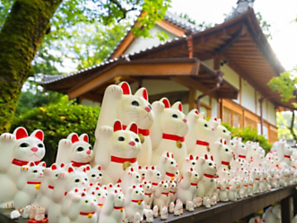
While white is the most popular color of maneki-neko, symbolizing universal luck, different colors convey more specific sentiments.
Some of those mythical cats were depicted as evil shapeshifters, while others were anthropomorphized as kimono-wearing, sake-drinking, hedonistic creatures of the night. The legend with the most staying power, however, was maneki-neko, or “lucky cat.” This now-ubiquitous seated figurine with a red collar and a raised paw is believed to bring customers into shops and good fortune into households that display his likeness.
Or the answer could be even simpler: Ask a local or a cat island visitor what makes these pets so appealing, and they’ll tell you they’re just plain kawaii (cute).
If you can’t fit a cat island into your Japan itinerary, there are myriad other ways for feline fanatics to cure their cat-scratch fever.
5 Other Ways to Spend a Purr-fect Day in Japan:
1. Stop into a cat café for a cappuccino and a cuddle: Though it originated in Taiwan, the cat café concept really took off in Japan, where small living spaces and strict rental agreements make pet ownership difficult. Today, the country boasts more than 150 cat cafés, with dozens in Tokyo alone. For the price of a cup of coffee, patrons can spend a few hours in the company of the kitties who call these cafes home.
2. Say “konnichiwa” to Hello Kitty: Since she was introduced by the Sanrio company 1974, Hello Kitty has become one of Japan’s most enduring characters. Her cherubic face and big, pink bow originally debuted on a coin purse but now grace everything from stationery and pajamas to home appliances and cans of motor oil.
3. Pet a hachiware: Literally translated as “split skull,” hachiware is the Japanese term for tuxedo cats, whose black-and-white facial pattern usually forms a triangle over the animal’s nose. This triangle is said to resemble Mount Fuji, as well as the kanji character for “eight” (八)—a lucky number in local culture—which makes the hachiware a local celebrity.
4. Take a stroll down Cat Street: This tree-lined avenue boasts upscale boutiques, vintage re-sellers, and artisanal restaurants that cater to Tokyo’s trendsetters. Unfortunately for cat lovers, Cat Street isn’t named for its “paw-destrian” clientele, but for the cool cats who frequent its hole-in-the-wall establishments. However, thanks to the booming nekonomic phenomenon, you’re still likely to find cat-themed wares in its shops—including ceramics, home décor, and even chopsticks.
5. Get lucky at Gotokuji Temple: Tucked away in one of Tokyo’s quiet, residential wards, this Buddhist temple is believed to be the birthplace of maneki-neko. According to legend, a cat who belonged to one of the temple’s monks saved a local lord’s life by beckoning him into the temple at just the right moment. In gratitude, the lord became a patron of the temple and maneki-neko became a symbol of luck and prosperity. Today, an estimated 4,000 maneki-neko figurines can be found on the temple’s grounds.
Walk in a whisker wonderland on our Japan’s Cultural Treasures adventure.
Petal Pushers
If Japan’s beloved seasonal tradition of hanami isn’t about the flower that appears on Japanese passports and the Imperial family crest, what is it about?
Sisters Out of Arms
Pearl Harbor National Memorial in Hawaii recently became an official "sister park" with what other war memorial?
Rent Control
Described as a heartwarming solution to loneliness, a popular new service in Japan named OK Obaachan lets you rent what?
Get The Inside Scoop On...
Like what you see here? Receive weekly updates right in your inbox.
inside-scoopArticles In This Edition

Animal Planet: 10 Beloved National Animals

Istanbul: "Cat Capital" of the World

Nchi Ya Simba ("Lion Country")

Nine Lives along the Nile: Cats in Ancient Egypt

Purr-adise Found

Where in the World?