Ever wonder what the days of ancient Egypt looked like? In this realistic 3D animation video, discover what the great civilization may have looked like during the height of its glory—from the famous temples to the boats that sailed the Nile. You’ll also see what everyday life was like for the people of the flourishing society, including the building of the pyramids—which travelers can visit on our Egypt & the Eternal Nile by Private, Classic River-Yacht adventure.
Doesn’t it beggar belief that after 4,500 years, no one has figured out how the pyramids were built? They’re getting close, though. All kinds of theories are floating around about how the massive blocks were lifted into place and secured—from mud-brick ramps on sledges and water-aided stone sleds to rolling wooden ramps. Scientists also claim to know what the mortar that binds the pyramid stones is made of—but have been unable to duplicate it. And as far as how the structures were built to such exacting precision without the use of modern tools goes, they have no idea.
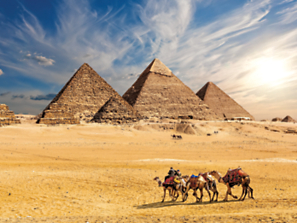
After 4,500 years, the Great Pyramid of Giza, the last surviving Wonder of the Ancient World, remains an engineering mystery which O.A.T. travelers can behold on our Egypt & the Eternal Nile by Private, Classic River-Yacht adventure.
The bottom line is the ancient engineering feats at Giza were so impressive that even the best scientists and engineers still aren’t sure how they were built. Maybe in another thousand years, they’ll figure it out.
There is one thing they do know for a near certainty, however. The pyramids were built to last an eternity—and they pretty much have done just that.
Khufu—built first, and built to last
There is an old Arab proverb that roughly translates to: "Man fears time, time fears the pyramids." That surely refers to the first and largest of the three towering pyramids perched on the outskirts of Cairo on the Giza Plateau—the Great Pyramid of Khufu. Second pharaoh of the Fourth Dynasty, Khufu ruled Egypt between 2585 and 2560 BC. Also known by his Greek name, Cheops, Khufu commissioned the funerary structure as his final resting place. And in order to secure his legacy—and showcase the wealth and power of the pharaohs—he chose to go big.
Overseeing the construction, Khufu’s pyramid was built using an estimated 2.3 million blocks of stone weighing between 2.5 and 15 tons each—some even up to 50 tons. Its height upon completion was 481 feet, making it the tallest structure in the world, a record the Great Pyramid of Khufu would hold for the next 3,800 years (for perspective, the Statue of Liberty is 305 feet, from the ground to the tip of her torch). The Great Pyramid’s record was finally surpassed in 1221 AD, when the steeple of London’s Old St. Paul’s Cathedral reached 489 feet (or at least it did until the steeple collapsed less than 350 years later).
If its height and weight is impressive, the precision that went into the pyramid’s design and construction is even more astonishing. At more than 750 feet per side at its base, the greatest difference in length among the pyramid’s four sides is a little more than an inch and a half; and the entire base is level to within less than an inch. Those numbers would be difficult to replicate even with today’s sophisticated tools and technology.
You would think such a massive structure would take a really long time to complete—centuries, even (especially when you consider how the temple complex at Karnak was worked on for 2,000 years). But the Great Pyramid of Khufu took just 20 years from start to finish. And it would have looked a lot different back then, too, encased in polished blocks of white Tura limestone (long since removed). And there would have been a capstone (known as a pyramidion) at the top, likely covered in gold. As good as it looks now, back then it would have simply dazzled. (In case you missed it, see what ancient Egypt really looked like in the video above.)
Like father, like son, like grandson
The other two major pyramids on the Giza Plateau weren’t too far behind Khufu’s. The pharaoh’s son, Khafre, built the second pyramid at Giza about 2520 BC. The second largest of the trio, Khafre’s pyramid stands 448 feet tall. The length of each base is 706 feet, and it was built with two-ton limestone blocks. It is believed that robbers removed most of the offerings buried with Khafre just a few hundred years after the pharaoh was buried here.
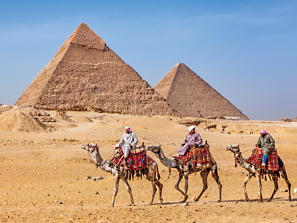
Bedouins—Arabic-speaking desert nomads of the Middle East—can often be seen riding on camels around the Pyramids of Giza.
The third of the major Pyramids of Giza was built by Menkaure, who was Khafre’s son (and Khufu’s grandson), in about 2490 B.C. At just 213 feet high, it’s considerably smaller than the other two, but the wealth of statuary recovered from its elaborate interior chambers almost seemed to compensate for its relatively short stature. Unfortunately, the pharaoh’s highly decorated black stone sarcophagus was lost at sea while it was being transported to England in 1838.
But words like "smaller" don’t apply to the Pyramids of Giza. In almost every photograph, the middle pyramid—Khafre’s—appears to be the tallest of the three. But it’s just an illusion. The Great Pyramid of Khufu only looks shorter because it was built on lower ground. The only way to truly appreciate their enormity is to stand next to them.
Pyramid builders—extra smart, not extra-terrestrial
Construction on the Pyramids of Giza began thousands of years before modern mapping techniques—or even the compass was invented. So how were ancient Egyptians able to position them in near perfect alignment, with each of the corners pointing in a cardinal direction: north, east, south, and west? This alignment had both astronomical and religious significance for Egyptians, especially the north-south alignment, which symbolized the pharaoh’s journey to the afterlife.
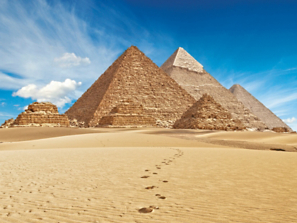
You can walk in the footsteps of ancient Egyptians during our Egypt & the Eternal Nile by Private, Classic River-Yacht adventure.
But how an ancient civilization was able to construct a structure situated so precisely on these cardinal points has puzzled scientists for centuries. So much so, that it even gave rise to fringe theories crediting aliens as the true pyramid builders. They must have, since our top minds couldn’t figure it out, right?! Actually, Harvard scientists appear to have finally cracked the code in 2017. To achieve a near perfect alignment of the pyramids, it was shown that the ancient Egyptians could have counted 91 days after the summer solstice to land exactly on the fall equinox. And on that day, they could have planted a large pole in the ground and followed the sun’s shadow (the pole would function as a "gnomon," which is the part of a sundial that casts a shadow). By marking the tip of the pole’s shadow across the sand throughout the day, a line will be created that points perfectly (or near perfectly) east and west. The corners of the pyramid can then be aligned to match the line in the sand. Almost all scientists agree that this is the most likely way the Egyptians were able to align the pyramids with such accuracy. The Egyptians left no written records so it can’t be stated with certainty that this was how they aligned the pyramids—so, it looks like the aliens are still in the running!
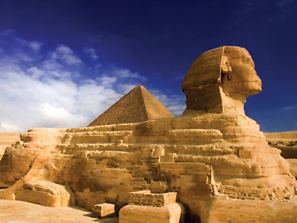
Scientists might have an answer for how the ancient Egyptians were able to precisely place the pyramids in perfect alignment, with each of the corners pointing in a cardinal direction.
Speaking of the pyramid builders, they certainly weren’t slaves. They were all skilled workers hired for the construction project—tens of thousands of them—and likely would have been honored to work for a deified pharaoh. Archaeologists have uncovered the remains of a large village near the Giza complex where the workers lived with their families. They also worked in shifts and had lunch breaks. In fact, food remains at the site show that they were very well fed—as they would have to be for such a physically taxing job.
Isn’t it pharaonic …
It’s difficult to not see the irony in considering the legacies of Khufu the pharaoh and Khufu the pyramid. Khufu’s pyramid—the largest, oldest, and sole surviving member of the Seven Wonders of the Ancient World—was the tallest structure in the world for almost 4,000 years (and looks like it could last another 4,000). And Khufu the pharaoh? The only surviving image we have of the pharaoh himself is an ivory statuette just three inches tall.
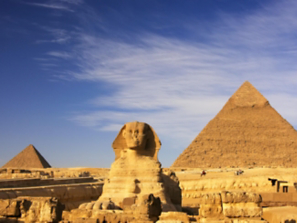
Khafre’s pyramid might look like the tallest of the three, but it’s actually an illusion—perhaps a riddle of the Sphinx?
Modern technology, including advanced cosmic-ray scans and 3D simulations have led to a wealth of new discoveries about the pyramids in recent years—including several hidden chambers and a 30-foot-long corridor near the entrance to Khufu’s pyramid in 2023. So even after 4,500 years, the pyramids aren’t through revealing their mysteries. And don’t even get us started on the riddles of the Sphinx …
Behold the Great Pyramids of Giza during our Egypt & the Eternal Nile by Private, Classic River-Yacht adventure.


