Learn about the history of the tea road from Munkhbat "Muuggi" Batbekh— Trip Experience Leader for O.A.T.’s Mongolia & the Gobi Desert adventure—overlooking the legendary Flaming Cliffs. The tea road was used by Mongolians to transport tea on camel back from China to Russia for hundreds of years.
Beneath the vast blue sky of Mongolia, where ancient trade routes once connected empires, Munkhbat Muuggi Batbekh guides travelers through landscapes steeped in history. As a Trip Experience Leader for O.A.T.'s Mongolia & the Gobi Desert adventure, Muuggi's intimate knowledge of his homeland brings to life the fascinating intersections of tea culture, nomadic traditions, and prehistoric wonders.
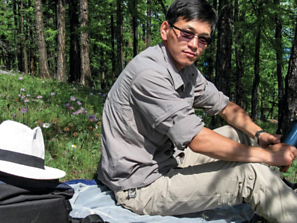
Munkhbat Muuggi Batbekh—Trip Experience Leader for O.A.T.'s Mongolia & the Gobi Desert adventure.
"Mongolians were mostly middlemen in the tea trade," Muuggi explained, discussing the historical role his ancestors played along the famed trade routes. "Back in the 13th and 14th centuries, under Genghis Khan and Kublai Khan, the Mongols ruled a huge empire that stretched across Asia. To keep their empire strong, they controlled the Silk Road, making it a safe route for trade."
This security system established by the Mongol Empire created what many historians consider the safest period for travel between Asia and Europe, allowing famous explorers like Marco Polo to make their legendary journeys. Tea was among the precious commodities transported along these routes, typically carried by camel caravans across challenging terrain.
When the Silk Road's safety deteriorated with the rise of the Ottoman Empire in the 15th century, alternative routes emerged. "That's when people started looking for new ways to trade, like the Tea Road, which ran through Mongolia, connecting China to Europe," said Muuggi. "To cross the harsh Gobi Desert and Siberia, they needed experienced camel breeders, which the Mongols had."
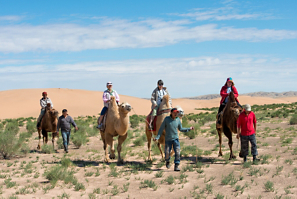
Camels were—and still are—a necessity when traversing the harsh terrain of the Gobi Desert.
Interestingly, while Mongolians facilitated this trade, tea was already deeply embedded in their culture. "There's no strong evidence that tea was directly introduced to Mongolia from China or Russia through the Tea Road," Muuggi noted. "Mongolians have been living on the Euro-Asian steppe for thousands of years, where they relied on animal husbandry. They've always made dairy products, and one of those is milk tea—tea mixed with milk, and sometimes butter or salt."
The spiritual significance of tea in Mongolian culture predates these trade routes as well. "Mongolians also have a tradition of sprinkling milk tea into the air as a way to honor the spirits of nature, ancestors, and gods. This custom existed long before the Tea Road was a thing," Muuggi said.
Today, tea remains central to Mongolian hospitality. "Tea is still a huge part of Mongolian culture," Muuggi emphasized. "It plays a big role in social life and hospitality. The most famous tea in Mongolia is suutei tsai (salted milk tea), which is different from the sweet tea you might find in other cultures."
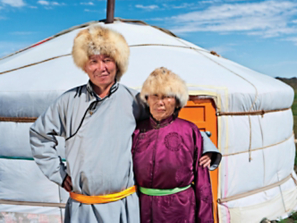
"In Mongolian nomadic culture, tea is offered first to visitors as a sign of respect," Muuggi explained.
For travelers experiencing Mongolia's nomadic culture, tea ceremonies offer a window into centuries-old traditions. "In Mongolian nomadic culture, tea is offered first to visitors as a sign of respect," Muuggi explained. "It's still drunk daily in rural areas, though in the capital, Ulaanbaatar, black tea and even coffee are more common, especially among younger people."
The preparation of this traditional beverage is itself a cultural experience. "Travelers can expect to see tea being made over an open fire in traditional gers (yurts). We show the milk tea preparation to O.A.T. travelers," said Muuggi. The distinctive salty flavor profile often surprises Western palates, but many find it surprisingly refreshing after adjusting to the unexpected taste.
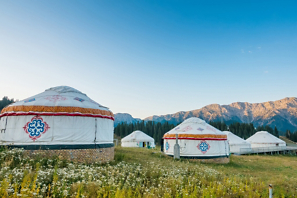
Tea is made over an open fire in traditional gers (yurts) like these.
Just as camels once carried tea across Mongolia's harsh landscapes, these resilient animals remain integral to nomadic life. "Bactrian camels, with their two humps, are native to Mongolia and have been important to the nomadic lifestyle for centuries," Muuggi shared. "Even though modern transportation has changed how many Mongolians live, camels are still key, especially in isolated areas."
The cultural importance of these animals was recently recognized internationally. "In fact, Mongol nomadic migration and its practices were added to UNESCO's intangible cultural heritage list in 2024," Muuggi proudly noted.
Mongolia also boasts an abundance of paleontological treasures, particularly in the area known as the Flaming Cliffs. "The Gobi Desert is full of paleontological sites, including the Flaming Cliffs, which are famous for dinosaur fossils," Muuggi explained. This region earned its reputation as a "cemetery of dragons" following American paleontologist Roy Chapman Andrews' groundbreaking discoveries there in the 1920s.
Interestingly, Andrews' expedition used the ancient Tea Road to access these remote areas. "When international expeditions like Roy Chapman Andrew's came through Mongolia, they used the old Tea Road since Mongolia didn't have proper roads," said Muuggi. "This is how places like the Flaming Cliffs in the Gobi Desert were discovered."
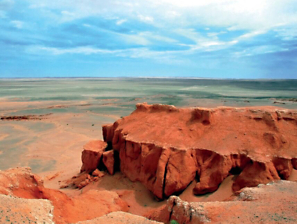
The flaming cliffs have been aptly nicknamed the "cemetery of dragons" in tribute to American paleontologist Roy Chapman Andrews' groundbreaking discoveries there in the 1920s.
Though fossilized remains are prevalent in the area, they're protected by strict regulations. "In the video, we found the bone with the help of locals. But no one is allowed to dig unless they're authorized paleontologists," Muuggi clarified. "Occasionally, bones are exposed by strong winds or rain, and that's how we can spot them."
For travelers fascinated by these prehistoric discoveries, Mongolia offers several institutional resources. "There's the Natural History Museum in Mongolia, where they display dinosaur fossils," Muuggi said. "We recommend this museum to our travelers during their free time, and we also take them to the Institute for the Study of Mongolian Dinosaurs."
While dinosaur bones may be relatively accessible in the Gobi's eroding landscapes, some of Mongolia's living treasures remain elusive. When asked about spotting rare wildlife like snow leopards, Muuggi admitted, "I've been on a few snow leopard tours, but I've never been lucky enough to see one myself. I've been to areas where they live and have trained herders who live in those regions to help protect them."
Walk along the legendary Tea Road during O.A.T.’s Mongolia & the Gobi Desert adventure.


