
If you time up your Back Roads of Iberia: Spanish Paradores & Portuguese Pousadas adventure to see Spain’s Semana Santa processions, you can experience one of the country’s most distinctive and powerful religious celebrations.
If you time up your Back Roads of Iberia: Spanish Paradores & Portuguese Pousadas adventure to see Spain’s Semana Santa processions, you can experience one of the country’s most distinctive and powerful religious celebrations.
Imagine yourself transported to southern Spain during spring time… the air vibrates with the thunderous rhythm of drums echoing through ancient, cobbled streets that have been worn smooth by centuries of devotion. The night comes alive as hooded figures materialize from shadows, their faces concealed behind conical capirotes, moving in solemn procession by the golden glow of hand-carried candles.
Above the hushed crowd loom colossal, intricately carved pasos—elaborate floats bearing lifelike religious sculptures that seem to breathe in the flickering light. These massive structures sway hypnotically, borne aloft by dozens of costaleros whose synchronized footsteps create the illusion that the sacred figures are walking among the people.
Women draped in exquisite black lace mantillas stand mesmerized as ornate Madonnas—the Virgins of Sorrow—glide past them. These baroque masterpieces glitter with precious gems and gold embroidery, illuminated by hundreds of candles.
This is Semana Santa (Holy Week), Spain's most visceral and haunting expression of faith, to which Juan Pedro Álvarez Vacas—a seasoned O.A.T. Trip Experience Leader for our Back Roads of Iberia: Spanish Paradores & Portuguese Pousadas adventure—offers a unique, northern perspective.
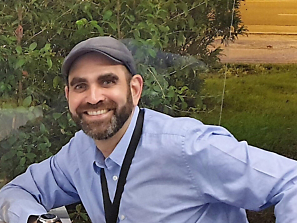
Juan Pedro Álvarez Vacas has been an O.A.T. Trip Experience Leader for our Back Roads of Iberia: Spanish Paradores & Portuguese Pousadas adventure for more than 10 years.
"I come from northern Spain, which originated from the first Christian kingdom during the Reconquest and blends with the pre-Roman Celtic tribes," Juan told us. "I also come from a mining region where religion wasn't particularly emphasized despite everyone being Catholic. It creates an interesting contradiction—where I live, Easter is mainly just a holiday period rather than a major religious celebration."
Semana Santa celebrations may be less elaborate in northern Spain, but Juan’s work as an O.A.T. Trip Experience Leader has allowed him to experience and appreciate the southern traditions: "Thanks to O.A.T., I've been able to truly understand and feel the profound significance of Easter that people in southern Spain experience," he shared.
Spain has a … "holy" spirit
To Juan, Semana Santa embodies the complex, multilayered nature of his country’s cultural identity: "Understanding Semana Santa requires understanding Spanish history," he insisted.
Indeed, historical context explains why the most spectacular Holy Week celebrations have flourished in southern Spain: "The Easter processions in the south originated in the 16th and 17th centuries when the church was trying to bring religion into the streets," Juan explained. At a time when Mass was conducted in Latin and most people couldn't understand the priest, these elaborate processions became a powerful method of religious education and storytelling.
"In southern Spain, the religious fervor is much more intense—partly because of how long the Moors occupied the region. Whether because people needed to prove their faith during the Inquisition or because they weren't able to practice Christianity openly during Moorish rule, the enthusiasm and devotion to religious festivities became far more pronounced," Juan said.
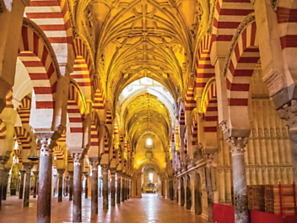
Moorish influence pervades Spain, most dramatically in the monumental Mezquita Cathedral—a mesmerizing eighth-century mosque and one of the world's largest Islamic buildings—with its Gothic Christian church, Capilla Mayor, inserted directly in its center.
"After the Reconquista, when Spain returned to Christian rule, many former Muslims and Jews who had converted to Christianity wanted to demonstrate the sincerity of their faith," Juan elaborated. "The Neo Christians—people who converted from Islam or Judaism—still needed to prove they were genuinely Christian."
The times they are a-changin'
While all of Spain (the south included!) has become increasingly secular in recent decades, Semana Santa remains a powerful cultural touchstone. Meanwhile, the brotherhoods and guilds that organize these processions are preserving centuries-old traditions that have oftentimes been passed down to them by their ancestors.
"Some of the brotherhoods and guilds that parade these statues date back to the 14th and 15th centuries," Juan noted. He described families he knows where "the entire family belongs to a single brotherhood—the same one their father belonged to. Now their children belong, and the grandchildren are already being inducted into the brotherhood."
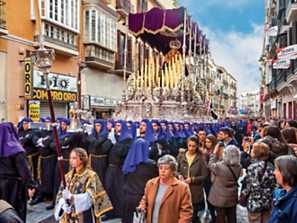
The Brotherhood of Crucifixión during a Semana Santa procession.
While regular religious practice has declined in Spain, tradition persists—spanning generations. "Even if someone isn't a practicing Catholic for most of the year, during Easter, Christmas, Corpus Christi, and other special dates, the number of ‘practicing’ Catholics significantly increases."
A litany of processions
So, what does the actual procession look like? Well, it depends where you are.
"Every city celebrates a little differently," Juan explained. "In some places, the processions are conducted in complete silence with profound solemnity. For example, the Christ of the Gypsies procession in Granada, Andalusia, maintains total silence throughout. Yet when it concludes, there's an explosion of joy and festivity. In other areas, the float stops because people from windows want to sing a saeta—a traditional song—to the figure of Christ or the Virgin Mary."
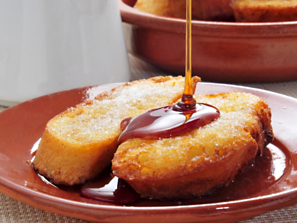
Juan’s abuela (grandmother) used to make torrijas—a Spanish dessert—during Lent and Easter.
Each location's celebration also has its own flavor and traditions, including special foods associated with the holiday. "There are specific sweets made only during Easter that become part of your childhood traditions," Juan reminisced. "My grandmother always made torrijas—similar to French toast. You slice stale bread, soak it in milk to soften it, then fry it and top it with sugar or honey. That's the most traditional Easter dessert in Spain."
In some cities, like Málaga and Seville, the massive floats—known as pasos—can weigh thousands of pounds and require extraordinary coordination to move through the streets: "The float of the Macarena weighs about 6,600 pounds," Juan revealed with amazement. "It's the heaviest float in Spain. The cities of Málaga and Seville maintain a rivalry over which has the largest floats and how many people are needed to carry them." These enormous structures are carried on the shoulders of volunteers known as costaleros. "Each float requires between 80 and 120 people to carry it."
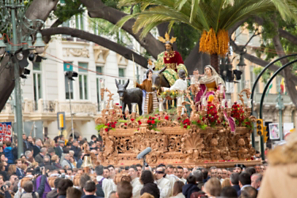
Massive floats—known as pasos—are moved through the streets during Semana Santa, carried by volunteers known as costaleros, and can weigh thousands of pounds.
The commitment of these participants is all the more remarkable considering the duration and the physical demands of the processions: "Some parades start in the afternoon and continue for eight, 10, even 12 hours—so they need extra people to give breaks to those beneath the float. Sometimes you have about 3,000 penitents walking in front of the float, along with ladies wearing mantillas. There's a director who guides the procession by striking a bell or board, signaling when to take regular steps. Behind all this follows the band," Juan described, painting a picture of the elaborate human organization required.
Peak devotion
One of the most striking—and controversial—aspects of Semana Santa processions is the distinctive attire of the participants. The nazarenos wear conical hoods (capirote) and long robes that completely cover their faces and bodies—an image that can initially shock American visitors who might associate the ominous silhouette with very different cultural references.
"Many Americans are shocked to see robes that resemble the Ku Klux Klan, and I understand that reaction," Juan acknowledged. "However, these brotherhoods—and their attire—predate that association by hundreds of years."
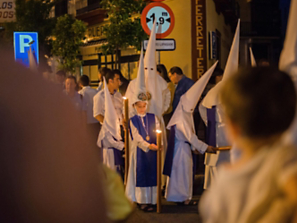
While the pointed hoods (capirote) of the nazarenos initially shock many American visitors due to their historical associations, Juan explained the deeper meaning behind this centuries-old design.
Juan explained the symbolism behind this controversial costume: "The pointed hoods direct toward the sky, toward God. What matters isn't who you are, but what's above. You're commemorating Christ's death and celebrating God, which is why showing your face isn't important." This anonymity serves a spiritual purpose. "You're not there to show off or display how faithful or Catholic you are. The idea is precisely not to be seen."
The colors of these robes also carry deep meaning: "Blue represents celestial love, white symbolizes peace, red signifies the blood of Christ, and purple represents penance," Juan explained. "Many brotherhoods combine these colors in their attire to express multiple symbolic elements."
Spanish "staycations"
Originally a regional religious tradition, Semana Santa has grown into a national cultural fiesta, with people from across Spain traveling to witness the most spectacular celebrations. "People from all over Spain travel to Úbeda, Seville, and Málaga—which host the largest and most elaborate processions," Juan explained.
This is especially the case for Spaniards from regions where elaborate Semana Santa celebrations are not common—like Juan. "For those who want to experience the deep emotional connection to Easter processions that exists in the south, they need to go there since many other regions don't have these traditions," Juan said. "In southern Spain, Easter is as significant as Christmas. People look forward to it all year—the moment when they can finally bring their floats out into the streets."
Meanwhile, for international travelers visiting Spain during Semana Santa, the celebrations offer an extraordinary cultural experience, but they also present logistical challenges. As a Trip Experience Leader, Juan must carefully navigate these complexities. "It sometimes creates difficulties because streets suddenly become filled with processions," he explained. "Certain areas become inaccessible, buses can't get close, and walking routes need to be adjusted accordingly."
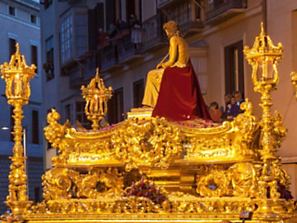
The Semana Santa processions draw massive crowds, sometimes making it challenging for Juan to navigate southern Spanish cities with O.A.T. groups.
Despite these challenges, Juan sees the processions as "some of the best O.A.T. Learning & Discovery opportunities available" for travelers seeking to understand Spanish culture. In his eyes, the processions provide a window into the soul of Spain that can't be experienced through museums or monuments alone.
North Star rising
On that note, Juan passionately advocates for travelers to experience both northern and southern Spain to understand the country's cultural diversity. "The north and south are fundamentally different," he emphasized. "For any O.A.T. travelers, missing the Northern Spain: Bilbao, San Sebastian & Medieval Villages post-trip extension would be a mistake. People often don't expect much from it, but it's a spectacular part of Iberia that contrasts completely with the south."
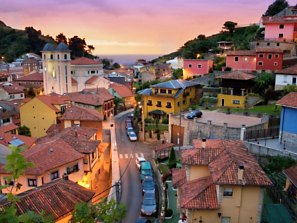
A little village of Asturias, Spain, next to the sea—the same region Juan is from.
Juan fondly described his home region of Asturias as "the greenest part of Spain—a blend of Scotland, Ireland, and Oregon with mountains and valleys. The north is much more Celtic in character—where I live, people play bagpipes. We drink cider that we pour from above into a glass below to oxygenate it and reduce the apple's acidity," Juan explained. "Every traveler I've taken on the post-trip has said their experience of Spain and Portugal would have been incomplete without seeing this region."
Visit Spain during Semana Santa on O.A.T.’s Back Roads of Iberia: Spanish Paradores & Portuguese Pousadas adventure.
Where Sheep Outnumber Selfies: Scotland's Secret Medieval Marvel
Trip Experience Leader Mark Mackenzie explores a medieval gem in the remote isles.
The Real White Lotus: Symbol of Spiritual Rebirth
From the market to the plate, learn the secrets of a perfect risotto from a Trip Experience Leader.
New Zealand is Not Middle Earth
Come separate fact from fiction and explore a "typical" New Zealand town with Trip Experience Leader Mike Matthew.
Get The Inside Scoop On...
Like what you see here? Receive weekly updates right in your inbox.
inside-scoopArticles In This Edition

Aria Kidding?

Center Stage

Float Like a Butterfly, Pray Like a Saint: Spain's Semana Santa

Japan Takes the Stage

Listening to Tuscany’s Most Famous Musical Sons

Top 10: Adventures with FREE Single Space Still Available in 2026