Question: 2026 is the “Year of the Fire Horse” in Japan, just like in China. Unlike in China, what plummeted in Japan when the Fire Horse last appeared in 1966?
Answer: Births
During the last “Year of the Fire Horse,” which occurred in 1966, birth rates in Japan indeed plummeted. There were 1,361,000 births in Japan that year—some 500,000 fewer births than in the previous or following years. The reason for this severe dip in the number of newborns in Japan may surprise you. But first, perhaps you’re curious as to why the Year of the Fire Horse only comes around every 60 years.
In Chinese astrology, each year is associated with one of the 12 zodiac animals: rat, ox, tiger, rabbit, dragon, snake, horse, sheep, monkey, rooster, dog, and pig. Each animal is paired with one of the five elements: metal, wood, water, fire, or earth—and the interplay between these elements and the animals is what gives the years different meanings. So, five elements and 12 signs mean any given combination occurs every 60 years. For example, we’ve gone through a few “Year of the Horses” since 1966. But in 2014 it was the Year of the Wood Horse, 2002 was the Year of the Water Horse, 1990 was the Year of the Metal Horse, and 1978 was the Year of the Earth Horse. That explains why the last time the Year of the Fire Horse made an appearance was in 1966.
A horse is a horse, of course, of course—unless it’s a Fire Horse
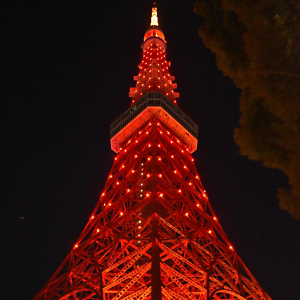
The Tokyo Tower glowing red for Lunar New Year.
The reason the birth rate plummeted in 1966 in Japan is rooted in a story from the early Edo period. During the evacuation of Edo after massive fire swept through the city in 1682, a teenage girl named Oshichi (who had been born in a Fire Horse year) fell in love with a novice monk. Desperate to see him again, she supposedly set another fire, hoping that the ensuing chaos would bring them back together—but she was caught and sentenced to death by burning.
Whether true or not, the girl’s tragic story spread throughout the country and was repeatedly adapted into kabuki plays and popular literature. And the meaning was clear—all women born in a Fire Horse year were hot-tempered, strong willed, and unsuitable for marriage. The superstition soon hardened into the widespread belief that Fire Horse women would “destroy their husbands” and “bring calamity to the household.”
In earlier centuries, baby girls born in a Fire Horse year were even killed at birth because families feared they would “bring misfortune.” Marriage prospects were denied to women solely because they were born in the 1906 Fire Horse year—tragically, many suicides soon followed. Which brings us the plunging birth rates of 1966, the last Fire Horse year in Japan.
There’s plenty of blame to go around, but much of it can be placed on the Japanese media. Like a modern-day conspiracy spreading like wildfire over the Internet, Japanese newspapers and magazines brought the superstition roaring back by warning expectant mothers not to give birth to Fire Horse girls—and it worked. Fearing social stigma, a half a million Japanese women avoided or terminated their pregnancies during the Fire Horse year of 1966.
Is it finally time to reign in the Fire Horse superstitions?
It’s difficult to predict if Japan’s birth rate will decline again in 2026, but there is no question that Oshichi’s story continues to linger in Japanese society. Why is that? With no evidence that Fire Horse women are particularly unlucky, dangerous, or destructive, some say it’s just due to the centuries of patriarchal fear of strong women. As mentioned, China is also celebrating the Year of the Fire Horse in 2026. But while the zodiacal cycle itself originated in ancient China, the irrational superstition about Fire Horse women’s suitability for marriage is unique to Japan. It’s unfortunate how a tragic Edo-era love story has been responsible for centuries of discrimination.
China puts a different spin on the Year of the Fire Horse, which has always been associated with either very good luck or very bad luck. The horse has always been linked to strength and dynamism, but everything is intensified when the element of fire is added—which can lead to personal or societal transformation or even turning points in history. Think what happened during the last Fire Horse year, 1966, when the Cultural Revolution plunged China into a decade of violent upheaval. And sixty years before that, in 1906, the deadliest earthquake ever to hit the United States struck San Francisco, resulting in more than 3,000 deaths. Hmmm, so, maybe there’s something to this Fire Horse stuff after all ...
A few more fascinating facts about the role of horses in Japanese culture
- My little (very tough) pony—Perhaps the most revered breed in Japan is the Hokkaido Pony (Dosanko).Believed to have been brought to the northern island during the Edo period (1600-1867) by fishermen who used them as work horses, the horses remained on Hokkaido when the fishermen left in the fall—and had to endure the extreme winter weather conditions on their own. Only the toughest survived to breed, which are ancestors of today’s very tough Dosanko In spite of their wild upbringing, the Dosanko have surprisingly gentle temperaments and are often used for inexperienced riders. They’re also popular mounts for Yabusame, the art of archery from horseback, that was common during Samurai battles. Even today, some ranches let the Dosanko fend for themselves in the mountain regions of Hokkaido, knowing they will return on their own in the spring to escape the bears that are emerging from hibernation.
- Baby, we weren’t born to run—More than twice the size of Dosanko ponies, Ban’ei are another breed that thrived in the bitter winters of Hokkaido. Also known as Banba, these muscular workhorses—once used to plow fields, transport goods, and pull logs—are capable of pulling up to a ton of weight, the exact skills required to participate in the Banei Keiba horserace in Obihiro. In this wildly popular annual event, the massive draft horses pull weighted iron sleds along a 200-meter course, often struggling on their knees to get up and over two hills built into the track. There’s plenty of drama in what is known as “the world’s slowest horserace.”
- Victory comes with saddle sores—While Japan’s Banei Keiba horserace covers just 256 feet in length, there’s a horserace in Mongolia that is considerably longer. Stretching across 621 miles of Mongolia’s steppe country, the Mongol Derby is the longest horse race in the world.
- Japan’s horses are true gentlemen—The gentle nature and chivalrous behavior of native Japanese horse breeds bring to mind the origins of the word chivalry—which comes from cheval, the French word for “horse.”
- Horse sense—An expression “uma ga au,” or “the horse matches well,” is sometimes used when people get on well with each other in Japan. The expression is based on the idea of riders being a good fit with their steeds. Another expression, bakyaku o arawasu, which translates as “revealing one’s horse’s legs,” is used when someone shows their true colors or shortcomings.
Discover how ancient traditions coexist alongside modern innovation during Japan’s Cultural Treasures.


