See Maxime Du Camp’s photos of Egypt in the slideshow above—and discover what has changed and what remains during Egypt & the Eternal Nile by Private, Classic River-Yacht.
Question: French writer Maxime Du Camp pioneered the field of travel photography in 1849 with images from what famous river?
Answer: The Nile
In 1849 Maxime Du Camp and his close friend Gustav Flaubert sailed to Egypt to explore the ancient sites. Flaubert spent his time recording their experiences in a journal while Du Camp wanted to see if he could capture images of the pyramids, the Sphinx, and temples of Luxor in photographs—a field that had only been invented a decade earlier. Both young men shared a love of travel and had already seen much of the world—but no cushy guided tours. It was true adventure travel for these lads.
This trip saw them spending time fighting off bandits, briefly getting arrested as spies, consorting with belly dancers and prostitutes, and ingesting all manner of drink and drugs. But even all that didn’t interfere with their productivity. Shortly after their return to France in 1950, Maxime Du Camp’s stunningly detailed photographs caused a sensation when he published the world’s first travel photography book. And his friend Flaubert made quite a name for himself as well when his novel Madame Bovary came out at about the same time.
Not bad for a pair of relatively unknown 27-year-old college dropouts.
Du Camp’s Astonishing Photos Were a Combination of Genius and Dumb Luck
Maxime Du Camp wasn’t the first person to travel up and down the Nile River with a camera. With the invention of photography by fellow Frenchman Louis Daguerre a decade earlier, there had been plenty before him with the idea of capturing the Egyptian monuments on film. But there was a problem. The early days of photography relied on daguerreotypes—which are positive images on metal plates. You could re-photograph it to get a copy but essentially, they’re one-of-a-kind photographs.
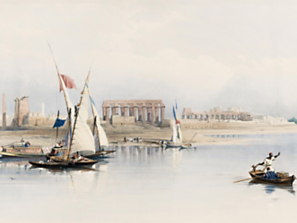
Before photography was commonplace, most of the world saw Egypt through illustrations like this one by painter David Roberts.
During Maxime Du Camp’s former travels, he always felt he wasted too much time sketching everything he saw—not only was he slow, he felt the end results weren’t very accurate. Before his upcoming trip through the Middle East, he wanted some way to record precise images of the temples and hieroglyphics without having to rely on pen and paper. He thought photographs might do the trick. But he had no photography experience. In fact, he wasn’t even a fan of the new medium.
Du Camp was a quick study, though. In a matter of weeks, he learned all there was to know about photography, including a new technique that would solve the daguerreotype problem. By sheer coincidence, another budding photographer had been perfecting a new waxed paper negative process and passed on the information to Du Camp. Paper negatives would mean that Du Camp would be able to produce an infinite number of prints without damaging the original. Du Camp was confident enough in his photographic expertise to pack a camera and all the fixin’s (darkroom supplies) before departing for Egypt.
Along With Photographs, A Few Problems Developed ...
What Du Camp was attempting was quite ambitious. Packing for an 18-month journey anywhere is a difficult task, but his “photographic voyage” required lugging all kinds of equipment—camera, paper, chemicals, and tents—in order to expose, develop, and fix the negatives in the middle of a desert. To illustrate just how cumbersome it was, when Du Camp and Flaubert stayed at the Maison de France in Thebes (Luxor), they had to rent an extra room just to store all the photographic equipment they needed. With the extreme heat and lack of distilled water necessary for photography, he probably couldn’t have chosen a worse location.
While the two travelers were in Cairo, Flaubert wrote a letter to his mother commenting on the challenging technical issues Du Camp experienced on their journey. “Photography absorbs and consumes Max’s days,” he wrote, “and he succeeds but gets upset every time he ruins a proof or a plate is badly wiped.” And to remove any doubt about his friend’s new obsession, he adds: “I don't know how Max doesn’t kill himself with the photographic mania he has.”
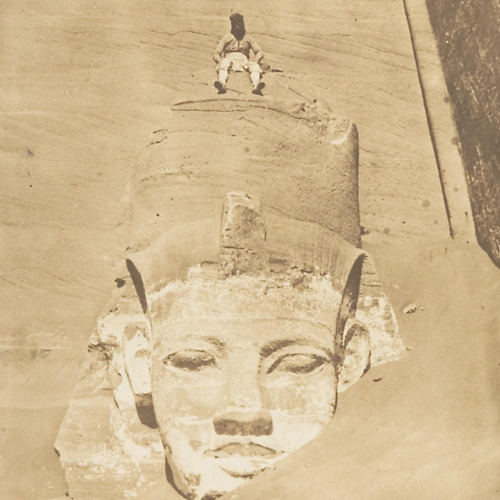
Du Camp’s 1950 image of a colossus at Abu Simbel.
Du Camp remembered things a bit differently, though. Reflecting on the expedition years later, he placed all his troubles on the harsh travel conditions. “Learning photography isn’t a big deal,” he said, “but transporting equipment by muleback, camelback, or the back of a human is a difficult problem.”
But things somehow worked out in the end. Du Camp was eventually able to produce 189 sharp images of ancient Egyptian relics and monuments. But by the time they reached Lebanon, the next destination of their itinerary, Du Camp began having trouble with the chemical baths used to develop his film and was only able to produce 27 more good negatives.
Increasingly frustrated, he decided that his fledgling photographic career was over. Wanting to return with something to decorate his Parisian home, he ended up trading all his equipment to a camera enthusiast in Beirut for ten feet of gold-embroidered damask fabric (trading his cameral for some fancy fabric seems rather odd, but Flaubert said Du Camp planned to use it to make a “sofa fit for a king”).
So when Du Camp returned to France, he was sans camera but he had something far more valuable—more than 200 negatives of ancient Egyptian monuments, landscapes, and people. The images would be published about a year later in Egypte, Nubie, Palestine and Syrie, recognized as the first photographic travel book. The book was especially popular with archaeologists, who now could see the Egyptian monuments in high definition without having to take the lengthy and difficult journey to Egypt for themselves.
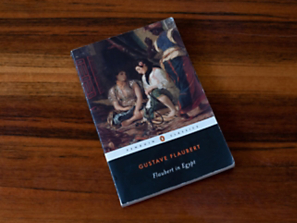
More than century after his journey, Flaubert’s notes and journals were published, including descriptions of brothels that scandalized his contemporaries.
Flaubert kept extensive notes on their experiences which were eventually published in 1972 as Flaubert in Egypt. Why such a long delay? Flaubert’s frank descriptions of what transpired in the brothels and bazaars of Egypt are capable of shocking even today’s audiences. But the excerpts from his travel diary also reveal how the concerns and complaints of 19th-century travelers aren’t so very different than those of contemporary travelers. Things that annoyed Flaubert at various stages of his journey were stubborn mules, hungry hyenas, fever, and bad cheese. He also noted that he occasionally suffered from boredom and depression. But his number one complaint seems to be that the local bird population in Egypt was using the Sphinx and Pyramids as their public toilet!
The collaboration between the two Frenchmen on the expedition had a lasting impact on the careers of both Flaubert and Du Camp. Flaubert credits Du Camp’s remarkably detailed photographs for influencing his future literary works—and the publishing of Madame Bovary just two years after they returned to Paris would propel him into literary greatness. And Du Camp was inspired by Flaubert’s approach to writing to branch out of travel writing and try his hand at novels—and he went on to a achieve success as a novelist, poet, journalist, and editor.
While he had been just an amateur shutterbug, Maxime Du Camp’s captivating images ended up making photographic history. And wouldn’t you know it, he never snapped another picture for the rest of his life.
A Few More Fascinating Facts About the Early Days of Photography
- Someone blinked, let’s take it again—The first photograph ever taken is credited to French scientist Joseph Nicéphore Niépce using a camera obscura in 1826—which took eight hours to capture because of the long exposure time required.
- It wasn’t that Farah Fawcett poster?—The most viewed photograph in history is believed to be Bliss, which served as the default wallpaper for Microsoft's Windows XP operating system between 2001 and 2007.
- It sounded OK at the time—When George Eastman was asked about the meaning of Kodak, the company he founded in 1888, he said it didn’t mean anything. He just thought the letter K seemed to be “a strong, incisive sort of letter.”
- Photo shoot at the O.K. Corral—A popular subject in the 1800s was photographing famous corpses, including Billy Clanton and the brothers Frank and Tom McLaury, who died in the Gunfight at the O.K. Corral. Many photos of the outlaws were taken while the bodies were on display in the plate-glass window of a Tombstone hardware store.
- Remembering the dead—Postmortem photography wasn’t just for the famous, though. Families would often preserve the memory of a deceased child with a photograph. Infant mortality was high at the time, and photographs were taken of a dead child posing with surviving siblings. Older children and adults were often propped up with belts and pulleys to make it look like they were still alive. For added realism, photographers sometimes added glass eyes to make it seem like the dead person was looking directly at the camera. When healthcare improved the life expectancy of children, the demand for death photography diminished.
- Photographing living children was more difficult—Early photography had long exposure times, requiring the subject to remain still for 30 seconds before a picture could be taken. It was difficult enough for adults to pose like this, but getting a child to stand still and stare at a camera for half a minute was next to impossible. This gave rise to something called “hidden mother photography,” where mothers would hide in the background while holding a child in place. Mom would be covered with clothes that would blend in with the background or disguised as chairs, curtains, or anything that would hide them from appearing in the photo.
- Don’t say “cheese”—Why is it that in pictures taken during the 19th and early 20th centuries, you rarely see people smiling? One reason was that early photography was considered an extension of painting, and paintings were supposed to look natural so anything other than a flat facial expression was frowned upon. But the main reason was the widespread belief during Victorian times that only idiots smiled!
- That’s the spirit—The long exposure times of early cameras also inspired another popular genre known as “spirit photography.” Subjects were required to remain still to prevent “ghosting,” or looking faint and transparent in the developed photo. In 1861, a photographer named William Mumler found a way to create consistent ghosts in his photographs and used it to defraud his clients. Claiming that he could take authentic photographs of ghosts, clients came swarming to his shop to get pictures with ghosts of their dead relatives—including Mary Todd Lincoln, who got a picture with the ghost of her dead husband, Abraham Lincoln.
Take your own photographs of the Nile and Egypt’s antiquities during Egypt & the Eternal Nile by Private, Classic River-Yacht.


