
Since the days of the ancient Romans, curious travelers have been drawn to the antiquities of Egypt—and Egypt & the Eternal Nile by Private, Classic River-Yacht is among our most popular adventures to this day.
Since the days of the ancient Romans, curious travelers have been drawn to the antiquities of Egypt—and Egypt & the Eternal Nile by Private, Classic River-Yacht is among our most popular adventures to this day.
When did the whole concept of recreational travel begin? We’re not talking about “explorers” like Marco Polo or Columbus seeking new trade routes, but ordinary people who traveled for pleasure rather than necessity. Even with humanity’s innate desire to set foot on foreign soil, this type of travel was simply not possible throughout much of human history. We can give credit to the ancient Romans for an innovative development that finally made pleasure travel a reality for the masses—roads.
At the height of its power in the second century A.D., the Roman Empire was the largest the world had ever known—covering close to two million square miles with more than 55 million people living within its borders. To facilitate troop movements and trade, the Romans built a vast network of more than 50,000 miles of stone-paved roads linking even the most far-flung provinces of the empire. Almost as important as the roads themselves, taverns and inns were built at regular intervals along the route. That way, travelers knew they always had a place to rest, feed the horses, or spend the night. And travel they did—well, at least the wealthy ones did.
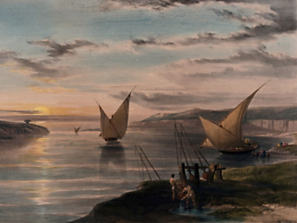
Graceful felucca sailboats have been traversing the Nile for centuries.
Just as today’s travelers have a curiosity about the world beyond our borders, the ancient Romans were no different. They were fascinated by the Egyptians and sought out the Great Pyramids and Sphinx of Giza, and always followed it up with a trip along the Nile. And they were fortunate enough to be living in a time when the Lighthouse of Alexandria, one of the Seven Wonders of the Ancient World, still stood. Another bucket list destination was Greece, especially to visit Athens and the Oracle of Delphi. Romans liked to follow up sightseeing with some relaxation and rest on islands like Lesbos, Chios, and Rhodes—home to the renowned Colossus, another “Ancient Wonder.”
One more must-see destination for wealthy Romans was England, whose legendary spas were featured in Roman travel guides. Archaeologists have even found hundreds of what were known as “curse tablets” left by visiting Romans, which called on the gods to bring harm to whoever had just stolen their clothes.
After such a promising start, the fall of Rome in the 4th century A.D. spelled the end of leisure travel for quite a while—and a lot of other things, too.
Historians still debate what to call the 900-year-period between the fall of Roman and Renaissance. Whether they label it the Dark Ages, the Early Middle Ages, or the Middle Ages, there wasn’t much pleasure travel going on in Europe. Any traveling being done was mostly by traders, plunderers, or religious crusaders. But with religion the center of life, another form of travel took hold later in the Middle Ages—the pilgrimage. Primarily done on foot, often sleeping on the side of roads, pilgrims made long journeys to places like Santiago de Compostela in northwest Spain to secure their place in heaven.
The Renaissance—typically defined as the period between the 14th and 16th centuries—represented a giant leap forward for European civilization, from culture and industry to exploration. Despite the fact that the ancient Roman roads had fallen into disrepair and travel by both sea and land was still quite dangerous, a popular form of recreational travel emerged among the aristocracy and upper classes during the Renaissance years. Known as the “Grand Tour,” young men from wealthy families would set off on extended tours across Europe to immerse themselves in the cultural and artistic treasures of the continent.
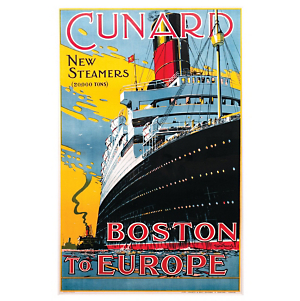
A vintage poster promotes steam travel between the U.S. and Europe—where wealthy travelers took the "Grand Tour."
Similar to what we now call a “gap year” (albeit one with a much bigger budget), the Grand Tour usually included iconic cities like Rome, Venice, and Florence, where travelers could cultivate their knowledge of art, architecture, history, and languages. They weren’t exactly roughing it either, like those “backpacking” tours through Europe with stays at cheap hostels popular in the 1970s. These young students would often be accompanied by an educational tutor and had their servants along with them, too!
The next period that transformed European society—and sowed the seeds of mass tourism—was the Industrial Revolution. Beginning in Great Britain around 1760, then spreading to continental Europe and the United States by 1840, the era saw an explosive growth in both population and spending power. Inland travel, which had previously been limited to horsedrawn carriage or foot, changed forever when the first public steam powered train in the world—called, fittingly enough, Locomotion No. 1—left the station in northern England on September 27, 1825. Said to have a top speed of15 mph, it was no bullet train, but it represented a new vision of society in which people could now travel with unprecedented ease.
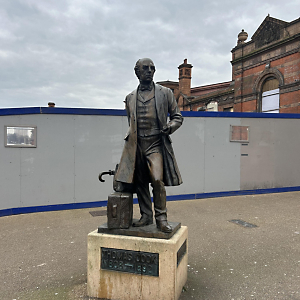
A statue of Thomas Cook, pioneer of group travel, in Leicester, England.
Someone who recognized how the advent of railroads reshaped the way we travel was Thomas Cook, a British temperance preacher and cabinetmaker. Cook had the idea that working class people may want to enjoy the benefits of travel, too. In 1841, he began a campaign to persuade carriers and a network of hotels to provide discount fares if he could bring them large numbers of passengers. And then, ta da, group tourism was born.
Sure enough, within 25 years of the train’s inaugural journey, railways crisscrossed the European continent. There were more than 13,000 miles of track covering Britain alone, with thousands more in Germany and the United States.
The steam engine revolutionized sea travel as well. Great steamships mostly transported poor immigrants to the United States, but many Americans made the return voyage to indulge in “Grand European Tours.” Crossing the Atlantic, a 16-day journey in 1838, was reduced to six days by about 1900. But while railroads made land travel accessible to the middle class, anyone familiar with the Titanic knows that oceangoing pleasure travel was still largely reserved for the very wealthy.
The tiny airplane on the Wright brothers’ first flight in 1903 was incapable of taking people long distances, but it sure paved the way for international travel and the opportunity to explore new cultures and destinations. The first commercial airline flight took place in 1914, a 23-minute puddle jump between St. Petersburg, Florida, and Tampa. Pan Am began flying to Cuba in 1927 before getting serious with the world’s first transatlantic airplane flight in 1939. With the introduction of commercial airlines and the proliferation of the automobile, suddenly long-distance travel was both efficient and convenient. Combine that with the emergence of the middle class as a result of Post-World War II prosperity, and leisure travel took off—and hasn’t looked back.
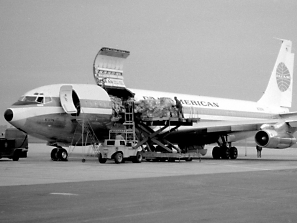
By introducing the first transatlantic flight, Pan Am brought travel into the modern age.
It's simply mind-boggling to think that we can be anywhere in the world in less than two days. While the way we travel continues to evolve with advancements in transportation, communication, and technology, the reason why we travel hasn’t changed since the time of the ancient Romans—to satisfy our innate curiosity about the world. And don’t be too concerned about running out of destinations to explore, there’s a good chance that space tourism is right around the corner …
Discover why Egypt was one of the world’s first travel destinations during Egypt & the Eternal Nile by Private, Classic River-Yacht.
Four Ways to Experience Egypt & the Nile
O.A.T. offers four different itineraries in Egypt—each designed for a different travel style.
Tomb Grader
The achievements of what ancient Egyptian figure were so remarkable that even centuries after his death he was revered as a god of wisdom?
Climbing to Khufu: Bending to Eternity Inside the Great Pyramid
Gloria braved the ascent to Khufu’s burial chamber within the Great Pyramid.
Get The Inside Scoop On...
Like what you see here? Receive weekly updates right in your inbox.
inside-scoopArticles In This Edition

Ancient Roam: The Long and Curious History of Pleasure Travel

Beyond the Trends: Undiscovered Journeys by Land, Sea & River

More than Polar Bears: Small Wonders at the Top of the World

Nature is Number One

On Trend: Top 10 Most Popular Journeys

Paradise Found