
Before her tragic maiden voyage, the majestic RMS Titanic embodied the golden age of ocean travel—a history you can explore at Belfast's Titanic Museum during O.A.T.’s Irish Adventure: Dublin, Belfast & the Northwest Counties.
In today's world of cramped seats and rushed connections, we've mastered the art of getting somewhere fast—but our ancestors knew a different way to travel. When crossing the Atlantic meant a five- to seven-day journey instead of a five- to seven-hour flight, travelers had no choice but to embrace the philosophy that the journey mattered as much as the destination.
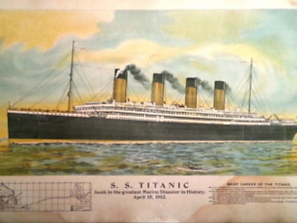
Before jet engines travelers traversed the seas aboard vessels like the RMS Titanic—whose birthplace travelers can be visited on Irish Adventure: Dublin, Belfast & the Northwest Counties.
These travelers journeyed aboard grand ocean liners, where life moved at an unhurried pace, offering moments of quiet luxury. The era of transatlantic ocean liners turned ordinary transportation into a vacation experience—and the legendary RMS Titanic served as the pinnacle of this golden age of maritime travel.
Full steam ahead
The late 1800s introduced fierce competition among shipping companies vying for maritime supremacy. The coveted Blue Riband award—presented to passenger ships that achieved the fastest transatlantic crossing—ushered in a wave of innovation in ship design and engineering. Companies like White Star Line and Cunard Line engaged in an arms race of luxury and speed, each striving to attract wealthy passengers with promises of faster crossings and increasingly opulent accommodations.
The RMS Titanic embodied humanity's grandest maritime ambitions. Launched in 1912, she represented the pinnacle of Edwardian luxury and engineering confidence. At 882.5 feet long and weighing 46,328 tons, the Titanic surpassed all previous passenger ships in size and grandeur. The voyage from Southampton to New York was scheduled to take 7 days, with passengers paying vastly different fares based on their class of travel. A first-class parlor suite ticket cost $4,350 ($125,000 in today's money), while a third-class berth could be secured for $36 ($1,040 today)—still a significant sum for many immigrants pursuing new lives in America.
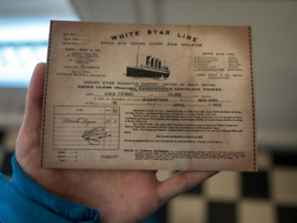
This third-class Titanic ticket could be purchased for around $36 (equivalent to $1,040 today).
Her first-class accommodations set new standards for opulence: the grand staircase featured ornate oak paneling and wrought iron, while the first-class dining saloon could seat 554 passengers amid elegant classical details and crystal chandeliers. First-class passengers could book private suites, some with their own promenades, equivalent to luxury hotel rooms of the era.
Even third-class accommodations were impressive for their time, offering unprecedented comfort for immigrant travelers. However, it’s worth noting that conditions varied and were not universally luxurious. Third-class passengers often faced challenges such as shared sleeping areas and limited amenities compared to higher classes.
That said, the ship boasted electric elevators, a swimming pool, Turkish baths, a squash court, and a gym equipped with the latest exercise machines. Perhaps most remarkably, the Titanic's kitchen staff served up to 6,000 meals a day from a menu that included oysters, salmon, lamb, duckling, and sirloin of beef.
Cold, hard truths
The White Star Line spared no expense in promoting their crown jewel as "practically unsinkable," thanks to innovative watertight compartments. This hubris would prove tragic on April 14, 1912, when several fateful decisions led to disaster.
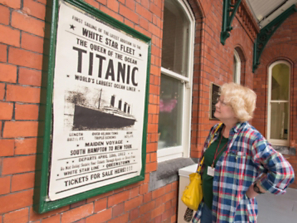
During Grand Circle’s Ireland in Depth Land Vacation, travelers can participate in a walking tour of the town of Cobh on the Titanic Trail—known as the Titanic’s last port of call in 1912.
Despite receiving multiple ice warnings, Captain Edward Smith maintained a speed of 22 knots through an ice field in darkness. At 11:40 PM, lookouts spotted an iceberg dead ahead. Though First Officer William Murdoch ordered a hard turn to port and engines reversed, the ship's starboard side scraped along the iceberg, puncturing its hull in multiple places.
The "unsinkable" design had a fatal flaw: while the watertight compartments were innovative, the walls between them didn't extend high enough. As the front compartments filled with icy Atlantic water, they tipped the bow down, allowing water to spill over into subsequent compartments like water flowing over the top of an ice cube tray. Within three hours, the mighty ship broke in two and sank to the ocean floor, claiming over 1,500 lives.
The disaster revealed other critical oversights: the ship carried only enough lifeboats for half its passengers, and there was no organized evacuation plan or proper crew training for emergencies. These tragic lessons led to sweeping maritime safety reforms—including requirements for sufficient lifeboats, mandatory safety drills, and 24-hour radio communications.
Docking the dream
The golden age of ocean travel began its decline with the rise of commercial aviation in the 1950s. In 1958, the first commercial jet service across the Atlantic marked a turning point—a journey that once took five days by sea could now be completed in mere hours. Yet the romance of these magnificent ships lives on in the modern cruise industry, where the focus has shifted from transportation to leisure and exploration.
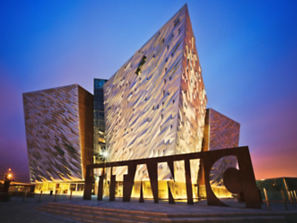
During O.A.T.’s Irish Adventure: Dublin, Belfast & the Northwest Counties, travelers can visit the Titanic Belfast Museum on the site of the former Harland & Wolff shipyard where the RMS Titanic was built.
Today, visitors to Belfast, Northern Ireland—the city where the Titanic was built—can explore the world's largest Titanic visitor experience. In Harland and Wolff shipyard, thousands of workers spent three years bringing her to life, using over three million rivets and consuming vast quantities of steel, wood, and labor. The museum's nine interactive galleries reveal compelling stories about the ship's construction, the lives of passengers and crew, and the disaster that changed maritime history forever. Visitors can walk through reconstructed cabins, explore digital projections of the ship's interior, and even experience the chill of that fateful April night through innovative multimedia exhibits.
Step back in time to explore Belfast's maritime heritage and visit the award-winning Titanic Belfast Museum during O.A.T.’s Irish Adventure: Dublin, Belfast & the Northwest Counties.
Pilfering Pints
Where do almost 163,000 pints of Guinness get put to waste every year?
A Nutty Night in Dublin
Thousands of Dubliners were awakened from slumber one 1867 night by an outpouring of what object from the skies?
Pilfering Pints
Where do almost 163,000 pints of Guinness get put to waste every year?
Get The Inside Scoop On...
Like what you see here? Receive weekly updates right in your inbox.
inside-scoopArticles In This Edition

Giving Back to the World We Travel: Great Barrier Reef Coral Nurture Program

Top 10: O.A.T. Small Ship Adventures with FREE Single Space Added in 2025

When Getting There was Half the Fun: The Golden Age of Ocean Travel

Where in the World?

Where in the World?