In the video above, travel to Chiang Mai, Thailand to see the intricate Silver Temple—a Buddhist holy site and tribute to local metal workers—with Are Keelawong Aittipol, Trip Experience Leader for Discover Thailand: Bangkok to Chiang Rai.
Located just south of the old city of Chiang Mai, Thailand, the temple complex of Wat Sri Suphan was initially founded in the early 16th century—but its crowning jewel does not appear in history books. The spectacular silver ordination hall, as described in the video above by Trip Experience Leader Are Keelawong Aittipol, was completed in 2016—proving that in Thailand, reverence for artistic traditions has stood the test of time.
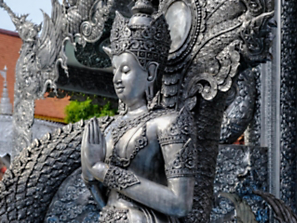
The entire façade of Wat Sri Suphan’s silver ordination hall is covered in intricate metalwork.
The idea for the so-called silver temple grew from the history of metalwork in this area. "Around 1782, the ancestors of this village relocated from Myanmar to Chiang Mai along with other craftspeople such as carpenters, paper makers, and blacksmiths. The artisans renowned as silversmiths settled in an area called Wualai," says Are. "The skill was passed down to a new generation in order to preserve the way of life and cultural heritage." To celebrate this unique artistic tradition, the villagers and local artisans conceptualized the new ordination hall made from silver, nickel, and aluminum in 2004—a modern interpretation of ancient Lanna Kingdom temple design.
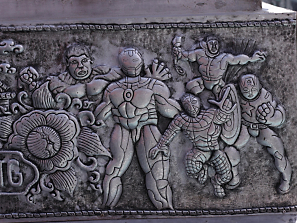
Look closely enough and you’ll find nods to modern popular culture—including Marvel superheroes.
The main techniques seen in the ordination hall are chasing (or embossing), in which a sheet of metal is hammered from the front to create designs; and repoussé, in which the design is pushed up from the back of the metal. While the techniques are ancient, the designs contain many nods to modern life, including spacecraft, nods to GPS, and even Marvel superheroes—all rendered in meticulous detail.
Other elements stay true to tradition, such as the naga (serpent) figures that flank the entrance. "Naga staircases are typical northern Thai architecture, with the serpents representing temple guardians," says Are. "We also see symbols of gods and Buddha images."
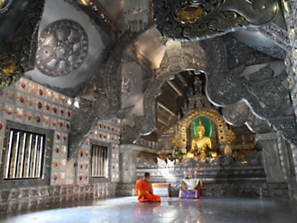
While women aren’t permitted to entire the ordination hall, the interior is mostly visible from outside.
Among these god symbols is a prominent image of the Hindu god Ganesh. "We can see Hindu gods and goddesses in many Buddhist temples, especially Lord Ganesh," says Are. "Thai artists believe Ganesh is the god of art in Thailand, and because Buddhism is not a religion, but a way of life, people can pray to gods and goddesses." Due to the artistic tradition of both the surrounding village and the silver temple itself, Ganesh is an especially important symbol here.
Other traditions, however, are hardly as inclusive: Women are not permitted to enter the ordination hall, though they are welcome to explore any part of the stunning exterior. "It’s a sacred space where monks perform their ordination rituals," says Are. "The restriction stems from the belief that a woman’s presence might unintentionally violate the monks’ vow of celibacy and purity."
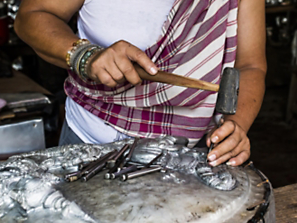
A silversmith demonstrates techniques used to create the silver temple.
Fortunately, the majority of the interior can be glimpsed from outside—and the exterior alone is stunning in itself—but Are still has a special treat for women travelers who haven’t gotten their fill of silverwork. "Five minutes’ walk from the silver temple is Wat Muen San art gallery, renowned for its talented silversmiths," says Are. "Here, you can find incredible silverworks of all kinds—the most beautiful masterpieces in northern Thailand."
In a country known for incredible temple complexes, many of which date back centuries, this architectural newcomer beautifully bridges ancient and modern—and helps ensure appreciation of a traditional art form for generations to come.
Visit the incredible silver ordination hall of Wat Sri Suphan during Discover Thailand: Bangkok to Chiang Rai.


