Join Trip Experience Leader Lukas Svoboda—a Trip Experience Leader for our Jewels of Bohemia: Czech Republic, Slovakia & Hungary adventure—for a conversation about Prague’s famous John Lennon Wall with Jakub, a composer and professor with unique insights into the monument’s importance in Czech history and culture.
Before it became an iconic symbol of peace and resistance, Prague's John Lennon Wall was known by a different name. "It was called the 'Wailing Wall' before 1989," explained Lukas Svoboda, Trip Experience Leader for our Jewels of Bohemia: Czech Republic, Slovakia & Hungary adventure. "People left messages and quotes on it as a form of protest against the Communist regime, similar to how people leave prayers at the Wailing Wall in Jerusalem."
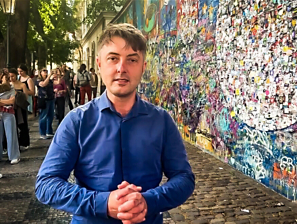
Lukas started as a Program Director for Grand Circle Cruise Line in 2012 but has been a Trip Experience Leader for O.A.T.’s Jewels of Bohemia: Czech Republic, Slovakia & Hungary adventure since 2020.
This limestone wall, tucked away in a quiet corner of Prague's Lesser Town, transformed into a powerful symbol of freedom following John Lennon's death in 1980. Young people, students, and dissidents began covering it with Beatles lyrics, portraits, and messages expressing both grief over Lennon's passing and opposition to Communist rule.
"The Communist regime disapproved of this symbol of resistance and repeatedly painted it over in white," Lukas said, "but new messages always reappeared." This continuous cycle of erasure and rebirth only strengthened the wall's significance as a canvas for forbidden expression.
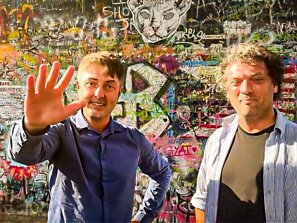
Lukas took a moment to talk about the history and impact of the John Lennon Wall with Jakub, a local composer and professor.
The Beatles' music held particular significance for Czech citizens living under Communist rule. As Lukas explained, "As someone clever said: 'The allure of the forbidden only enhances its flavor.' Always, when something is forbidden, it tastes better." Beyond their restricted status, The Beatles' message resonated deeply with Czech youth. "Of course, the beam of freedom and equality in their lyrics" spoke to those living under oppression, Lukas noted.
The act of contributing to the wall carried severe risks. "To write or draw anything on the wall was a Protest with a capital P itself," Lukas emphasized. "Just to sit down by the wall with a guitar could be a trigger for some action." The consequences could be dire: "The Communist regime had strict surveillance, especially over any behavior that hinted at anti-government sentiment. People caught writing on the wall risked immediate detention by the police or the secret police. They could face interrogation, intimidation, and even physical harm."
The courage required to protest extended beyond individual risk. As Lukas explained to his travelers, "In case somebody from a family did anything against the authorities, the whole family would be punished. So always you had to think about your family members as well."
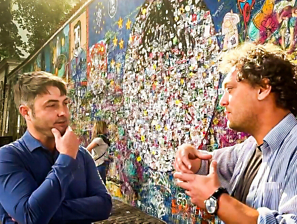
The conversation between Lukas and Jakub offered unique insights into the monument’s importance in Czech history and culture—check it out in the video at the top of the page!
To help visitors understand the era's complexity, Lukas often discusses Václav Havel, Czechoslovakia's first democratic president and a leading opponent of the Communist regime. "There is one theory why he never had children," Lukas shared. "The theory highlights a fact that Havel led a highly public life, deeply involved in the dissident movement, often facing persecution and frequent imprisonment, which brought significant instability to his life. Given these circumstances and risks, having children would have been extremely challenging."
Today, the John Lennon Wall stands as a living memorial to those who dared to dream of freedom. For O.A.T. travelers, many of whom grew up in countries where protest art was legal, understanding the wall's significance requires context. "We talk about the communist era with my travelers a lot on daily bases," Lukas said. "Therefore, the exposure to the wall is not only a brief trip in the time-machine. It is part of a continuous process, the process then leads to the proper understanding of what the communist regime was over here in former Czechoslovakia."
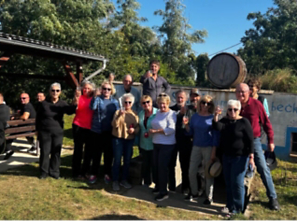
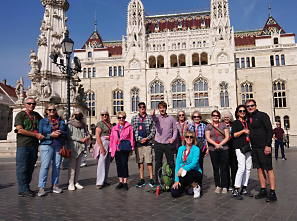
Lukas uses the John Lennon Wall to teach O.A.T. travelers about the era of Communist rule
over Czechoslovakia.
The wall continues to evolve, with new artwork and messages appearing regularly, though now without the risk of persecution. It serves as a powerful reminder of art's role in resistance and the enduring human spirit's drive toward freedom.
Check out the John Lennon Wall during your free time to explore in Prague during our Jewels of Bohemia: Czech Republic, Slovakia & Hungary adventure.


