
While we can’t guarantee a seat on the famed Hello Kitty shinkansen, you will experience the remarkable efficiency of Japan’s bullet train between Tokyo and Kanazawa during Japan’s Cultural Treasures.
In spite of the experiences of Steve Martin and John Candy in the 1987 road trip film, Planes, Trains and Automobiles, innovations in transportation have been the driving force in transforming society. By closing the distances between far-flung locales, the introduction of things like Roman roads, steam powered trains, and airplanes made travel accessible to the masses as never before. Not all of them lived up to expectations, of course. Things like dirigibles, Concordes, and even personal Segways shone brightly for a brief period of time before fading from memory.
One that continues to surpass expectations is the shinkansen, Japan’s legendary bullet train. That pair of mismatched strangers in John Hughes’ classic comedy certainly would have been home for the holidays with time to spare if they had taken the shinkansen. Even today, Japan’s high-speed trains are considered one of the fastest, safest, most comfortable, and most efficient ways to travel in the world.
Their global reputation for speed and excellence is even more impressive when you realize the shinkansen has been around for more than half a century. Introduced to coincide with the Tokyo Olympics, the world’s first bullet train was launched on October 1, 1964, taking passengers from Tokyo to Osaka just a few days ahead of opening ceremonies.
But compared to planes, don’t trains have a poor “track” record?
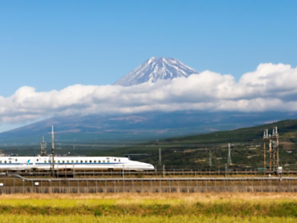
In a classic example of Japan’s many contrasts, the cutting-edge shinkansen travels past the natural wonder of Mt. Fuji.
Haven’t you always heard that air travel is the safest form of transport? It’s always backed up with statistics comparing the low number of plane crashes with train and automobile accidents. But Japan’s bullet trains shatter that assumption. In the 60 years since its launch, more than 10 billion passengers have ridden on the shinkansen—and there has not been a single recorded passenger fatality or injury caused by derailment or collision. Zero.
The reliability of the shinkansen is unparalleled. In places like Boston, where commuting using public transportation is plagued with daily delays and breakdowns, the efficiency and punctuality of Japan’s shinkansen trains is difficult to process. But Japan takes such pride in punctuality that a train departing the platform too early would be a national headline. In fact, when one shinkansen left the platform 20 seconds earlier than scheduled in 2017, the company publicly apologized for the mistake and any inconvenience it may have caused. And on the rare occasion when a train is late, you probably won’t even notice it. The average delay time for the shinkansen—if it happens at all—is under one minute. That’s across all routes and in all weather. Delays due to natural disasters are even factored into the equation. How is that even possible?
As you can imagine, an earthquake will disrupt power sources, even the power that feeds the mighty bullet trains. But thanks to a new lithium-iron battery developed in 2019, Japan’s bullet trains are able to run on an independent power source that allow them to continue running slowly but steadily or to reach the safety of a tunnel if necessary.
OK, it’s reliable. But how fast is it?
Japan’s inaugural shinkansen in 1964 traveled at 127 miles per hour—at the time, this was the fastest train the world had ever seen. The bullet trains currently in operation can reach top speeds of 199 mph. Similar bullet trains are now in operation in various parts of the globe, of course. But Japan is actively pursuing technological developments in high-speed trains. In 2015, Japan Railways Group (JR) broke the world railway speed record once again with a maglev (magnetic levitation) train they were testing that reached a speed of 375 mph. The country has plans to have a full network of maglev trains up and running in a few years.
There are currently some maglev trains in operation in China and South Korea, but when Japan’s maglev trains become fully operational, they will be much faster. For example, Japan’s maglev is expected to cut travel time between Tokyo and Nagoya, which currently takes 90 minutes by shinkansen, to 40 minutes—faster than it takes to fly between the two cities.
Enjoy special themed trains and catch the “shinkansen kiss”
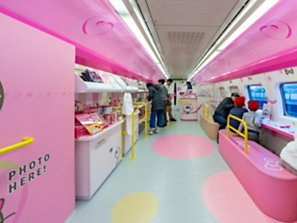
The interior of the Hello Kitty shinkansen is as vibrant as the outside.
As if having one of the fastest, most efficient, and seamlessly run railway systems in the world isn’t enough, Japan kicks things up a notch with a series of unique themed trains to enhance the journey. One of Japan’s most famous characters even has her own bullet train—there’s no mistaking the brightly colored pink and white Hello Kitty shinkansen as she pulls into the station. You may have caught a glimpse of it in the recent Brad Pitt action comedy, Bullet Train, which includes scenes filmed in one of the Hello Kitty passenger cars—along with several other nods to Japanese culture.
Other themed rail journeys include a sightseeing train featuring Kuro-chan the black dog, an all-yellow Pokémon themed train with a Pikachu playroom, and a very realistic Thomas the Tank Engine train. The Kishi Station in Wakayama even has a feline stationmaster—yes, a real cat, who wears a jaunty hat on the job while waiting for the cat-themed train to pull into the station. When the most recent to hold the title, named Nitama, passed away at age 15 in November 2025, 500 people attended her funeral.

While Nitama sadly passed away in 2025, the famed feline stationmaster is likely to have a successor.
But there’s something else about the shinkansen that’s been attracting train enthusiasts and those in the know for decades—it’s called the shinkansen kiss. It was even mentioned on CNN as one of the most charming quirks of Japanese railway culture. What is it? The “kiss” happens when two bullet trains approach each other in opposite directions on the same track and connect seamlessly nose-to-nose. Some call it a symbol of Japan’s dedication to precision and aesthetics, but it really is a rather poetic moment watching the sleek, aerodynamic fronts of these futuristic looking trains come together and align with perfect precision.
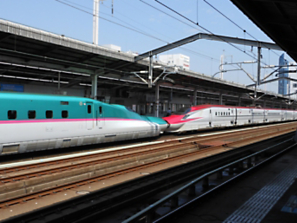
For any other trains willing to attempt this, it might be a kiss of death.
While it happens in a few stations, the northern city of Morioka is considered the best spot to observe the “kiss,” as this one involves the pairing of red and green trains—and even though it occurs up to 17 times a day, there are usually clusters of families, photographers, and train enthusiasts waiting on the platform for the magic moment!
A few more fascinating facts about planes, trains, and automobiles
See how modern marvels like the shinkansen contrast with Japan’s cherished ancient traditions during Japan’s Cultural Treasures.
Purr-adise Found
Where in the world can cat fanciers find islands populated with more felines than people?
Soak it In: The Art of Forest Bathing—Japan's Natural Stress Relief
Whether seeking stress relief, immune system support, or simply a moment of peace in nature's embrace, forest bathing offers a scientifically validated path to wellness that bridges ancient wisdom with modern needs.
Parting Shots: The Art of Japanese Death Poems
The Japanese tradition of "Death Poems"—or jisei—were a creative means of accepting death and often beautiful reminders to cherish life.
Get The Inside Scoop On...
Like what you see here? Receive weekly updates right in your inbox.
inside-scoopArticles In This Edition

Bon Appetit in Vietnam

Japan’s Magic Bullet, and More Fun with Planes, Trains & Automobiles

No Plane? No Problem: Get on the Bus

Time Delay

Top 10: Our Favorite UNESCO World Heritage Sites

Wonder No More?