In the video above, ascend to the ruins of Delphi with Androniki Stavroulaki, Trip Experience Leader on Hidden Gems of the Dalmatian Coast & Greece, to learn how the ancient Greeks revered it as a font of divine prophecy, and to take in the breathtaking mountain views that can still be enjoyed today.
As Trip Experience Leader Androniki "Niki" Stavroulaki states in her video, Delphi is among the most important ancient sites in Greece, with a stunning location to match. According to legend, this is where Apollo, god of the sun and truth, slew the serpent Python and took control of the Delphic Oracle from Gaia, the earth goddess. The ancients believed Delphi to be the center of the Earth, with the dragon protecting the world’s omphalos, or navel.
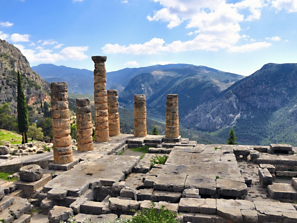
Citizens and dignitaries from throughout the ancient world sought prophecies from the Temple of Apollo.
The Oracle, always a woman, was called Pythia, because it was believed that the vapors that sent her into a prophetic trance rose from Python’s corpse. Today, it’s speculated that the Oracle’s trances were caused by breathing ethylene gas rising from a fissure in the earth. In her trance, Pythia would mutter nonsense that was then interpreted into prophecy by the temple’s priests. (Learn more about how mysterious vapors put the "high" in high priestess.)
Citizens from all over the Hellenic world came to consult the Oracle once a month, with the richest visitors skipping the line by giving lavish gifts to Apollo’s temple. Pythia’s prophecies were so in demand that the historian Plutarch, who was also a priest at the temple, wrote that eventually there were three Oracles: two to work in shifts and a spare in case the others needed a break.
The Oracle was abandoned after an earthquake in 373 BC, and contemporary research has shown that the temple is located on top of two fault lines, suggesting the possibility that the quake closed off the fissures releasing the ethylene gas that allowed the Oracle to prognosticate. The Oracle’s last recorded response in 362 BC stated "the temple has fallen." The rise of Christianity also contributed to the Oracle’s demise.
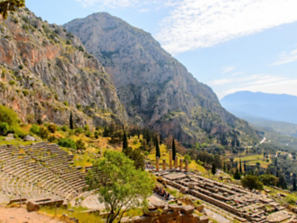
Delphi is also home to an amphitheater that offers commanding views of the entire site.
Today, the incredibly well-preserved ruins demonstrate how the ancient Greeks seamlessly blended architecture with the surrounding natural environment. As visitors approach the archaeological site via a path called the Sacred Way—just as the ancients did—one can almost imagine the profound sense of anticipation those early truth-seekers must have felt before communicating directly with the gods.
Visit the UNESCO World Heritage Site of Delphi during O.A.T.’s Hidden Gems of the Dalmatian Coast & Greece Small Ship Adventure.


