
Carol and her family took advantage of their early arrival to explore Tsukiji Market on a foodie tour—which set the stage for their culinary discoveries during Japan’s Cultural Treasures.
Carol and her family took advantage of their early arrival to explore Tsukiji Market on a foodie tour—which set the stage for their culinary discoveries during Japan’s Cultural Treasures.
By Carol L. Bowman, 19-time traveler from Spring, TX
It has been said that every traveler should explore Japan at least once in a lifetime. I hate to admit it, but somehow Japan never showed up on my destination radar until after I had visited 120 other countries. When I finally made the trip, I couldn’t get enough of it.
The majority of first-time visitors to Japan start their adventure in Tokyo, as we did. Exposure to a conservative culture whose traditions and customs, steeped in thousands of years of history, unfolds as completely different from anywhere else in the world. Tokyo pulsates with excitement and offers a magical blend of ancient sites that command respect and reverence and modern neighborhoods that electrify with neon lights and edgy technology. No matter what the traveler includes on "must see" itineraries, one thing is for sure: everyone needs to eat. Traditional Japanese food, known as washoku, with its tantalizing ingredients, strange pickled vegetables, exotic sushi, soups, and sashimi requires at least a sketchy prefix of what to expect.
O.A.T. assisted us in airport pick-up and hotel arrangements to arrive in Tokyo a few days before joining our small group adventure, Japan’s Cultural Treasures. It’s a great way to shake off jet lag, and explore the city independently. My husband and I, our adult son, and his wife traveled early for two things: to learn about and taste basic, Japanese culinary delights and to attend a Kabuki Theater performance.
Foodie Tour of Tokyo’s Tsukiji Outer Market
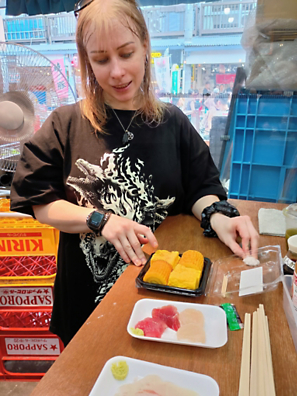
Tour guide Chiara introduced Japanese omelet and sashimi.
A myriad of Foodie Tour companies exist in Tokyo, but we booked City Unscripted beforehand and personalized our private tour with a guide. Our hotel, Vista Tokyo Tsukiji was located within a five-minute walk from the renowned Tsukiji Outer Market. Our guide, Chiara Miske, a funky, fun-loving transplant from Berlin to Tokyo 14 years ago, knew Japanese food, the local lingo, the merchants, Japanese dining etiquette and she spoke perfect English; an ideal match for our family.
The Tsukiji Fish Market, located in the neighborhood of Chuo City since 1935, once had the distinction of being the largest seafood market in the world. Constructed on reclaimed land from Tokyo Bay after the Great Kanto earthquake of 1923, the Outer Market serves as the retail subdivision, while the wholesale section with its lively 5am tuna auction for fishermen to sell their daily catch, moved a few blocks to Toyosi Market in 2018.
Open from 5am-2pm, closed Wednesdays and Sundays, the Outer Market provides a labyrinth of narrow streets, vendors lining both sides, where chefs from local restaurants navigate through the maze to shop for the freshest ingredients. The environment whets the novice visitor’s appetite for the unique, Japanese culinary experiences to come. Mornings, when the streets awaken with lively activity and the food choices are plentiful and fresh, remain the favorite time to wander around.
With taste buds primed, we arrived for our fun, street-foodie event under Chiara’s watchful eye at 9am. Since we had pre-paid a set amount, the company allotted our guide a generous budget to purchase food we wanted to sample and strange treats she knew we’d encounter at meals.
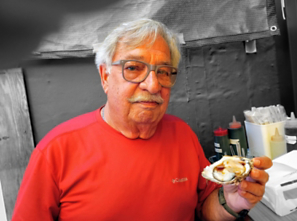
Ernie slurped an oyster "the size of his hand."
As we meandered through the crowded market streets, we saw Japanese customers standing at high-rise tables in front of food stalls, eating raw fish, seafood, or vegetable tempura, and drinking sake or beer for breakfast. My husband, Ernie, joined the throng with a fresh oyster, the size of his hand, as he slurped it and let the succulent mollusk slide down his throat. Chiara guided us to a stand that she knew sold only top-grade, A-5 Wagyu beef on a skewer, and after the vendor grilled it to perfection, my son smiled after every bite.
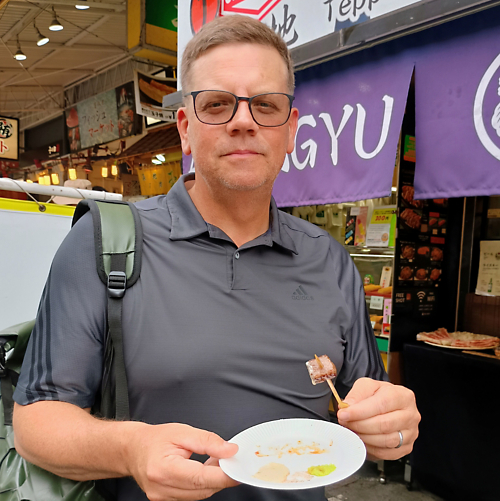
Carol’s son savored every last bit of a wagyu beef skewer.
I couldn’t imagine trying to maneuver this overwhelming scene without the wisdom and information of a knowledgeable guide. Chiara introduced us to sashimi—raw fish—tuna, red snapper and salmon, and nigiri—Japanese style sushi with thinly sliced, oblong pieces of raw shellfish, hand-pressed over white rice. We feasted on yomagi mochi—sticky rice cakes filled with red bean paste, tamagoyaki—a Japanese omelet, with folded layers of seasoned scrambled eggs, and tako tamago—small octopus wrapped around quail eggs.
We learned about karebushi—dried bonito fish flakes; bonitos are classified as medium predatory fish in the same family as tuna and mackerel. The flakes are used to make dashi—a clear fish stock used as an essential ingredient in Japanese cuisine. We sampled one of the many craft beers for which Japanese have a thirst and drank shots of sake before 10am. Due to the volcanic soil, the enormous size of fruits and vegetables shocked the senses; peaches the size of large grapefruits, gigantic cucumbers and beets. We bought bags of dried seaweed sprinkled with sesame, rice cake snacks and wasabi coated beans to munch on in Japan and to bring home.
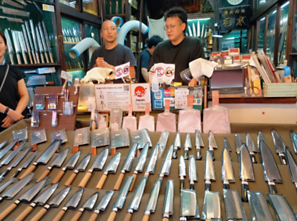
A traditional Japanese knife makes for an heirloom-worthy souvenir.
Specialty shops selling tea sets, pottery and the centuries-old skill of Japanese cutlery and exquisite knives popped up, but we could have never found the stalls without Chiara’s infinite map of the whole area in her head. My son and his wife found sharp steel treasures in a knife shop that has been at this same location for over 100 years.
Fine-dining restaurants, some hidden away in small alleyways, dotted the marketplace. Ernie and I made a mental note of one of the unique eateries that specialized in Wagyu beef. When we returned there for dinner later in the week, the streets were deserted, dark, and spooky. The vibrancy of daytime activities felt like a ghostly memory, but the tender beef melted in our mouths like butter. Despite only a few footsteps heard from other people going to dinner, we felt not a moment of fear. An aura of safety permeated. It was a peaceful, unfamiliar feeling.
The Ins and Outs of Tokyo’s Kabuki Theater
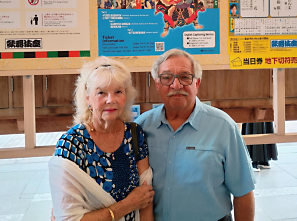
Carol and Ernie outside the Kabuki-za theater.
We wanted to squeeze our extra day with Japanese culture activities not included in the O.A.T. itinerary. Our O.A.T. leader, Kaori Sakai, helped us with information to obtain same-day tickets for Kabuki-za Theater, located within walking distance from our central location.
Kabuki Theater, recognized internationally as one of Japan’s most important offerings to the performing arts, has been a tradition of Japanese culture for over 400 years. The three characters of the word, "ka-bu-ki" literally reflect its components: "ka" means song, "bu" refers to dance, and "ki" means acting skill.
Three acts make-up Kabuki-za Theater. In Part I, performers enact a domestic drama set in the Edo area, (1603-1868) plus dance and begins at 11:00am; Part 2 also reflects drama in the Edo era, plus dance at 2:30pm and Part 3 provides a modernized version of kabuki drama, without dance at 6:15pm. Although the patron can attend all three parts, I advise the available single-act only. The foreigner, unfamiliar with nuances of Japanese language and history, can enjoy the flavor and spectacle of Kabuki in this one-act performance. You can purchase English captioning service for the single-act for 1000 Yen [a little under $7USD], cash only.
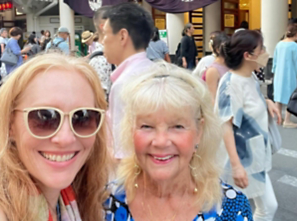
Carol and her daughter-in-law amidst a Broadway-like atmosphere.
To obtain non-reserved tickets for Same Day, Single-Act Performance, go to the Single-Act Box-Office after 10:00 am, located to the left of the theater’s main entrance. All seats for this type of first-come, first serve ticket cost 1000 Yen. Beware that the spacing between the rows of these seats, located in a special section on the fourth floor of the theater, is extremely narrow. Anyone over 5’5" will have knees screaming. Get to the theater early to be first in line to grab front row seats in the designated area.
The theater itself, located on one of Tokyo’s busy, wide avenues, stands out, with its traditional Japanese architecture, between modern, gleaming skyscrapers. Waiting outside the theater for the performance felt like attending a Broadway play in New York. Excited patrons, dressed-up for the event, milled around outside until the doors opened. Once we entered Kabuki-za Theater, the spirit of Japanese tradition came alive.
My advice to anyone traveling with O.A.T. to faraway places: Go a day or two early, become acclimated to the surroundings, feel the culture and be ready to take on the rigors of travel.
Take Carol’s advice and take extra time to explore Tokyo before Japan’s Cultural Treasures. For more details on how you can personalize any O.A.T. adventure, click here.
Toilet Training
Join traveler Stephen C. as he compares the differences in Japanese toilets after making a return trip 59 years after his first visit.
My Reunion in Boston with a Trip Experience Leader
When Bob’s Japanese Trip Experience Leader visited O.A.T. headquarters, the two seized the opportunity.
Japan Takes the Stage
In honor of World Theater Day, learn about Japanese performing arts.
Get The Inside Scoop On...
Like what you see here? Receive weekly updates right in your inbox.
inside-scoopArticles In This Edition

Communing with Gods at the Center of the Earth

Culture Club

Early Arrival, Extra Culture: Street Food & Kabuki in Tokyo

On Trend: Top 10 Journeys by Land, Sea & River

The Culture of Dirt

Where in the World?