
During Japan’s Cultural Treasures, this sushi chef was one of many locals who appreciated Bob’s “baseball card diplomacy,” celebrating our countries’ shared love of America’s “national pastime.”
By Bob Brady, 23-time traveler from Braintree, MA
One of the most rewarding features of foreign travel is interacting with local people. In many instances however, one may need to work around the challenge of communicating where neither speaks the other’s native tongue. In advance of my international travels, I try to find a nonverbal “tool” that would break through any language barrier. In the case of Japan, our two countries’ love of the sport of baseball provided me with such a device that met with success during my time in the “Land of the Rising Sun.”
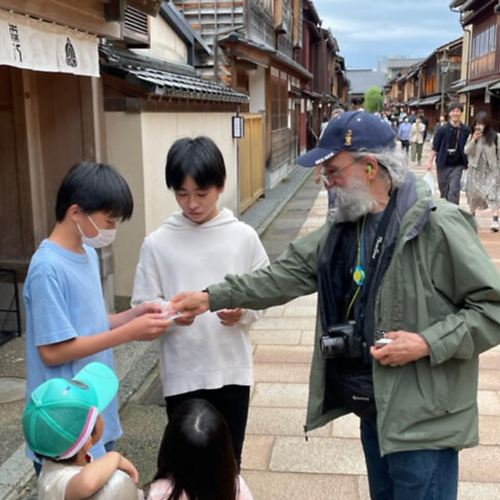
Bob’s baseball cards facilitated connections with locals of all ages.
Japan’s interest in our “national pastime” can be traced back to the 1870s when the sport was introduced by visiting American scholars to university and high school students there. Amateur leagues eventually formed and traveling U.S. major league ball clubs and barnstorming All Star teams increased interest by performing exhibitions. A highlight of these international visits happened in 1934 when an All Star team featuring Babe Ruth and Lou Gehrig competed against local opposition. The sport quickly developed a professional level.
After being interrupted by World War II, baseball increased in popularity in the post war years as illustrated by the formation of league play similar to the American game. U.S. professionals, referred to as gaijins (foreigners or outsiders) began to appear on the rosters of Japanese ball clubs to the extent that rules capping their numbers were instituted. The flow of Nipponese ballplayers to America also accelerated, with players such as Ichiro Suzuki and Shohei Ohtani among those imports achieving fame and All Star status on our shores.
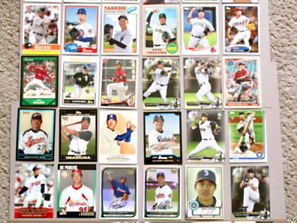
In preparation for his trip, Bob attended baseball card shows in search of Japanese players.
As a kid, I collected baseball cards up to my teens. Those that “mom didn’t throw out,” ended up with a younger brother. Having some familiarity with the hobby, I came upon the idea of attending local baseball card shows where collectors engage in selling their excess stock. I sought out cardboard images of Japanese players performing for U.S. teams. My intent was to accumulate a sufficient supply of such cards to bring on my upcoming O.A.T. trip to hand out as “nonverbal” conversation pieces to stimulate exchanges with local fans.
After successfully acquiring an adequate inventory, I packaged the cards in transparent packets with famous Japanese ballplayers now on U.S. teams prominently displayed face up in the front and back and with lesser lights inserted in between. I began my experiment shortly upon arriving at Narita Airport in Tokyo to begin the tour. The driver who transported me to our hotel spoke no English but immediately recognized the ballplayer images and reacted very positively when I presented him with an inaugural gift.
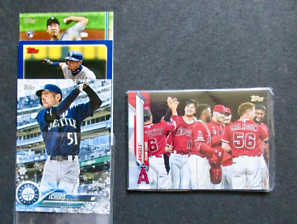
Bob created packets of cards to conveniently share with locals.
Further evidence of the future usefulness of the card packets came from viewing programming on the large hotel flat screen TV in my room. A portion of the sports programming on news broadcasts was devoted to daily updates on the performance of Shohei Ohtani in the States with the Los Angeles Angels. Dubbed the “Babe Ruth of Japan,” he excels as a pitcher and a batter and is a leading candidate for the Most Valuable Player award. And I had cards of him in my packets!
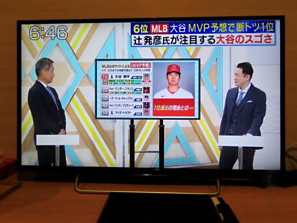
Shohei Ohtani, with the Los Angeles Angels at the time, made an appearance on Bob’s hotel TV.
I had many wonderful encounters as I handed out my cards to children and adults alike. Baseball seemed to provide a universal way to communicate. Mutually reciting the names of the players on the cards and making baseball-playing gestures brought smiles to our faces. Even a noted sushi chef became temporarily distracted from our class in that culinary art form to transform into a baseball fan!
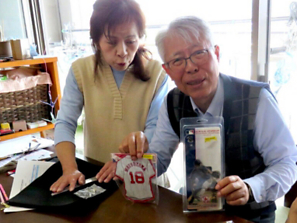
Bob brought special baseball mementoes for the family who hosted his group in Kanazawa—who happened to share the last name of a famous pitcher.
At my group’s home-hosted event in Kanazawa, I brought along not only the card packets but also other baseball mementos that were well received by Seiichi and his wife, Junko. Their last name of “Maeda” sounded familiar to me and I quickly realized that the surname was identical to that of Kenta Maeda, a pitcher from Osaka, Japan who’d achieved prominence with the Los Angeles Dodgers. I hastily searched my stash of cards but was unable to come up with one of him to hand to our hosts. However, upon returning home, I found a card of the Dodgers’ hurler and mailed it to the Maedas to thank them for their hospitality. Seiichi emailed me back acknowledging receiving the namesake card and mentioning that he was able to follow his exploits and other Japanese ballplayers in the U.S. by watching Major League Baseball broadcasts carried on Japanese television.
Other major U.S. sports also provide a similar opportunity for sports card diplomacy. Players from all over the world have populated America’s professional football, basketball and hockey leagues, both on the field and in collectible card sets. Consider undertaking your own personal “diplomatic mission” on an upcoming O.A.T. trip!
Perhaps you’ll engage in “baseball card diplomacy” when connecting with locals during Japan’s Cultural Treasures.
Early Arrival, Extra Culture: Street Food & Kabuki in Tokyo
Read a traveler’s advice on making the most of an early arrival in Tokyo, Japan.
My Reunion in Boston with a Trip Experience Leader
When Bob’s Japanese Trip Experience Leader visited O.A.T. headquarters, the two seized the opportunity.
Exploring My Granddaughter’s Artistic Passions
Learn about this grandmother and granddaughter duo’s inspiring trip to Japan.
Get The Inside Scoop On...
Like what you see here? Receive weekly updates right in your inbox.
inside-scoopArticles In This Edition

13 Markets & Local Specialties with Our Experts

Engaging in Baseball Card Diplomacy in Japan

Head Case

Sugar & Spice: Savoring the Flavors of Turkey

Where in the World?