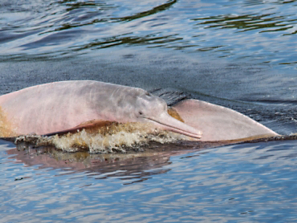
Few experiences in the Amazon are more magical than witnessing pink river dolphins in their natural environment. Intelligent, playful, and curious, these flamboyant freshwater mammals are capable of leaping out of the water with the grace of Olympic gymnasts while navigating the Amazon and its winding tributaries in search of prey. But like the Amazon itself, much of our knowledge about these near-mythical creatures remains shrouded in mystery.
Of the five freshwater species of dolphins, Amazon pink river dolphins are the largest. Known by the natives as boto, pink river dolphins can reach nine feet in length and weigh up to 400 pounds, with a lifespan in the wild believed to be up to 30 years. And of all the species of dolphins, they are surely the most distinctive.
When is a dolphin not a dolphin?
All dolphins and porpoises are actually cetaceans that are classified as toothed whales—but however they’re classified, Amazon pink river dolphins are unlike any of them. Along with its prominent hump, beady eyes, and lumpy head, it has an elongated snout that always seems to be grinning—although that skinny snout contains 25 to 28 pairs of sharp teeth that can crack the shells of river turtles. Unlike all other dolphins, the vertebrae in their necks are unfused, giving them much greater flexibility when they’re maneuvering—that, and their ability to swim forward with one flipper and paddle backwards with the other lets them turn on a dime.
That’s using your melon
Their eyes may be small and beady, but they have decent vision above and below the water. Perfect vision isn’t necessary anyway, as they rely on echolocation to navigate the dark waters of the Amazon in search of prey. Their highly developed echolocation system is housed in the dolphin’s bulging forehead, known as their "melon" (really, that’s what it’s called!). Researchers think the dolphins can actually change the shape of their melon when they need to adjust the echolocation’s pulse direction and its frequency—which is very weird. But we told you they were smart. And they do, in fact, have unusually large brains (with 40% more capacity than humans!) and are capable of problem-solving.

No creatures in the amazon hunt the pink river dolphin, making them apex predators.
All this built-in technology serves a purpose, of course. Other dolphin species may be faster, but a pink river dolphin’s agility is unparalleled. While caymans, jaguars, and anacondas may salivate when they spot one, pink river dolphins really have no natural predators. They are, in fact, apex predators themselves.
Food and flood control
They’re really in their element during the Amazon’s wet season, when water levels rise up to 40 feet, flooding the surrounding forests. That’s prime dining time for the nimble freshwater mammals, who easily navigate the murky waters to reach a smorgasbord of tasty prey hiding in the dense tangle of submerged branches and vines.
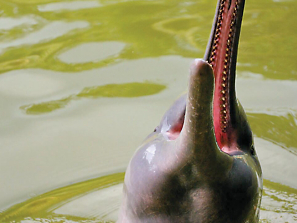
Those sharp teeth are designed to chow down on more than 50 fish species—even piranhas!
The diet of pink river dolphins is the most diverse of the toothed whales. They chow down on more than 50 fish species (including piranhas!), along with shrimp, crabs, turtles, and more. Because they have two types of teeth—sharp and pointy ones up front for catching prey, and flatter ones in the back for crunching it up before swallowing—the Amazon is pretty much an endless buffet.
So, is it their diet that keeps these dolphins in the pink?
The reason for the distinctive pink color of these Barbie dolls of the Amazon isn’t as simple as one would think. Certainly, the abundance of blood capillaries near the skin’s surface (which grows more translucent as they age) is part of it. But the precise reason isn’t fully understood, and it seems that genetics, diet, and environmental factors also play a role. They do eat a diet high in carotenoids, the organic pigment responsible for the pink color of flamingos. Some think hormones, stress, and other factors are at play.
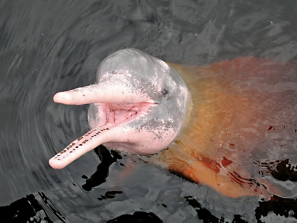
These dolphins are actually born gray—not pink—and scientists still don’t understand why they change colors.
We know they weren’t born pink. They’re born gray and slowly turn pink as they age. Males are much pinker than their female counterparts—it seems the ladies prefer the males with the brightest pink coloring. Another theory has it that pink scar tissue forms after males get into fights with other males—which serves as proof of a male’s aggressive behavior and worthiness to attract a female. So, to achieve more "pinkness" males go out looking for fights. Other typical "male" behavior includes waving things like floating branches or live turtles in front of a female to get their attention during mating season—if it doesn’t work, he might up his game by twirling it around and smacking it on the surface of the water.

These yellow-spotted Amazon turtles better watch out if a male pink river dolphin wants to impress a potential mate!
But the real head-scratcher relating to the pink coloration might be that when dolphins get excited, some of them flush and turn a brighter pink—weirdly similar to humans!
Flipper with a split personality
Generally speaking, Amazon pink river dolphins are solitary, very shy creatures. On the other hand, they are often seen gathering in groups during feeding time (perhaps to catch up on the local gossip) before going their separate ways. In fact, their solitary nature is why researchers find it so difficult to calculate how many pink river dolphins exist today. Since they don’t swim together in large groups and the river basins where they hang out are so dark and murky, their actual numbers are murky as well.

The river basins of the Amazon are often dark and murky, making it difficult for researchers to get an accurate gauge of how many pink dolphins there are.
But while pink river dolphins are generally elusive and shy, they seem curiously drawn to people, especially local children along the banks of the river. They also exhibit playful behavior, like tossing leaves or twigs with their snouts, leaping out of the water, or swimming up to boats to see what’s going on. They’ve even been known to snatch the oars away from distracted fishermen. And while it may sound fishy, more than one Amazonian tribe has insisted that stories of pink dolphins saving people from drowning by bringing them to shore are not legends. There already enough legends associated with these charismatic, gentle souls …
Guardians of the Amazonian galaxy
The elusive nature and enchanting personality of the boto has made it an important part of traditional Amazonian folklore. Many indigenous tribes consider them shapeshifters called encantados—magical beings who live as dolphins in the water by day and then turn into handsome young men who leave the river at night and stalk the rainforest under the bright light of the moon to seduce young girls. They are said to disguise themselves by wearing colorful clothes—with a white hat covering their blowhole—and always return to the river before dawn. Concerned parents warn their daughters not to be deceived by these wily shapeshifters. (Hey, if that’s what it takes to keep them out of trouble, we’re all for it!)
Another legend forbids the killing or eating of botos—or even gazing into their eyes for fear of bad luck. The only way to ensure abundant fishing, it insists, is to make peace with botos, who are considered the "guardians of the river."
Shapeshifters or not, an encounter with an Amazon pink river dolphin is pure magic.
Get the chance to see an Amazon pink river dolphin with your own eyes during O.A.T.’s New! Peru’s Nazca Lines & Amazon Rain Forest adventure.