
Snaking across 13,000 miles of mountains and deserts, the Great Wall represents humanity's most ambitious construction project—and it can be explored on O.A.T.’s New! China’s Imperial Cities, Natural Splendor & Modern Marvels adventure.
Snaking across 13,000 miles of mountains and deserts, the Great Wall represents humanity's most ambitious construction project—and it can be explored on O.A.T.’s New! China’s Imperial Cities, Natural Splendor & Modern Marvels adventure.
From the dragon-like spine of the Great Wall snaking across mountain ridges to the concrete colossus of the Three Gorges Dam taming the mighty Yangtze, China's landscape tells a story of human ambition forged in stone and steel.
These two engineering marvels, separated by millennia yet united in their audacity, showcase how the Middle Kingdom has long dared to reshape nature itself. While one was built to keep invaders out and the other to harness water's power, both monuments share a common thread: With enough determination, even the impossible can become possible.
Stone sentinels
The Great Wall began its journey not as the unified structure tourists climb today, but as scattered defensive walls built by warring states as early as the seventh century BC. It wasn't until Emperor Qin Shi Huang unified China in 221 BC that these fragments were connected into something grander. Talk about a home improvement project that got out of hand—what started as simple fortifications evolved into humanity's longest architectural feat.

Thanks to all of the poor souls who perished building it, the Great Wall of China is often called the "longest cemetery on Earth."
Over subsequent dynasties, particularly during the Ming period (1368-1644 AD), the wall grew and transformed. Builders hauled millions of tons of rammed earth, stone, and brick across treacherous terrain, creating a barrier that stretched over 13,000 miles when all its branches and secondary sections are included. The main wall alone spans roughly 5,500 miles—long enough to stretch from New York to Buenos Aires.
But the Great Wall was more than just a barrier. It served as an ancient highway system, complete with watchtowers doubling as post offices and signal fires that could relay messages across the empire faster than any horse. Garrison towns sprouted along its length, creating a militarized zone that was part fortress, part trade route, and part population control system.
Modern marvel
Fast forward to 1994, when China began constructing what many call the "Great Wall across the Yangtze River." The Three Gorges Dam represents a different kind of conquest—not over human invaders, but over one of the world's most powerful rivers. Completed in 2012, this concrete giant stretches 1.4 miles across and towers 607 feet high, making it the world's largest power station by installed capacity.
Where ancient workers moved earth with baskets and wheelbarrows, modern engineers deployed satellite positioning systems and computer modeling. The dam required 27.2 million cubic meters of concrete—enough to build a sidewalk around the Earth at the equator 33 times. Its 32 main turbine generators can produce 22,500 megawatts of electricity, powering millions of homes while helping China reduce its coal dependency.
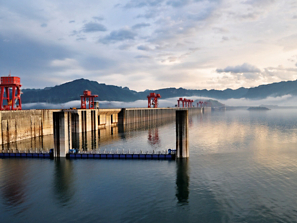
The Three Gorges Dam is often called the "Great Wall across the Yangtze River."
The reservoir created by the dam stretches 410 miles upstream, transforming the Yangtze into what amounts to an inland sea. This massive lake allows 10,000-ton ships to navigate 1,500 miles inland to Chongqing, turning an interior city into a major port. It's as if ancient wall builders had figured out how to make the Yellow Sea reach Beijing.
Counting costs
Both projects extracted tremendous human costs. Historical estimates suggest hundreds of thousands, perhaps millions, died building the Great Wall over centuries—so many that it's sometimes called the "longest cemetery on Earth." Bodies of workers were often buried within the wall itself, leading to legends that their bones became part of the mortar.
The Three Gorges Dam displaced 1.3 million people, submerging 13 cities, 140 towns, and 1,350 villages. Ancient temples, archaeological sites, and entire communities vanished beneath the rising waters. Critics argue that just as the Great Wall couldn't ultimately keep out the Mongols, the dam might not prevent the floods it was designed to control, while potentially creating new environmental challenges.
Yet both projects also brought undeniable benefits. The Great Wall provided security and facilitated trade along the Silk Road. The Three Gorges Dam generates clean energy equivalent to burning 31 million tons of coal annually and has helped control devastating floods that historically claimed thousands of lives.
Engineering evolution
The construction techniques reveal how Chinese engineering has evolved while maintaining certain constants. Great Wall builders developed innovative methods like rammed earth construction and specialized mortars using rice flour. They created standardized brick sizes and developed logistics systems to move materials across impossible terrain.
Three Gorges engineers faced equally daunting challenges, diverting the entire Yangtze River during construction and developing new concrete formulas to withstand enormous pressures. Both projects required not just technical innovation but organizational genius—coordinating massive workforces across vast distances and hostile environments.
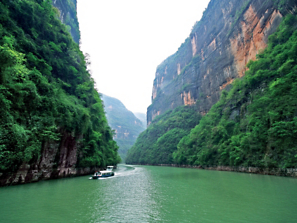
The Three Gorges Dam has helped control devastating floods from the Yangtze River that historically claimed thousands of lives.
What hasn't changed is the sheer audacity of vision. Whether moving mountains to build a wall or moving rivers to generate power, these projects reflect a civilization willing to attempt what others might consider impossible. Both monuments embody the Chinese proverb: "The foolish man moves mountains."
Living monuments
Today, both structures continue evolving in purpose and meaning. The Great Wall has transformed from military fortification to cultural icon and tourist magnet, drawing millions of visitors annually. UNESCO World Heritage designation has spurred conservation efforts, though many remote sections continue crumbling back into the earth from which they arose.
The Three Gorges Dam operates as a living piece of infrastructure, its turbines spinning out electricity while its ship locks raise and lower vessels in aquatic elevators. Tour boats filled with visitors cruise where ancient towns once stood, while engineers constantly monitor and adjust operations to balance power generation, flood control, and environmental concerns.
Both monuments remind us that China's approach to engineering has always been about more than solving immediate problems. These are statements written in stone and concrete, declarations that human ambition can reshape geography itself. As China continues its rapid development, these two great walls—one keeping people out, the other holding water back—are impressive examples of what happens when a civilization decides that even nature's boundaries are negotiable.
Marvel at the Great Wall's ancient watchtowers and cruise through the Three Gorges Dam's massive locks during our New! China’s Imperial Cities, Natural Splendor & Modern Marvels adventure.
Get The Inside Scoop On...
Like what you see here? Receive weekly updates right in your inbox.
inside-scoopArticles In This Edition

10 Journeys with O.A.T. and Grand Circle that Visit Ancient Feats of Engineering

Empire Building

Stone Dragons and Concrete Giants: China's Two "Great Walls"

Toilet Training

Where in the World?