
Amelia Earhart in 1936, almost a decade after her she historically set down in a cow field just north of Derry—a location travelers visit during O.A.T.’s Irish Adventure: Dublin, Belfast & the Northwest Counties adventure.
Amelia Earhart in 1936, almost a decade after her she historically set down in a cow field just north of Derry—a location travelers visit during O.A.T.’s Irish Adventure: Dublin, Belfast & the Northwest Counties adventure.
Nearly a century after her mysterious disappearance over the Pacific Ocean, Amelia Earhart's story remains one of history's most famously unsolved mysteries. But that may soon change—the location of the aviation pioneer who dared to dream beyond the constraints of her era may have been captured on satellite imagery.

Travelers on O.A.T.’s Irish Adventure: Dublin, Belfast & the Northwest Counties adventure will visit Derry—where Amelia Earhart landed during her historic 1928 flight.
Recently, Purdue Research Foundation and the Archaeological Legacy Institute announced an ambitious effort to locate her Lockheed Electra 10E aircraft in a remote Pacific Island lagoon where satellite photos may have pinpointed the outline of her legendary "Flying Laboratory." The expedition is slated to launch this fall.
However, the continued fascination with Earhart's fate speaks to something deeper than mere curiosity about a missing plane. Indeed, her legacy began long before she ever took to the skies. To understand why the world remains so captivated by her mystery, one must first understand the remarkable woman who refused to let others define her destiny.
Prairie roots
Born on July 24, 1897, in Atchison, Kansas, Amelia Mary Earhart entered a world where women's horizons were largely confined to home and hearth.
Her father, Edwin Earhart, was a railroad lawyer whose drinking problem created financial instability for the family. When her parents' marriage dissolved, young Amelia learned early lessons about self-reliance and resilience—qualities that would define her remarkable life.
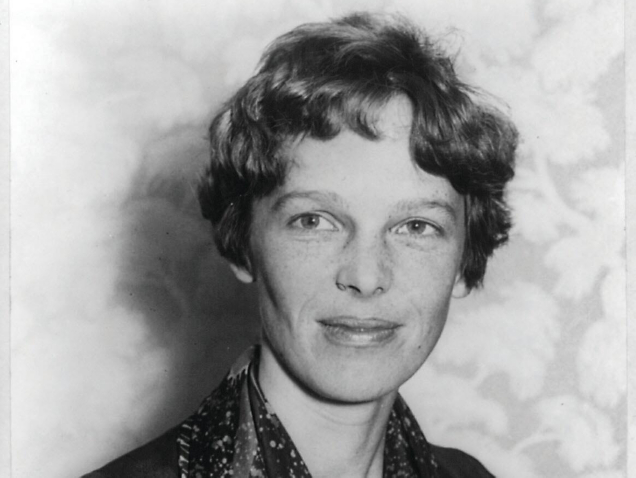
Earhart began her journey as a young woman from Kansas who refused to accept the limitations society placed on her gender.
Despite the family's struggles, Earhart's mother, Amy Otis Earhart, encouraged her daughters to pursue education and independence. Amelia excelled academically, eventually attending Ogontz School in Pennsylvania and later Columbia University, where she studied medical research.
However, her path took a dramatic turn during World War I when she witnessed wounded soldiers returning from the front lines. Moved by their suffering, she left her studies to serve as a nurse's aide at Toronto's Spadina Military Hospital, caring for wounded servicemen with the same compassionate determination that would later characterize her aviation career.
It was during this period in Toronto that fate intervened. At a local airfield, Earhart took her first airplane ride—a ten-minute flight that would forever alter her destiny. "By the time I had got two or three hundred feet off the ground, I knew I had to fly," she later recalled. The experience ignited a passion that would propel her from curious observer to aviation legend.
Taking flight
In 1921, Earhart began taking flying lessons from pioneering aviator Neta Snook, one of the few female flight instructors of the era. Within six months, she had saved enough money to purchase her first aircraft—a bright yellow Kinner Airster biplane she affectionately nicknamed "The Canary." By October 1922, she had set her first aviation record, reaching an altitude of 14,000 feet—a women's world record at the time.
But it wasn’t all "smooth sailing"—Earhart's early flying career was marked by both triumph and tragedy. She witnessed the deaths of fellow aviators, experienced her own crashes, and faced constant skepticism from those who believed flying was "no occupation for a lady." Yet she persisted, supporting her aviation pursuits through various jobs including photographer, truck driver, and social worker.
The breakthrough that would catapult Earhart to international fame came in 1928 when she was selected to be the first woman to cross the Atlantic Ocean by air. Though she served as a passenger on the flight—with pilots Wilmer Stultz and Louis Gordon handling the controls—the achievement made her an instant celebrity. Upon landing in Derry, Northern Ireland, after a 20-hour, 40-minute journey, she was greeted by cheering crowds and international acclaim.
With typical humility, Earhart downplayed her role in the historic flight: "Stultz did all the flying—had to. I was just baggage, like a sack of potatoes. Maybe someday I'll try it alone."
That "someday" would come sooner than anyone expected.
Solo success
Earhart's promise to fly solo across the Atlantic became reality on May 20, 1932—exactly five years after Charles Lindbergh's famous crossing. Piloting her red Lockheed Vega 5B, she took off from Newfoundland bound for Paris, following Lindbergh's route. However, mechanical problems and severe weather forced her to land in a pasture in Northern Ireland after nearly 15 hours in the air. Two local men were mending fences nearby and witnessed the bright red plane circling overhead and then making an awkward landing—when they first approached the plane, they asked "Have you flown far?" and Amelia replied, "Only from America".
The achievement brought her international recognition, numerous awards, and opportunities to inspire others through her writing. Her books, including "20 Hrs. 40 Min." and "The Fun of It," chronicled her aviation experiences while advocating for women's advancement in all fields. She used her celebrity status to promote aviation safety, women's rights, and educational opportunities, becoming a sought-after lecturer and role model.
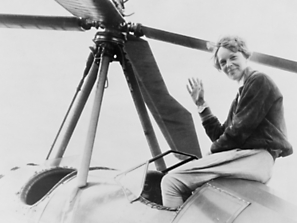
Amelia Earhart, shortly after she became the first woman to complete a solo coast-to-coast flight.
In 1931, Earhart married publisher George Palmer Putnam in what she called a "partnership" with "dual control." Putnam became her manager and strongest supporter, helping to finance her increasingly ambitious flights.
The "Flying Laboratory"
By the mid-1930s, Earhart had set multiple aviation records and was ready for her most ambitious challenge: circumnavigating the globe. With support from Purdue University—where she served as a visiting faculty member and adviser to women students—she acquired a twin-engine Lockheed Electra 10E aircraft. She dubbed the plane her "Flying Laboratory" because of its advanced navigation equipment and her intention to use the flight for scientific research and testing new aviation technologies.
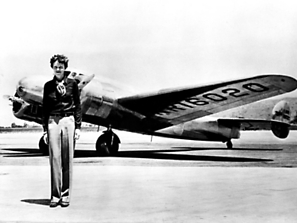
Amelia Earhart standing in front of the Lockheed Electra—or "Flying Laboratory"—in which she disappeared on July 29, 1937.
The Electra was equipped with state-of-the-art radio equipment, including a Bendix direction-finding radio system that was intended to help her navigate the vast stretches of ocean on her planned route. However, the sophisticated equipment proved challenging to operate, a factor that would play an unfortunate role in her eventual disappearance.
Earhart's first attempt at the around-the-world flight began in March 1937, flying westward from Oakland, California. However, the journey ended abruptly in Hawaii when the Electra crashed during takeoff, suffering significant damage. Undeterred, Earhart had the plane repaired and modified her route to fly eastward instead.
Final flight
On June 1, 1937, Earhart and navigator Fred Noonan departed from Miami on their second attempt to circumnavigate the globe. Over the following month, they successfully completed 22,000 miles of their journey, making stops across South America, Africa, Asia, and the Pacific. They were nearing their goal with only 7,000 miles remaining when disaster struck.
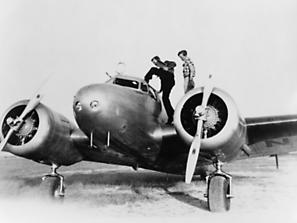
Amelia Earhart and Fred Noonan on the wing of her Lockheed L-10E Electra airplane.
On July 2, 1937, Earhart and Noonan took off from Lae, New Guinea, for what should have been a routine 2,556-mile flight to Howland Island, where the U.S. Coast Guard cutter Itasca was waiting with fuel for the next leg of their journey. The tiny island—just two miles long and one mile wide—proved impossible to locate in deteriorating weather conditions and with failing radio communications.
The last confirmed radio transmission from Earhart came at 8:43 a.m. local time: "We are on the line of position 156-137. Will repeat message. We will repeat this message on 6210 kilocycles. Wait. Listening on 6210 kilocycles. We are running north and south." Then, silence.
Endless search
As tragic as it was, the response to Earhart's disappearance demonstrated the profound impact she had made on the American public and the world during the challenging years of the Great Depression. President Franklin D. Roosevelt immediately authorized the largest search and rescue operation in U.S. history to that point, involving multiple ships and aircraft scouring 250,000 square miles of Pacific Ocean. Her husband financed his own private search efforts that continued until October 1937, spending his fortune in a desperate attempt to find his missing wife.
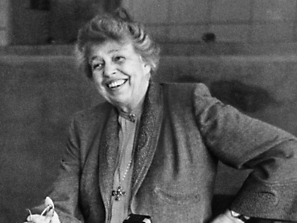
Eleanor Roosevelt, wife of President Franklin D. Roosevelt, was—like Earhart—a symbol of women's rights and progressive activism.
Today, nearly nine decades later, the mystery of Amelia Earhart continues to inspire new expeditions and theories. As aforementioned, recent efforts have focused on Nikumaroro—a remote Pacific island where researchers believe satellite imagery may have captured the remains of her Flying Laboratory buried in sand. Whether these latest efforts will finally solve aviation's greatest mystery remains to be seen, but Earhart's legacy as a trailblazer who refused to accept limits continues to inspire adventurers and dreamers around the world.
Visit Derry in Northern Ireland during O.A.T.’s Irish Adventure: Dublin, Belfast & the Northwest Counties adventure—where Earhart landed after her historic Atlantic crossing landing in 1928.
When Getting There was Half the Fun: The Golden Age of Ocean Travel
Before the advent of planes made intercontinental voyages more accessible, there was a golden age of maritime travel—and the RMS Titanic was a grand manifestation of it.
50 for 50
Read about how 16-time traveler Bob B. connected with the Irish locals. And it only cost him 50-cents!
Get The Inside Scoop On...
Like what you see here? Receive weekly updates right in your inbox.
inside-scoopArticles In This Edition

Ain’t No Sunshine

Amelia Earhart: The Daring Pioneer Who Captured the World's Heart

Discovering Hammamet's Ancient Soul with Anas Abouda

Photographers: Do Not be Afraid of the Dark!