Hear what Anas Abouda— Trip Experience Leader for O.A.T.’s Tunisia: From the Mediterranean to the Sahara adventure—loves about his home city of Hammamet on the Mediterranean coast, from its ancient roots, to its colorful modern traditions.
For 15 years, O.A.T. Trip Experience Leader Anas Abouda has been guiding travelers through Tunisia's Mediterranean treasures, with five of those years dedicated to O.A.T. But it's his hometown of Hammamet that truly captures his heart—a city where ancient civilizations have left their mark in layers as intricate as the golden wires adorning a traditional Tunisian wedding costume.
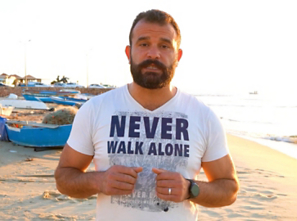
Anas Abouda is a Trip Experience Leader for O.A.T.’s Tunisia: From the Mediterranean to the Sahara adventure.
"All the ancient civilizations chose this location to be their place," Anas explains, his voice filled with the pride of someone who has spent a lifetime uncovering his city's secrets. "Berbers, Carthaginians, Romans, Arabs, Spanish, Ottomans, and even French and Italians—they all fell in love with its beauty."
This coastal gem, nestled along Tunisia's eastern shores, tells a story that spans millennia. The Romans, who called the city Pupput, left behind ruins that still whisper tales of their grandeur. But it was the Arabs who gave the city its current name—Hammamet, meaning "the baths" in Arabic, amazed as they were by the abundance of thermal baths they discovered upon their arrival.
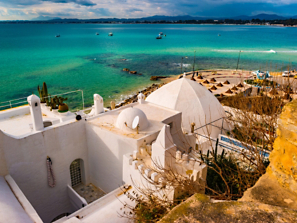
Hammamet translates to "the baths" in Arabic, but its settlers—the Romans—knew it as Pupput.
Perhaps nowhere is Hammamet's layered history more visible than in its medina, the walled old city that remains one of the best-preserved examples around the Mediterranean. Built during the tenth century CE, this architectural marvel embodies what Anas describes as the five essential elements of a true medina.
"When we speak about medinas, we speak about five elements," he emphasizes. "If one of them is missing, then you'll be speaking only about an old city." These elements include the protective walls, the living quarters where daily life unfolds, the souk where merchants have plied their trades for centuries, the kasbah serving as a defensive monument, and at its heart, the great mosque.
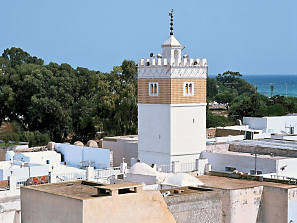
The mosque in the Medina of Hammamet.
The kasbah itself tells a story of conquest and reconquest. "In Hammamet, we have one which is known as the Spanish fortress because it was fortified by the Spanish during the 16th century," Anas explains. "However, it was built by the Arabs during the tenth century CE."
Walking through the medina's narrow streets today, visitors are embraced by colors that have become synonymous with Tunisia's coastal architecture—blue and white. "You will be charmed by the warm smile of its buildings," Anas says.
Before tourism transformed its economy, Hammamet was primarily an agricultural town. "Hammamet has always been an agricultural town living from its olive trees, citrus, and its fishing boats," Anas recalls. The shift began in the late 1960s when the first hotels started attracting international visitors. Today, it stands as Tunisia's third-largest resort destination, yet it has managed to retain its authentic character.
The town's appeal to visitors isn't new. During World War II, Winston Churchill found solace here, writing portions of his diaries at Dar Sebastian, a villa built by a wealthy Romanian aristocrat. "That villa is now a cultural center where international artists are performing during the whole month, every summertime," Anas shares.
While Hammamet embraces modernity with its active nightlife—"youth spending long nights dancing in its various discos and lounges"—it's the preservation of ancient traditions that truly sets it apart. During traditional wedding celebrations, "dozens of beautiful, just married women" with dazzling costumes (that can be seen in the video above) perform movements that represent "the current of love," Anas explains.
For Anas, who spends long hours fishing along Hammamet's golden shores, the Mediterranean is more than just a body of water—it's a teacher and a constant companion. "It taught me how to be patient," he reflects. "Some days I make it, and many others, I will just learn how to never give up and keep trying, how to give without expecting anything back."
Through Anas's eyes, Hammamet is a city that, "remained attached to its traditions and its dear collective memory"—a quality that makes it an invaluable window into Tunisia's heritage. For travelers seeking to understand the layers of Mediterranean history, Hammamet offers what Anas calls an experience that demands "all your senses." It's a place where the ancient and modern dance together, much like the women in their golden costumes at a traditional wedding—forever moving, forever connected, forever celebrating the ancient spirit of this remarkable coastal city.
Explore Hammamet during O.A.T.’s Tunisia: From the Mediterranean to the Sahara adventure.


