
A reproduction of da Vinci’s ornithopter flying machine hangs in Milan’s Science and Technology Museum. Learn about da Vinci’s visionary genius in the region where he apprenticed during Tuscany & Umbria: Rustic Beauty in the Italian Heartland.
A reproduction of da Vinci’s ornithopter flying machine hangs in Milan’s Science and Technology Museum. Learn about da Vinci’s visionary genius in the region where he apprenticed during Tuscany & Umbria: Rustic Beauty in the Italian Heartland.
One would think that it would be thrilling enough to be recognized for painting some of the greatest masterpieces the world has ever seen. But to remember Leonardo da Vinci (1452-1519) solely as the creator of works like the Mona Lisa and The Last Supper would be doing the Renaissance man a great disservice. Da Vinci’s insatiable curiosity about the world around him (it’s an understatement to simply label him a “genius”) put him centuries ahead of leading thinkers in fields like anatomy, zoology, geology, mathematics, and military engineering—to name just a few. He made sketches of his ideas and recorded scientific observations on thousands of sheets of paper which were gathered in volumes known as Codices—including one called Codice sul volo degli Uccelli, or Codex of the Flight of Birds.
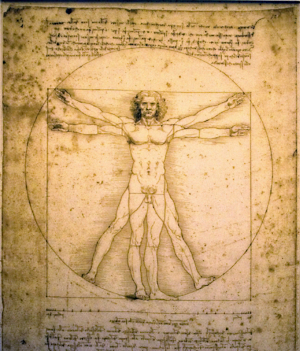
Da Vinci’s "Vitruvian Man" is a symbol of the Renaissance, representing a perfectly proportioned human form and the intersection of science and art.
Leonardo da Vinci was fascinated with the possibility of human mechanical flight for most of his life. His Codex of the Flight of Birds includes more than 35,000 words and 500 sketches devoted to ideas about flying machines, the nature of air, and bird flight. While da Vinci’s dreams of flight wouldn’t be realized for another 400 years or so, his concepts and theories would play a crucial role in the development of the first successful flight in a powered aircraft by brothers Wilbur and Orville Wright in 1903.
Da Vinci’s models inspired by birds may have driven him batty
Da Vinci's designs for his flying machine were modeled after the anatomy of birds—but he may have found greater inspiration from the anatomy of bats. His sketches featured a pair of enormous wings (some 33 feet across) connected to a wooden frame made of pine and covered in raw silk to create a light but sturdy membrane. Inside the frame, an intrepid pilot would lie face-down and move the wings up and down by turning a crank connected to a series of rods and pulleys
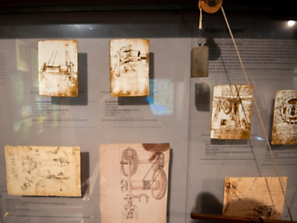
A collection of da Vinci’s mechanical sketches at the Leonardo Museum Palazina Uzielli in Vinci, Italy.
Although the device may have flown, it is unclear how the flying machine (also known as an “ornithopter”) could have gotten off the ground without an engine—as a person could never have generated enough power on his own. Nevertheless, it is almost certain that da Vinci himself knew the technology of his time was insufficient to overcome the limitations of human power and weight.
Most—but not all—of Leonardo da Vinci’s aeronautical designs were ornithopters, which are machines that employ flapping wings to generate lift and propulsion. His detailed sketches of these flying machines included a pilot lying prone, standing vertically, using arms, and using legs showed great imagination, but could never overcome the fundamental barrier of all ornithopters—the limited muscle power and endurance of humans compared to birds.
If da Vinci’s flying machine couldn’t fly—where’s the innovation?
Da Vinci may have been ultimately unsuccessful in delivering a working prototype of his flying machine, but that’s missing the point. It was his visionary theories and insightful observations on the mechanics of flight that paved the way for the development of the airplane in the early 20th century.
In his studies about birds in flight, da Vinci discusses the crucial concept of the relationship between the center of gravity and the center of lifting pressure on a bird’s wing; while observing the behavior of birds ascending against the wind, he introduced the modern concept of a stall; he demonstrated an understanding of the relationship between a curved wing section and lift; his writings on the concept of air as a fluid was a precursor to the science of aerodynamics. And when Leonardo observed the gliding flight by birds and how they balance themselves with their wings and tail—this was just as the Wright brothers did in developing their initial aeronautical designs.
It would be centuries before any progress toward a practical flying machine would be achieved. But the ideas and foundational concepts required for the future of flight all began with the fertile imagination of Leonardo da Vinci. Something else to keep in mind is that da Vinci’s dreams and designs of flight extended well beyond the “flapping wings” of his ornithopters.
A different type of bird—the helicopter
Another innovative flying machine design that da Vinci sketched during the 1480s was a device sometimes referred to as the “helical air screw”—but really, it looks and behaves just like a modern helicopter. Instead of rotor blades, however, da Vinci’s device featured a single, screw-shaped blade that was designed to spin or “bore” through the air that would allow it to ascend vertically.
Once again, though, manpower alone would never have been sufficient to power a device like the helical air screw. Like the ornithopter and other aviation designs, the problem wasn't how to keep them in the air, it was how to get them in the air. The lightweight materials and technology required to power true aircraft were still centuries away.
Not to drone on about da Vinci’s helicopter, but …
Those remote-controlled drones may seem to be everywhere these days, but there could be a lot more of them. What’s preventing the wide-scale use of modern drones—especially in densely populated areas—is noise pollution. It’s not the decibels, though. Drones produce high-frequency “sinusoidal” tones that are particularly annoying to human ears—far more so than road traffic or aircraft noise at the same level. And the tones produced by drones tend to bounce back up off the ground, making them even louder and longer lasting. It’s a big problem.
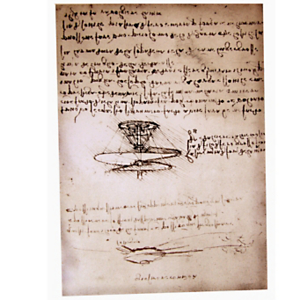
Could da Vinci’s "air screw" concept improve the performance of modern-day drones?
Here's where Leonardo da Vinci comes in. Studies are currently underway on a drone based on da Vinci’s design of the “helical air screw.” And initial results show that it is capable of producing more mechanical power and lower noise than modern drones. With its larger surface area, the aerial screw moves slower to create the same lift, thus requiring less power. And the noise it does produce is lower-pitched and dissipates quicker than the noise of modern drones.
So, in a head-to-head competition between decades of the most advanced military and private R & D on the one hand, and a 15th-century eccentric with no formal education who never saw a drone in his life on the other, it certainly appears that Leonardo da Vinci emerges as the clear victor.
A few more aeronautically-inspired inventions of Leonardo da Vinci
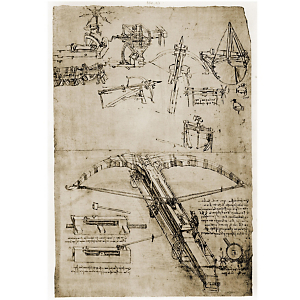
Fear-inducing, indeed!
Walk in the footsteps of Leonardo da Vinci and learn about his enormous impact on art and science during Tuscany & Umbria: Rustic Beauty in the Italian Heartland.
What Did Ancient Rome Look Like?
What did ancient Rome actually look like during its height in the first and second centuries AD, when the city was home to over a million residents and the heart of an empire spanning three continents?
How—and why—did Hannibal cross the Alps with elephants?
Hannibal Barca's audacious crossing of the Alps in 218 BCE—a treacherous journey with an army of 70,000 infantry, 20,000 cavalry, and 37 elephants—challenged the limits of human endurance and military strategy, ultimately catching Rome off guard and reshaping the course of the Second Punic War.
Old School
Learn the history of Bologna University—the oldest in continuous operation in the world.
Get The Inside Scoop On...
Like what you see here? Receive weekly updates right in your inbox.
inside-scoopArticles In This Edition

9 O.A.T. Adventures that Take to the Skies

Extreme Adventure

Flights of Fancy: Leonardo da Vinci and his Flying Machines

Peak Performance

The Sky Belonged to Her