
Carol (fourth from right) and her group at their Home-Hosted Dinner in Samarkand during The Silk Road: Central Asia’s Ancient Trade Route. “By evening’s end, strangers became friends.”
Save up to $4,000 on select 2027 departures
Carol (fourth from right) and her group at their Home-Hosted Dinner in Samarkand during The Silk Road: Central Asia’s Ancient Trade Route. “By evening’s end, strangers became friends.”
By Carol L. Bowman, 20-time traveler from Spring, TX
Over 2,500 years ago, camel caravans, laden down with silk, tea, spices, and porcelain, traveled from the Far East to the Mediterranean where traders exchanged their goods and their culture. They encountered hazardous mountain passes and harsh deserts on a patchwork of trails, called the Silk Road. Tales of Zoroastrians spreading religion, Alexander the Great, Genghis Khan, and Kublai Khan seeking conquest and Marco Polo searching for adventure used these same pathways.
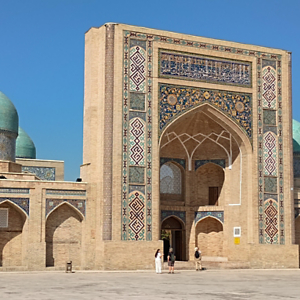
Barak Khan Madrassah in Tashkent was Carol’s fist introduction to ancient Islamic architecture.
Every ancient convoy, dependent upon the region’s rivers and desert oases, crossed over one thousand miles of the Silk Road in what is present-day Uzbekistan. A journey to this Central Asian country, celebrating 35 years of independence from the USSR, could turn retracing the Silk Road from a distant mirage into reality. Excited when Uzbekistan dropped visa requirements for U.S. citizens in January 2026, my husband and I booked Overseas Adventure Travel’s Silk Road: Central Asia’s Ancient Trade Route.
Tashkent
We taxied from the airport to the 5-star Lotte City Palace Hotel, in Tashkent, capital of Uzbekistan, to meet our eleven O.A.T. traveling companions and our Uzbeki tour leader, Marat, who proved to be brimming with enthusiasm, knowledge, and valuable insights. We marveled at the wide, treelined boulevards and parks meticulously interspersed among the Soviet style boxy apartments. The absence of litter or chaos felt almost contrived. Although the Soviet Union rebuilt Tashkent as a model Soviet City after the devastating 1966 earthquake, today, Tashkent exudes cosmopolitan, optimistic energy.
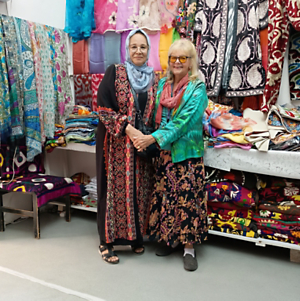
Carol was grateful to this Uzbeki artisan who created a reversible silk jacket for her.
Twentieth century sites worth a visit included Independence Square, symbolizing freedom from the Soviet Union in 1991, the Crying Mother’s Monument honoring 400,000 Uzbeki soldiers who died in WWII, and the Earthquake Memorial, remembering thousands left homeless by the 1966 tremor. Our first exposure to ancient mosques, mausoleums, and madrasahs prevalent throughout Uzbekistan was the 16th Century Barak Khan Madrasah, an Islamic school converted to commercial space for skilled artisans.
It was here that I fell in love with ‘must have’ silk creations, an important art bought from China two millennia ago. An Uzbeki daughter translated for her mother, creator of the beautiful reversible silk jacket I purchased. Both mother and daughter put their right hand over their hearts, an Uzbeki gesture of genuine gratitude that transcends all languages. So touched, I too, offered thanks in this manner throughout our journey.
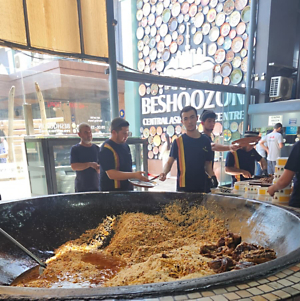
At Besh Qozon, men prepare the national dish, plov, in a massive cauldron.
With Marat’s guidance, we experienced authentic experiences blending in with the locals. Inside the legendary green-domed Chorsu Market, we purchased warm, savory Uzbeki bread rounds directly from a tandoori oven, we rode the immaculate Tashkent Metro, stunned by the art gallery feel of every station, and we lunched at the “not to be missed” Central Asian Plov Center, Besh Qozon. Thousands of Uzbeks come daily to feast on the National Dish, plov, which combines beef, carrots, onions garlic, rice, and spices, cooked in six-foot caldrons, only by men. A gastronomic and cultural treat.
Samarkand
Our six-hour overland adventure across the Silk Road to Samarkand, one of the oldest cities, considered the Crossroads of Culture, offered roadside encounters revealing Uzbeki daily life. Always on the look-out for local interaction, Marat had our faithful driver, Dill, stop for us to sample smoked river fish, help a young couple squeeze fresh pomegranate juice, and experience a huge roadside melon auction.
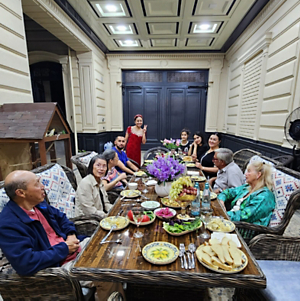
Dining on Uzbeki favorites at an “unforgettable” Home-Hosted Dinner.
Once in beguiling Samarkand, our group spent an entire day visiting the greatest concentration of ancient Islamic architecture in the world. Registan Square, considered the most iconic sight in Central Asia, left me overwhelmed. Three madrasahs, built over the course of two centuries, their facades of mosaic tiles crafted from turquoise, lapis, indigo, and gold and aqua tiled minarets, gleamed in the sunlight. Marat showed us how each tile was individually crafted.
The architectural gem that seized my attention, the staggering 14th Century Gur-e-Amir Mausoleum, built as the final resting place for emperor Tamerlane, commanded silent reflection. The main portal, interior plaza, gilded chamber, crypt, burial markers, and gigantic dome and flanked minarets caused pause to take in the magnificence. My husband and I returned to the complex at night to witness its magical glow under evening illumination.
Home-Hosted Dinner
An O.A.T. tradition, our final evening in Samarkand unfolded as the most meaningful: the Home-Hosted Dinner. Divided into two smaller groups, we were privileged guests of local families. My husband and I exchanged wide-eyed glances as our hosts gathered outside their palatial home to welcome us. Shoes removed, inside the home, we met the extended household—parents, married children, sisters, cousins—all living together, an Uzbeki tradition.
A young niece studying tourism translated as we shared a meal of Uzbeki favorites, dumplings, salads, vegetables, sweets, and fruit. Seated at the head of the table, the father brought out a prized bottle of Uzbekistan Premium Vodka. He demonstrated the proper way to “throw-back” the strong spirit, no sipping here, and the merriment increased as he refilled our shot glasses. We discussed, with keen interest, the recent marriage of their Christian son to his beautiful Muslim wife. After an evening filled with camaraderie, strangers became friends and warm hugs remained our parting memories of Samarkand.
Discover the longstanding traditions and rich cultural heritage of Uzbekistan during The Silk Road: Central Asia’s Ancient Trade Route.
Conversation with a Geisha
In Japan, a traveler learned that Westerners often have preconceptions of this ancient profession.
To Bee or Not to Bee: A Day in the Life at Moka Honey Farm
Away from the tourist crowds, this hands-on beekeeping experience proved an unforgettable highlight.
Early Arrival, Extra Culture: Street Food & Kabuki in Tokyo
Read a traveler’s advice on making the most of an early arrival in Tokyo, Japan.
Get The Inside Scoop On...
Like what you see here? Receive weekly updates right in your inbox.
inside-scoopArticles In This Edition

Festive Holiday Flavors Around the World

First Two Stops on Uzbekistan’s Silk Road Route: Tashkent to Samarkand

Happy Meals

Let’s Talk Turkey

Top 10: This Week’s Trending Black Friday Adventures