
Carol’s group geared up "for the thrill of interacting with honey bees" during their A Day in the Life experience at Moka Honey Farm—a highlight of O.A.T.’s The Aegean Islands, Athens & Istanbul Small Ship Adventure.
Refer Friends & Earn Cash Rewards—Up to a FREE Trip.
Carol’s group geared up "for the thrill of interacting with honey bees" during their A Day in the Life experience at Moka Honey Farm—a highlight of O.A.T.’s The Aegean Islands, Athens & Istanbul Small Ship Adventure.
By Carol Bowman, 19-time traveler from Spring, TX
Any Overseas Adventure traveler knows A Day in the Life on the itinerary translates into the group embracing a local family’s daily activities. This special event, planned with the help of the specific country’s experienced O.A.T. trip leaders, sets O.A.T. apart from other small travel groups. Having completed 19 O.A.T. trips, I have had the privilege to participate in many of these "way of life" experiences all over the world. There can only be one "best" Day in the Life and for me, it occurred recently: May 2025 on The Aegean Islands: Athens & Istanbul Small Ship Adventure.
We waded through the expected multitudes of tourists at Ephesus and Hagia Sophia in Turkey, and in Greece, on the island of Santorini, and Delphi on the mainland. Our O.A.T. tour leader, Konstantina, made valiant efforts to rouse the group early to avoid the throngs of visitors that would swell each day. Konstantina promised that after the Delphi Archaeological Site, the next day would bring an experience in the countryside without any tourists except for our group, and she delivered: "A Day in the Life at Moka Honey Farm."
After a restful night in the stunning alpine town of Arachova, plastered against the steep cliffs of the majestic Parnassus Mountain, we headed down toward the Corinthian Gulf, through the valley of Itea in Fokida Prefecture toward our destination, the Moka Honey Farm. Scattered windswept grasses, sprinkled with colorful spring wildflowers, passed by the vehicle’s windows. At the dirt lane leading to the farm’s entrance, we vacated the travel bus to be greeted by co-founders Nikiforos Kalafatis and Ioannis Moraitis.
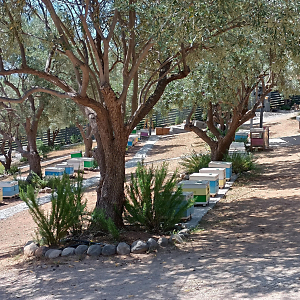
Although rides to the main hub of this first-and-only, interactive, visitable apiary in Greece were offered, we all roamed on foot through fields of olive trees, and smelled the aroma of sweet buttercups, daisies, and pure farm-fresh air. In the distance we spied pink, blue, green, and yellow stacked beehives. I felt recharged and renewed in these open spaces free of the tourist crowds.
Nikiforos, a sound engineer who left his post in advertising, and Ioannis, a PhD agronomist from Agricultural University of Athens, whose grandfather taught him the skill of beekeeping, would guide us through a full day of learning and discovery and in the end change our perception of bees, honey, and olive trees.
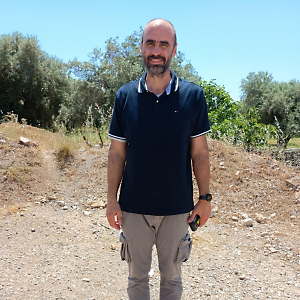
They spoke about the mission of the Moka Honey Farm: “to redefine eco-friendly local farming, to provide the highest quality honey and olive oil while minimizing the impact on the environment, to demonstrate the farm-to-table approach, and to educate visitors.” Both inherited the passion for bees and olive trees, and the tradition of making pure, preservative-free honey and olive oil, from their grandparents. Moka Honey Farm became a reality in 2014, with the first harvests of both honey and olives. By 2016, their goal of educating the public through group, family, school, or individual tours and offering products of the purest quality, became a reality.
Rounding out the team of expertise: Konstantinas Koutrolikos, a graduate from the University of Athens, History and Archaeological Department, teaches the olive tree farm tours. Nick Bougas, a transplant from Great Britain and a natural conservation specialist who led tropical and subtropical projects in Belize and Indonesia, discussed with the group the worldwide plight facing the bee industry and offered extensive knowledge of "everything we never knew about bee colonies."
The "show and tell" demonstrations from Nikiforos, Ioannis, and Nick of the communal working relationships within a beehive kept me almost hypnotized. Nick reported that after computer analysis, AI concluded that a working beehive proved to be so efficient, it needed no improvements. Archaeologists discovered 3,500-year-old pots of edible honey in Egyptian tombs, making it a perfect food, a "forever" source of nourishment.
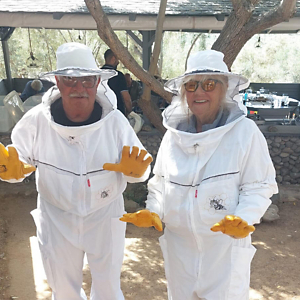
After learning "bee basics," the fun, interactive part of this unique experience began. We suited up in protective white coveralls, long sleeve gloves and a mesh face, head covering that zipped tight around the neck, to keep "the sting from the skin." Bees become aggressive when threatened by dark colors, so bee suits are always solid white. Nikiforos lifted one frame after another from a hive to point out the one queen whose only function is egg laying; the drones who do the fertilizing once, then die; and the main decision makers of the hive, the worker bees. Through innate ingenuity, the worker bees keep the cells on frames one, two and nine, ten clean, ready to store the produced honey in comb configurations.
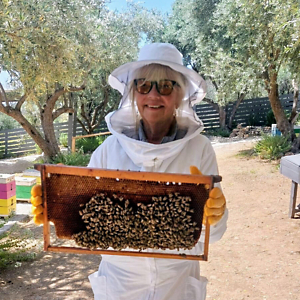
Everyone in our small group had the opportunity of a lifetime: to be a pseudo-beekeeper for a moment, to be close to these magnificent insects we usually run from. Wrapped in my cocoon, I felt the thrill without the fear of holding a frame of buzzing bees. As promised, I will never look at a honeybee the same way again.
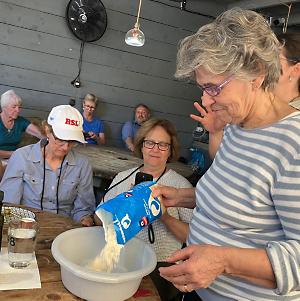
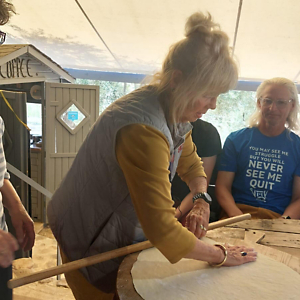
The outdoor kitchen became our next classroom with crew member, Mrs. Lemonia, instructing, and Konstantina doing an excellent job of translating into English. We learned how to prepare phyllo dough as the base for the authentic Greek spinach pie, spanakopita. I took on the task of rolling the dough from a thick disk to a large paper-thin round using a slender wooden rolling stick. The delicate, almost transparent dough pressed into a deep baking dish, filled with spinach, fruit, or vegetables, and sealed over with the remaining phyllo results in a scrumptious baked pie.
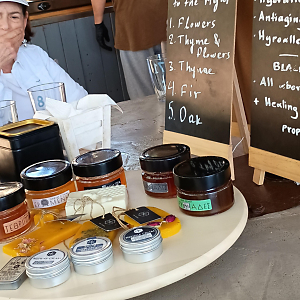
We sipped the strong Greek distilled spirit with an alcoholic content of between 40-45% called "tsipouro," often referred to as the drink of the poor, and we tasted olive oil and local traditional Greek dishes. Contented and sated, we drifted down the hill to the wooden barn where a diverse selection of farm-based products waited. Thyme or oat honey, extra-virgin olive oil, beeswax sachets, soaps, and candles, could be purchased to remember our experience long afterwards.
The Day in the Life at Moka Honey Farm unfolded as one of the most special, soothing, yet exciting experiences in all of Greece. It has made my "must-see, must-do" list and my favorite O.A.T. Day in the Life experience. Private tours can easily be arranged with only 24-hour notice. Families, small or large groups, and individuals have the choice of booking: the Honey Stories Tour, the Olive Stories Tour or the Wax and Soap Stories Workshop where participants make their own wax products and take their creations home. Tour prices are available online.
Our O.A.T. excursion to the environs of Delphi, Greece had ended with an unforgettable, magical, hands-on experience at Moka Honey Farm, where we had the privilege to learn, discover, and participate in the effort to "Save the Bees." I came away as a forever bee enthusiast with an understanding that our lives and natural food supply depend on the life of honeybees.
See how Moka Honey Farm ranks among your own Day in the Life experiences during our Aegean Islands, Athens & Istanbul Small Ship Adventure.
Where in the World?
Where in the world would ancient noblewomen channel prophecies by inhaling the fumes of a slain snake’s rotting corpse?
Scent of a Roman
Classical scholarship recently revealed that Greco-Roman marble statues featured what surprising embellishment?
Cult Classic
What creature did the ancient Greeks associate with longevity, health, and wellness–one that has become a universal symbol of healing?
Get The Inside Scoop On...
Like what you see here? Receive weekly updates right in your inbox.
inside-scoopArticles In This Edition

First to the Finish

Old Spice

On Trend: Top 10 Journeys by Land, Sea & River

Recipe: Moroccan Kefta Kebabs

To Bee or Not to Bee: A Day in the Life at Moka Honey Farm

To Market, To Market: Egypt's Bustling Bazaars