By Diana White, 23-time traveler from Spring, TX
The sun has begun to light up the world as it does every morning. At first all I see is an orange line in the distance at the horizon. I had never seen that color before, seeming to show the edge of the world. What a delightful way to start the day in vibrant color which seems to want to show me this will be a spectacular day filled with color and beauty and joy.
Later, clouds appear below us that look like waves on the ocean. The sun rises in the sky—shining with more intensity and making the clouds below seen to shine. Now the sky above is a beautiful robin egg blue. We glide along, descending, trusting our pilot and airplane will bring us safely down in London. It is so nice not to be in control, but full of faith that we will land safely.
Now green fields appear beneath us, separated by darker green trees. How much history has taken place here over the centuries. It is hard to imagine what the people here suffered during WWII with the bombings. Now the sun brightens the scene of farms and small towns. Our day has truly begun.
The Alps
We started our flight to Malta from London. I dozed at first as I was still tired from the long flight from Houston. I was glad I had a window seat to see what we were passing over. For nearly an hour there were green fields and tiny houses and trees. I assumed this was France and enjoyed the rural look of the landscape. I couldn’t help but think of WWII destroying so much of this famous country.
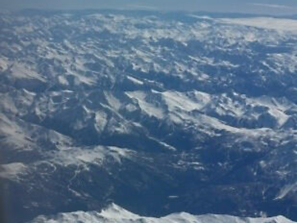
Diana’s breath was "taken away" by the beauty of the snow-covered Alps as she flew over them.
Then, all of a sudden, my breath was taken away with the snow-covered Alps beneath us. The mountains were rugged, reaching toward the sky. The snow softened the scene but still they seemed forbidding. No buildings, roads or people could be seen. Just the magnificence of nature. All too soon we moved on and were over water with an island to the right. Flat low clouds seemed to be protecting the land underneath from prying eyes. Malta appeared and we landed smoothly as we gave thanks for our safe arrival and for the promise of unforgettable days to come.
Valletta
It’s a beautiful sunny day with a wind blowing enough to make me glad I wore a fleece jacket. We walk on a tour of the city, learning of its history since the 1500s. Being strategically located in the Mediterranean means that it was the location of many battles in the past. A number of forts are seen in the distance, reminding us of the importance of this island. As we walk and enjoy the view we hear a recording of military type music. A fitting accompaniment to what we have been learning.
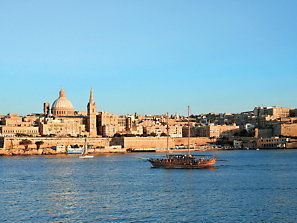
Valetta is a walled city that was established in the 1500s on a peninsula by the Knights of St. John, a Roman Catholic order.
Many languages are heard as we walk. Some are easily recognizable and some aren’t. I’m assuming some are Maltese—a fusion of the languages of the many peoples that came here and stayed, putting their stamp on the Maltese culture. I’m so glad the Maltese language is still spoken and taught in school.
I’m amazed at the huge number of tourists on the streets—many in groups and others obviously alone with guidebooks in their hands.
We are all walking, taking in this beautiful city and enjoying a sunny day.
Funeral Procession
Later in the afternoon we are walking along Republic St. and see large crowds of people ahead and the street is blocked off with a long line of black cars. As we come closer, we see one vehicle is a hearse with fresh flowers attached to the front and top. The rear door is opened up. Then we hear sad music being played. I kept thinking of the word "dirge". Many priests and bishops are lined up. A very plain wooden coffin is taken out of the hearse and carried by four men.
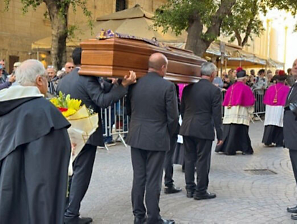
Diana witnessed a funeral procession for an Archbishop.
This was the body of the Archbishop, who died recently. The procession of clerical nobility led the way, followed by the coffin and then other priests. The somber music was played from a balcony, draped in black, until the procession entered the Cathedral of St. John where a funeral would be held on Saturday. How fortunate we were to arrive just in time to see and hear the final procession for the archbishop. May he rest in peace.
Grand Master’s Palace
We enter the Grand Master’s Palace in the late afternoon. It appears to be a large building but is quite plain on the outside. The history of the building is explained in detail in several rooms past the entrance. We go upstairs and are nearly overwhelmed with the Armory—a large room with an amazing collection of suits of armor, firearms, and a bronze cannon. This building was built in the 1570s and for 200 years was the home to the Grand Master, the supreme head of the Order of the Knights of St. John.
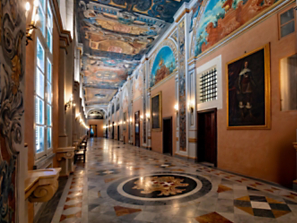
Valetta’s Grand Master’s Palace is lavish, to say the least.
The farther we walk we see more amazing corridors and chambers filled with tapestries, marble floors, and priceless artwork. At every turn we are reminded of the fabulous wealth and influence that the Knights had. Portraits of the Grand Masters with their coats of arms are displayed on the walls, making sure we remember how powerful they were and the part they played in the history of Malta.
Mdina
We leave Valletta in the morning to drive to Rabat and Mdina. We pass low dry-stone walls, some dividing properties and others along the edge of the road. Along with the stone walls are an amazing number of prickly pear cactus plants that add a touch of life to the otherwise harsh feeling of the stone walls. How much history took place right here in the relatively short distance we drove! Armies marching to Mdina, which was the original capital. The rule of the Knights for over 200 years. Conquering forces from many countries insisting on their domination.
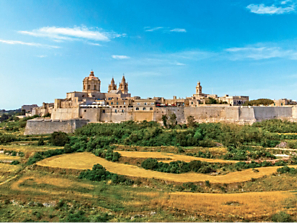
Mdina is a historic city where the Knights of Malta once made a famous stand—commonly known as the "Siege of Malta".
But the Maltese people have survived all of this and hold their heads high and honor their ancestors, their traditions, their language and their culinary treats that combine all that they experienced in the past. We arrived in Rabat, then Mdina, and drove through the narrow winding streets feeling the spirit of the people and we give thanks for being here to honor them.
Gozo
We approach the Ggantija temples from the rear after having received an excellent talk on the history of these temples and the society in which they were built. It is hard to imagine that something built in 4000 BC could still be standing! The rear walls were just as the pictures inside the museum depicted them. The rocks were massive and positioned perfectly. They have weathered countless storms and natural disasters. It is a miracle they were not hit in the bombing of the island during WWII.
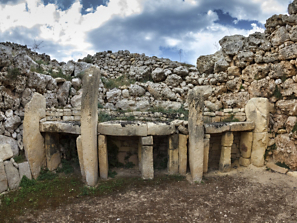
The ruins of the Ggantija temples date back to 4000 BC, erected in three stages by the community of farmers and herders inhabiting the small island of Gozo.
We walk around the structures and are amazed at the yellow buttercup flowers and the beautiful purple flowers that are growing out of many of the walls. They offer a touch of the beauty of creation along with the powerfully strong stones that have stood here for so long. Oh, if only these stones could talk to tell us how they were positioned as they are and how this structure was used. Now we rely on archaeologists and modern technology to answer some of our many questions.
Explore Malta for yourself during The Maltese Archipelago pre-trip extension to O.A.T.’s New! Journey Through Southern Italy: Sicily, the Aeolian Islands, Calabria & Puglia adventure.


