
Crossing this small wooden span leads travelers to the Jewish Ghetto Nuovo—which, despite its name, is the oldest section. Explore this little-known area of Venice during Undiscovered Adriatic: Eastern Italy, Venice, Puglia & Malta.
Crossing this small wooden span leads travelers to the Jewish Ghetto Nuovo—which, despite its name, is the oldest section. Explore this little-known area of Venice during Undiscovered Adriatic: Eastern Italy, Venice, Puglia & Malta.
By Carol Bowman, 18-time traveler from Spring, TX
Venice brings romantic images of gondolas skimming along the winding canals, pigeons cooing amongst the crowds in St. Mark’s Square, enjoying an Aperol Spritz at a sidewalk café, or boarding water taxi vaporettos. But secret places with fascinating histories wait for you in Venice, places that most international tourists miss.
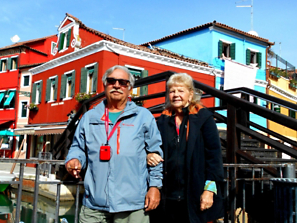
Carol and her husband, Ernie, in Venice.
Come with me as we walk 200 meters past the Rialto Bridge to a small wooden span over a wider waterway which flows into the Grand Canal on the right. Cross over the bridge, walk straight for 100 meters, turn left and enter—the Jewish Quarter. The Jewish Ghetto, located in the Cannaregio District, conveys a peaceful emptiness of crowds with time to reflect on its 500 years of Jewish heritage.
As early as the 12th century, Jewish merchants who traveled to Venice were only allowed to stay for short periods of time, but by the 16th century, their ranks had swelled to almost 1,000. The March 29, 1516 Decree of Doge Leonardo Loredam and the Senate of Venice compelled all Jews to live together in a section near San Girolamo, segregated from spilling over into other parts of Venice by walls with only two gates. Closely guarded by four Christians, the gates were opened at sunrise with the ringing of St. Mark’s largest bell, and locked at sunset. The Edict required the Jews to pay the guards’ salaries.
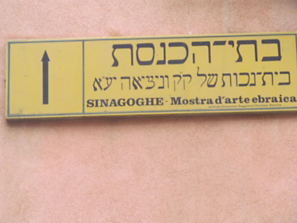
Shop signs in Hebrew signal one’s arrival into Ghetto Nuovo.
The English word "ghetto" originated in this first Venetian Jewish community, located near a getto (pronounced "jet-to"), where they threw, getar in Italian: waste from a foundry that smelted copper to make cannons. Unable to pronounce "getto," the German Jews used their hard "g" sound and called the area "ghetto." It became the universal term for segregated, Jewish communities ever since.
Early on the Jews were required to wear yellow badges and to hang a piece of lead, a symbol of shame, around their necks; women had to wear one black shoe and one red with an attached bell, so Venetians would know when a Jewish woman walked by. The interned populace could practice only three professions: money lenders, pawn brokers, and sellers of second-hand clothing. Despite the restrictions, the confinement and the harsh conditions, the Jewish community thrived with its customs and celebrations. Five synagogues constructed within the area had to be ethnically separated as well. Between 1528 and 1575, the German, Italian, Spanish, Portuguese, and Levantine synagogues were built within existing structures, devoid of outside ornamentation that would distinguish them as synagogues.
On May 12, 1797, the Army of Italy, commanded by 28-year-old Napoleon Bonaparte, occupied Venice, dissolved the Venetian Republic, and the gates to the Jewish ghetto were flung open, ending centuries of forced segregation. Jews remained living in this area by choice, not edict, and continue their traditions and customs to this day.
As we turned the corner, street and shop signs in Hebrew confirmed that we had entered the Ghetto Nuovo, which means "new" but in contradiction encompasses the older ghetto. Several blocks further on the Ghetto Vecchio, which means "old," is actually the newer section.
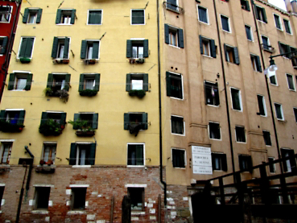
The ceilings of these nine-story buildings were lowered to create additional floors and accommodate more residents.
We meandered through the narrow streets to reach the Campo (square) Del Ghetto Nuovo. Tall, nine-story buildings, thought to be Venetian skyscrapers, lined the square on all sides. The Jewish population had swelled to over 5,000 by the 1600s, and, restricted to a limited area, the ingenious Jews added wooden partitions to lower the ceilings in order to make additional floors to house more people per building. Some of the units’ ceilings were lowered to the point that it was difficult to stand up straight within each apartment.
Approximately 450 Jewish families still live in this area. The first floors of these elevated buildings now house shops reflecting daily life for Venetian Jews with a bakery, bookstore, a Kosher Guest House and restaurant, a Museum of Jewish Art, Judaic shops, and two of the original synagogues.
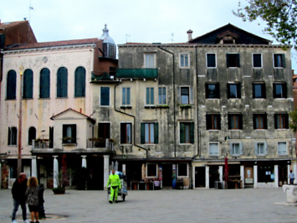
Businesses occupy the first floors of buildings, while some 450 residents still live on upper floors.
I notice with interest a large carved, memorial plaque fastened to a building exterior—a monument to the Venetian Holocaust victims. In 1943, the Nazis launched a systematic hunt for Jews in Venice. Reportedly, only eight Jewish residents returned from the death camps alive.
As we left the square, we wandered the quiet, empty streets of the ghetto, but soon happened upon the highlight of our exploration of this undiscovered historical area. Directly across from the bakery at Cannaregio 1233 in Ghetto Nuovo, we entered a world of scenes of the Jewish ghetto residents and their passion for daily life. The walls of the shop, The Studio in Venice, danced with brightly-colored images that jumped off the canvases with delight.
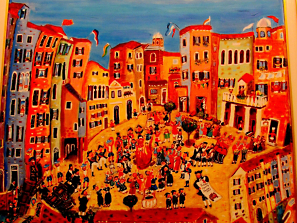
In a studio near the square, Haifa-born Israeli artist Michal Meron sells paintings depicting 16th-century Jewish life in the ghetto.
Famed, Haifa-born Israeli artist Michal Meron and her publisher husband, Alon Baker, have captured early Jewish Ghetto experiences in an illustrated book entitled, 500 Years of Venetian Ghetto History and Scenes of Daily Life. Michal has completed an extensive scroll of her unique pictorial interpretation of the Torah and Jewish Festivals. Wonderful images on canvas, ready to roll up and travel, depict the struggles in this first ghetto in Europe in 1516. The paintings show the unique environment with greater clarity than written text could ever describe and must be studied to appreciate the breadth of daily activities illustrated. As an example of the exceptional detail, cats, brought to Venice to solve the rat problem, dot every landscape.
Michal ranks as an acclaimed leader in the field of micrography—a Jewish form of embellishment of biblical texts, and marriage contracts developed in the ninth century. I felt joy all around me, and marveled at the fervor with which Michal spoke about her desire to share the Ghetto’s story with the world. I left the shop with a deeper understanding of life in the Jewish Ghetto and how these people had the will to turn hardships into advantages. For further information, go to their websites, www.thestudioinvenice.com; www.veniceghetto500years.com.
I have visited Venice before. I have marveled at the canals, St. Mark’s Cathedral, the Bridge of Sighs, all the tourist spots. But I have never felt the connection to the people of Venice as I did after visiting the Jewish Ghetto. On your next trip to Venice, leave the hordes behind, find that little wooden bridge and walk through the streets of 500 years of unique history and marvel at humanity rather than architecture and waterscapes.
Escape the crowds and discover this history-rich area of Venice during Undiscovered Adriatic: Eastern Italy, Venice, Puglia & Malta.
Get The Inside Scoop On...
Like what you see here? Receive weekly updates right in your inbox.
inside-scoopArticles In This Edition

Art Attack

Exploring the Jewish Ghetto in Venice

NEW Adventure: Italy’s Coastal Charms: Naples, Ischia Island & the Amalfi Coast

That's Amore: O.A.T.'s 10 Most Popular Italy Adventures

Where in the World?