
The combination of black and red is particularly auspicious in China due to the colors’ associations with wealth. Learn about this rich tradition of symbolism during New! China’s Imperial Cities, Natural Splendor & Modern Marvels.
The combination of black and red is particularly auspicious in China due to the colors’ associations with wealth. Learn about this rich tradition of symbolism during New! China’s Imperial Cities, Natural Splendor & Modern Marvels.
Lucky charms aren’t just some children’s cereal in China. They are a deeply ingrained part of Chinese culture, influencing everything from superstitions to business deals to major life decisions. It’s estimated there are hundreds of lucky symbols in China, including characters, colors, numbers, animals, deities, and more. Many are derived from ancient times—and they all continue to play an important role in the daily lives of Chinese people. A few of China’s symbols of luck and prosperity have even been adapted and embraced by other cultures worldwide.
So, do ya feel lucky?
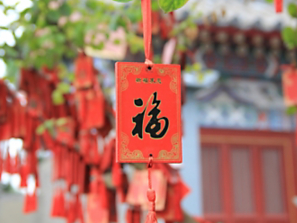
Hang a lucky fu symbol to keep poverty away from your home.
Perhaps the most important Chinese symbol of good luck is the pinyin (“phonetic spelling”) character for “fu,” which represents good fortune. The Chinese tradition of hanging a fu symbol on a front door began in 256 B.C. during the Zhou Dynasty and is still practiced during the Chinese Spring Festival and Chinese New Year. Originally meant to keep the Goddess of Poverty from visiting or residing in your home, it now more broadly symbolizes a year of good luck, prosperity, and happiness.
Fu symbols are drawn in black in calligraphy on red paper because these are the two traditional colors believed to bring the most good luck. Red is the royal and national color that translates to wealth and power, and black is a color of wealth—the one-two punch of red and black is a particularly auspicious combination.
Roll out the red carpet
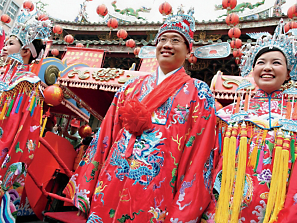
From dresses to gift envelopes, red is a fixture at Chinese weddings.
China doesn’t just bring out the color red for fu symbols. The color is deeply rooted in Chinese culture. To ancient Chinese royalty, red represented power, status, and confidence, while for ordinary Chinese people red represented happiness and good fortune. While modern weddings are becoming increasingly “westernized,” traditional Chinese wedding dresses and all wedding decorations have always been a sea of red due to the color’s association with happiness. Wedding guests still hand out red envelopes to the newlyweds (and the money inside should always be in an even number for reasons we’ll go into later).
Enter the dragon
Mythical or not, fire-breathing dragons are always portrayed as evil in Western culture. It’s just the opposite in China, where dragons are revered and considered the ultimate good luck symbol. Lyrics in a classical Chinese song, The Heirs of the Dragon, help to explain why dragons are so special: “In the Ancient East there is a dragon, her name is China. In the Ancient East there is a group of people, they are all the heirs of the dragon.” So dragons are not just symbols of prosperity, strength, and auspiciousness, but the Chinese people actually see themselves as descendants of dragons. All the ancient Emperors of China were also identified as the sons of dragons.
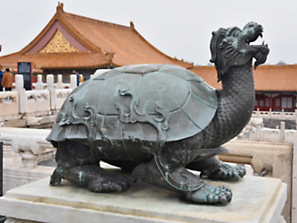
A dragon turtle statue within Beijing’s Forbidden City.
Dragons are ubiquitous in Chinese culture and appear in many forms—too many to even mention. But one of the most common is the Dragon Turtle—which are two of China’s four heavenly animals (dragon, tiger, phoenix, and turtle). Just like the name suggests, the dragon turtle has the body of a turtle and the head of a dragon. A dragon turtle statue is believed to protect its owner from betrayal in business while promoting healthy harmony at home. Other types of dragon turtle statues include one carrying a pagoda on its back, which is a good luck charm for academic success. A dragon turtle with a baby or two sitting on its shell is believed to improve fertility and family harmony. And you can probably figure out what a dragon turtle sitting on a pile of coins and gold bars means.
“Dragon” is also one of the 12 Chinese zodiac signs. To illustrate how these imaginary creatures continue to deeply influence modern Chinese culture, the birth rate in every “Year of the Dragon” is much higher than in other zodiac years—because Chinese parents want to have “dragon babies” born in the Year of the Dragon. Even the word itself (dragon translates to Lóng) is a favorite Chinese name—Hong Kong film star Jackie Chan’s stage name is “Sing Long” and Bruce Lee’s was “Lee Siu Long.”
Another animal—this one real—that has opposite meanings in Chinese and Western culture is the bat. Let’s be honest, bats aren’t held in very high esteem in Western culture. More often than not, they’re seen as blood sucking creatures or vampires. But they’re seen as symbols of wealth and good fortune in China. Again, it’s because the Chinese translation for bats is similar to a word meaning fortune or happiness. And it’s particularly auspicious to place five bats together in a home, as they would symbolize the “Five Blessings”: long life, wealth, health, love of virtue, and a peaceful death.
It’s Not Just China—Lucky Symbols Are Big in Western Culture, Too
Just in case anyone’s feeling a bit superior, thinking “Oh, that’s China. We would never take good luck charms like that seriously.” Really? What about four-leaf-clovers, perhaps the most iconic symbol of luck in the Western world? How about when a ladybug lands on you? We’ll bet you don’t crush it. You’re more likely to stand still and then patiently wait for it to fly away while feeling sure that good luck will follow. Lots of homes still have a horseshoe hung above a doorway with the ends pointing up. What’s that all about?
In Chinese culture, the number 8 is considered the most powerful symbol of luck. That’s because phonetically, it sounds very similar to “wealth” or “prosper.” They also believe that repeating the number increases its power, so 888 is especially auspicious. You’ll find 888 appearing in phone numbers, license plates, and jewelry. But don’t we do the same thing—except with the number 7?
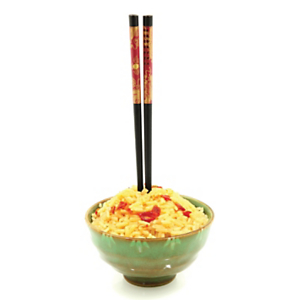
Never place chopsticks upright in rice, as it mirrors a traditional funerary practice.
In the West, the number 7 has been regarded as a lucky symbol since ancient times due to its appearance in religious texts, nature, and folklore—from seven days in a week and seven colors in a rainbow to seven hills of Rome and Seven Wonders of the Ancient World. The sequence 777 is special too. Known as the angel number, triple sevens also symbolize inner wisdom and spiritual awakening—and, of course, will always elicit shrieks of joy when the sequence comes up on a slot machine.
There are a couple more interesting properties of the number seven that add to its mystical allure in the West. Along with being a prime number (magical enough for mathematicians), it has been demonstrated that most people can retain roughly seven items of information in their short-term memory (that’s the reason phone numbers in the U.S. and many other countries are limited to seven digits). And something all magicians know, when people are asked to pick a number between one and 10, almost everyone chooses the number seven.
So, before judging other cultures for their reliance on silly superstitions, perhaps one should take a good hard look in the mirror first. Just be careful not to break it, because, you know …
A few more fascinating good luck symbols in Chinese culture
May good fortune shine upon you during our New! China’s Imperial Cities, Natural Splendor & Modern Marvels adventure.
Space Added to Meet Demand: New! China's Imperial Cities, Natural Splendor & Modern Marvels
From giant pandas in their natural habitat to the legendary Terra Cotta Army, this adventure offers a perfect blend of cultural immersion, natural wonders, and authentic local encounters.
The "4 Great Inventions" from Ancient China That Shaped the Western World (and Several More That May Surprise You!)
From gunpower to paper to the compass to the printing press and more, here are four inventions from Ancient China that shaped the Western World.
Stone Dragons and Concrete Giants: China's Two "Great Walls"
China's ancient Great Wall kept invaders out for centuries, but can its modern counterpart—the Three Gorges Dam—keep the Yangtze River in check?
Get The Inside Scoop On...
Like what you see here? Receive weekly updates right in your inbox.
inside-scoopArticles In This Edition


