
In Kyoto, Bonnie enjoyed the beautiful architecture around the Fushimi Inari Shrine during Japan’s Cultural Treasures.
By Bonnie Mack, 9-time traveler from Clearwater, FL
If I told you that I just returned from a country that was clean and efficient; the people were kind and friendly; a place where everyone I saw every day, from babies to senior citizens was dressed like they emerged from the pages of a catalog; a place with pristine lakes, beautiful mountains, modern skyscrapers, and traditional ancient buildings—would you believe such a place exists?
Would you like to stay in a hotel where it's appropriate to roam the halls in leisure pajamas and slippers (all provided in your guest room)? How about wearing them in the lobby—better yet, in the dining room, where you can walk barefoot, if you prefer. Because guests aren't allowed to wear their shoes in the hotel, slippers are provided—three pairs—one for use in your room, and around the hotel; a second pair to be worn only in the bathroom; and a third pair indicated for "emergency." I still wonder about the "emergency" slippers—are they meant to be worn in an emergency such as an earthquake, or an emergency in the event that you misplaced one of the other two sets of slippers? In public restrooms, several sets of slippers are set inside the entrance for one to exchange their shoes, before going into the restroom.
Would you believe me, if I told you that the toilets provided in every hotel room, restaurant, or public building do more than just flush? You can regulate the temperature of the seats, as well as the water that gently sprays your bottom, before blowing the area dry. "Music" is also an option, but it sounds like someone gargling or a giant waterfall, so you may wish to opt out of that selection.
When was the last time you climbed into a clean taxicab? Was the driver dressed in a black suit, white shirt, and tie (white gloves are optional)? Even the black leather seats in the taxis had white doilies on the headrests, and sometimes the entire back of the seat. The black cars looked like limousines that just emerged from a car wash.
No one jaywalks—except for tourists, of course. Locals all wait for the "chirping" light signals to indicate when it's safe to cross the street. Speaking of streets—sidewalks and streets are extremely clean, and yet no trash containers can be found anywhere. Instead, the locals dispose of their trash at home!
Have I forgotten anything? No doubt, because this country is an assault on your senses—but in a genuinely good way. It's a place of contrasts—modern buildings and skyscrapers amidst ancient structures in traditional architecture.
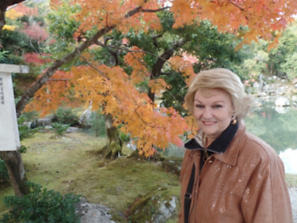
While she had hoped to see the cherry blossoms in springtime, Bonnie learned that Japan is also beautiful in autumn.
So, where is this place with such an interesting and unique social structure and traditions? How about Japan. I initially passed through 48 years ago, and swept through again 36 years ago. For some reason, Japan was calling me back once more. Two trips had been canceled due to COVID, and I forced myself to realize that I couldn’t wait any longer to see those cherry blossoms, so I’d best forget about Japan, and move on to another country. But then I remembered that Japan is also known for its beautiful autumn colors. Hooray! Japan was back on the docket. I was in the mood to visit a country whose culture is very different from ours. And then the "mood" became a yearning.
Spending two weeks in a country is a lot different than sweeping through for a few days, en-route to somewhere else on the globe. It had been so long, that my memories were few—as in "very few." I recalled "eastern" style toilets (porcelain holes in the floor)—and then there was the huge lantern hanging at the entrance to Asakusa Temple in Tokyo. Guess that was it for lasting impressions—other than the numerous deer who roam freely around the grounds of the Todaiji Temple in Nara. I’ll never forget when my friend Geri bent over to feed a cookie to one of the deer, and another nipped her behind. Of all things, Geri was dressed in a beautiful lavender suit, and wore stockings and high heels (after all, it was 1975, when travelers still dressed up). All in all, it made for a memory I’ll always recall.

Following lunch served by sumo wrestlers, Bonnie and her companions enjoyed being photographed with them.
Tokyo was fairly quiet when we arrived, because it was on a weekend—but the city was alive with people and traffic on Monday morning. As someone who hates large cities and huge crowds, I questioned what I was doing in Tokyo. We were so busy, I didn't have time for jetlag … meet the sumo wrestlers, and learn about their art, before they served us lunch (very odd, but humorous, to watch nearly naked sumo wrestlers lean over to put a cup of soup before you). Then on to visit shrines, temples, and gardens—and squeeze in a lesson on Taiko drumming. Were it not for the huge lantern I remembered from previous trips, I wouldn't have recognized the Asakusa Temple, the oldest temple in Tokyo.
The sprawling city was full of beautiful, modern office buildings and stores whose lights sparkled like diamonds at night. Adjacent to every subway stop was a huge shopping mall, with stores that made Macy’s and Dillard’s look like bargain-basement discount stores. Despite the city’s size, there was a sense of feeling safe anywhere and everywhere, no matter the time of day, or night.
I was anxious to visit Hakone, in the mountain region, about 55 miles from Tokyo. The scenery and Lake Ashi were beautiful, as was Mount Fuji, of course. I was disappointed, however, that the foliage had only started to change color. Apparently, Japan was experiencing the same long, hot summer as we were, and the weather was only starting to cool to the low 60s.
We rode the famous bullet train part of the way to Kanazawa on the west coast of Japan, and at the edge of the Sea of Japan. "Bullet" certainly describes the train. We readied our cameras to film it as it passed us by—but before we could snap a photo, it was long gone. It was so fast that we couldn’t even hear it approaching.
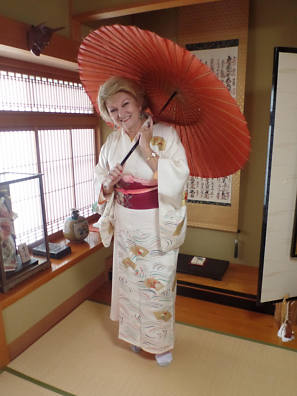
During a home visit in Kanazawa, Bonnie’s hostess dressed her in a kimono.
Kanazawa is a smaller version of Tokyo—very modern, but we saw more of the traditional Japanese architecture, with rice paper window screens, and wooden buildings with pointed, black tile roofs. I was in "architecture heaven." Perhaps the experience I’ll never forget was being invited into the home of a Japanese couple. My companions and I wondered how we’d fill our 90-minute visit if the hosts didn’t speak English. Worry no more, Google provided a translation app that helped us through difficult "conversations." When our time was up, we regretted not having an additional 90 minutes.
The app was also most useful in translating the instructions for operating those modern toilets. After several days of pushing buttons to determine which "wash cycle" was going on beneath me, I was finally able to make an enlightened selection. I just had to remember to bring my phone with me every time I entered a bathroom.
The best part of our visit was when the hostess asked if we would like to try on her kimonos. My previous assumptions were validated—the beautiful, decorative obi sash worn around the lady’s mid-section is like wearing a tight corset. And, as one would again assume, it keeps your posture in check—no slouching when sitting or standing. Dressing in a kimono is a tedious procedure, with lots of cords and strings, folds and tucks—all of which make one feel like a work of art, when wearing one.
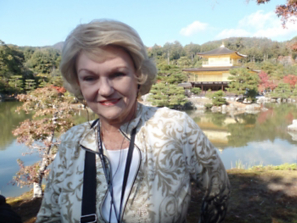
Bonnie enjoyed revisiting the famous Temple of the Golden Pavilion in Kyoto.
By the time we reached Kyoto, Japan’s former imperial capital, the autumn colors started to burst, and I think I photographed every tree whose green leaves had turned to pink, red, orange, yellow, or gold. There were so many temples, I couldn’t tell one from another—although there was one special temple—the Temple of the Golden Pavilion, dating from 1397. It’s perhaps the most photographed temple in the country, and one I remember from my first visit in 1975. As with all truly beautiful things, one can't stop photographing them, but pictures can never capture their actual beauty—that's what our memories are for—but now I'm certain I won’t have to remember them for the next 48 or 36 years.
Discover what makes Japan such a uniquely rewarding destination when you join O.A.T. for Japan’s Cultural Treasures.
Engaging in Baseball Card Diplomacy in Japan
In Japan, America’s "national pastime" has international appeal, which made for fun exchange with locals.
Early Arrival, Extra Culture: Street Food & Kabuki in Tokyo
Read a traveler’s advice on making the most of an early arrival in Tokyo, Japan.
Toilet Training
Join traveler Stephen C. as he compares the differences in Japanese toilets after making a return trip 59 years after his first visit.
Get The Inside Scoop On...
Like what you see here? Receive weekly updates right in your inbox.
inside-scoopArticles In This Edition

A Unique Country That Offers Lasting Memories

Always More to See: Top 10 Most Popular Optional Extensions

Food from the Earth: Rwandan Sweet Potatoes with Bosco Mugabe

Hoppy Hour

Pilfering Pints