
The concept of “yin” represents darkness and cold, while “yang” represents light and warmth. Explore the origins of this and other Chinese traditions during New! China’s Imperial Cities, Natural Splendor & Modern Marvels.
Question: What ancient cultural symbol is directly linked to celebrations of winter solstice, the shortest day and longest night of the year?
Answer: Chinese yin & yang
It’s difficult to miss how the days have been growing shorter, and the nights have been growing longer—unless you’re from the Southern Hemisphere, of course, when you’ve been watching the days grow longer, and nights grow shorter. Winter solstice is when everything reverses course, that mystical event that marks the shortest day of the year, the longest night of the year, and the first official day of winter. It should come as no surprise that so many cultures and religions around the world celebrate the time of year that coincides with the return of longer days—a precise knowledge of seasonal cycles was something that ancient peoples depended on for their very survival.
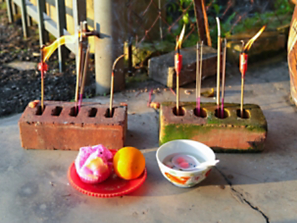
To honor their ancestors during Dōngzhì, families burn incense and leave offerings of food.
While the origins and traditions of winter solstice celebrations vary widely throughout the world, it’s safe to point to at least two things they all share—family and food. Like many of them, China’s winter solstice festival—called Dōngzhì—is a time for families to get together, to worship their ancestors, and to feast on traditional dishes. So, what exactly is “Dōngzhì” and what does “yin” and “yang” have to do with it?
China runs hot and cold during Dōngzhì
The origins of Dōngzhì (which roughly translates to “winter’s extreme” or “winter’s arrival”) go back more than two thousand years. It’s rooted in the Chinese concept of “yin” and “yang,” an ancient symbol of harmony and balance, because the Chinese believe that when the days are short, there is insufficient “yang” energy in nature (which is warm) and too much “yin” energy (which is cold). Put another way, the Chinese believed that the winter solstice was the apex of yin—with its darkness, cold, and stillness—and Dōngzhì was the return to yang, and the slow ascendance of light and warmth.
Dōngzhì became a winter festival celebrated across China during the Han Dynasty (206 BC-220 AD) after someone named Zhou Feng figured out the precise date of the winter solstice using a simple sundial. Official workers and commoners were granted a day off to return home to gather with their families. It rose to prominence during the Tang (618-907 AD) and Song dynasties (960-1279 AD) and was declared a public holiday and people began paying visits to each other and exchanging gifts of food.
Food is especially prominent during Dōngzhì as it is so closely tied to agriculture. The winter solstice was a crucial time for ancient farmers, marking the end of the harvest season and a brief period of rest. It was a chance to celebrate all the hard work that had been done in the previous season, prepare for spring planting, and pray for a bountiful harvest in the upcoming year.
Traditional Dōngzhì foods—something for all woks of life
Traditional foods served during Dōngzhì are meant to help offset the “yin” and “yang” imbalance, so people pile on dishes that are more “yang” in nature, which will warm you up and counteract the “yin” (cold) of winter. With China so large and home to varying climates, however, Dōngzhì traditional dishes vary by region—especially between northern and southern China.
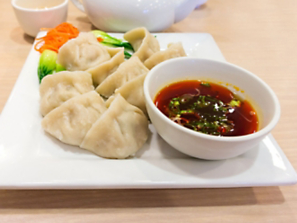
While we’re not sure a dumpling can cure frostbitten ears, the shape of jiaozi is a nod to the affliction.
In China’s northern wheat-growing region, the go-to cold weather food is jiaozi (dumplings). There’s a reason for the signature “ear shape” of the dumplings, too. The tradition began when a Han Dynasty physician, Zhang Zhongjing, served a batch of the warming and filling dumplings to a group of poor farmers who were suffering from frostbitten ears one harsh winter.
In China’s rice-growing southern region, Dōngzhì is all about the tangyuan. The tradition of serving these glutinous rice balls began as a way for those who couldn’t afford filling foods like meat to participate in Dōngzhì. Stick-to-your-ribs tangyuan usually have sweet fillings like sesame paste or red bean paste, come in different colors, and are served in a broth or sweet soup. And since tangyuan is very similar to the Chinese word tuanyuan—which means reunion— the rice balls are said to symbolize family unity and prosperity.
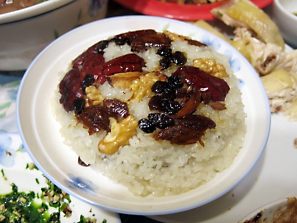
The “treasures” in babao porridge include red beans, lotus seeds, peanuts, dates, and walnuts.
In other regions of China, dishes like mutton hotpot, lamb soup, and babao porridge (also called eight-treasure porridge) take center stage during Dōngzhì. The purpose of all the dishes is to help keep the body warm and healthy during the cold winter months.
Don’t forget to save a plate for grandpa
Just as it is in most Chinese festivals, ancestor worship is an important part of Dōngzhì. Families might visit their ancestors’ graves to pay their respect, tidy up the tombs, burn incense, or set up altars with food offerings. In Taiwan, a popular Dōngzhì tradition is making nine-layer cakes as offerings to ancestors. Made from glutinous rice flour, the cakes are shaped like different animals—chickens, pigs, and tortoises—that are symbols of auspiciousness and good fortune.
It makes sense that so many regions of the world celebrate winter solstice. It’s a time to look forward to lengthening days and more hours of sunlight. Without the winter solstice, life would be pretty bleak—or in the words of that wild and crazy guy Steve Martin: “A day without sunshine is … like night.”
A few more fascinating winter solstice-related observations
Experience the rich traditions—and delicious cuisine—of China at any time of year during New! China’s Imperial Cities, Natural Splendor & Modern Marvels.
Comfort in a Cup: Global Tea Rituals
From Chinese tea rituals to Indian chai, tea is a universal sign of companionship, connection, and comfort.
Stone Dragons and Concrete Giants: China's Two "Great Walls"
China's ancient Great Wall kept invaders out for centuries, but can its modern counterpart—the Three Gorges Dam—keep the Yangtze River in check?
Lucky Charms: Symbolism in Chinese Culture
Discover the myriad signs of luck and prosperity with ancient roots in China.
Get The Inside Scoop On...
Like what you see here? Receive weekly updates right in your inbox.
inside-scoopArticles In This Edition

High Noon

Hygge and Lagom—A Guide to Scandinavian Living

Top 10: Adventures for Spring & Summer 2026

Turnaround Time

Where Argentina Meets the Alps: San Carlos de Bariloche