Catch a glimpse of Bariloche’s natural beauty as you ski the slopes of Cathedral Hill with Ezequiel Gonzalezsalas, Trip Experience Leader for Chile & Argentina: The Andes to Patagonia, followed by a plate of traditional picadas (finger food) at a local microbrewery.
As you will see in Ezequiel’s video above, Argentina’s beloved outdoor playground, San Carlos de Bariloche, is known for the beauty of its mountains and lakes. But for a richer understanding of the city, it’s worth taking a cue from the word “Bariloche,” a version of the indigenous term Vuriloche, which literally means “the people behind.” To fully appreciate the city, it helps to meet some of the most fascinating “people behind” its colorful 117-year history.
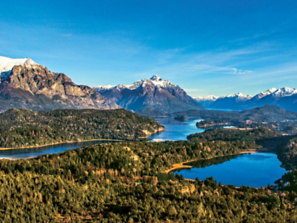
Set along the banks of the 40-mile-long Lake Nahuel Huapi, Bariloche is the gateway to Patagonia's Lake District.
Sweet beginnings
The story begins simply enough: with one determined character. Carlos Wiederhold, a German immigrant living in Chile, wanted to live in the Andes, and settled on the current site of Bariloche in 1895. He opened a general store named not for its contents but himself: La Alemena (the German). This small wooden outpost, which sold everything from sundries to penny candy, soon attracted his fellow Germans and Austrians, as well as a few Italians and Slovenians. With this mix as its founding population, perhaps it’s no surprise that the city modeled much of its architecture after Europe, designing itself to look like a fairy-tale village.
But Weiderhold was not the only European named Carlos to define the city. In 1928, Swiss candymaker Carlos Tribelhorn (often misspelled as Triberholn) opened a chocolate shop in the city center. The handmade confections combined traditional Swiss chocolate-making skills with the use of regional fruit. The unassuming white-stone shop, a wooden balcony its only flourish, drew crowds of eager locals, and soon other master chocolatiers opened storefronts. To this day, Bariloche is synonymous with chocolate for many Argentines.
The dark side
Not everyone came to Bariloche with aims of contributing to local life. One notorious duo famously used Bariloche as a way station on their criminal exploits. In the 1880s. Robert Parker and Harry Longabaugh, better known as Butch Cassidy and the Sundance Kid, fled to Argentina in hopes of ditching the well-known Pinkerton Detective Agency, which had been pursuing the bank robbers since their Wild Bunch days. After several quiet years ranching in their adopted country, the pair returned to their bank-robbing ways, which revealed their location to Pinkerton detectives, who had never stopped trailing them.
With their cover blown, the duo set off for Bariloche, traversing Lake Nahuel Huapi safely into Chile. But Argentina still beckoned them, and when the heat died down, they returned. This time, their idyll was shorter: Within the year, the pair robbed yet another bank, and once again, Bariloche was their escape hatch. They hiked from the outskirts of the city into the mountains, leaving the frustrated Pinkerton detectives in their wake. The robbers never made it back to Bariloche, though historians still debate whether they died in a Bolivian shootout or retired to life as ranchers elsewhere.
The same remoteness that made the city so attractive to the famous outlaws made it an ideal haven for criminals who occupied a much darker place in history a half-century later. After World War II, Argentina became a destination for Nazis trying to escape prosecution. While easy-to-recognize figures like Adolph Eichmann passed through Bariloche briefly, others were able to fly under the radar and settle in. One SS captain, for instance, lived here 50 years—eventually sitting on the board of a local school—before his discovery and arrest. Bariloche’s most notorious author, Abel Basti, even claims that Hitler and mistress Eva Braun did not die in Germany, but in fact lived out the rest of their lives here. Though such a claim is easily disputed, it seems fitting that Bariloche's dramatic landscapes might give rise to such wild speculations.
Visions of grandeur
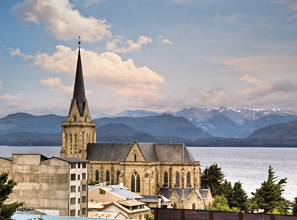
The Cathedral of San Carlos de Bariloche lends to the city’s European-inspired charm.
Wild ideas played a central role in a scheme intended to put Argentina on the scientific map. In 1948. President Juan Peron chose Bariloche’s Huemul Island to be the location of the world’s first fusion reactor. The top-secret project cost $300 million—and failed. The official reason for the flop was that the advanced technology needed was simply not available in such a remote locale at that time. The reason given by most locals was that Ronald Richter, the plant overseer, was mentally unhinged. With his wild mop of hair and a penchant for wearing spy-style raincoats at all times, the man who claimed he could deliver nuclear energy in milk bottles was taken seriously by few aside from Peron. The president eventually admitted his error, shutting down the project in embarrassment, while leaving behind an empty complex, the remnants of which can still be visited today.
A man who had no such problem finishing what he started was Alejandro Bustillo, whose architecture anchors the city. One of the nation’s most acclaimed painters and architects, Bustillo designed the luxury Llao Llao Hotel, a grand all-wood structure—which burnt to the ground nearly as soon as it was finished. Undeterred, he redesigned the hotel to mimic its original glory but in concrete and stone, and the sweeping, red-roofed result became a town icon. (It remains a member of The Leading Hotels of the World consortium.) Among his other edifices here, the Cathedral of San Carlos de Bariloche is most striking, a castle-like Neo-Gothic church that furthers the impression of a European idyll.
Experience the scenic beauty and European-inspired charms of Bariloche during Chile & Argentina: The Andes to Patagonia.


