
During Heart of India, our travelers have the opportunity to participate in the Sikh tradition of the communal langar meal, prepared and served by volunteers at Sri Bangla Sahib gurdwara in Delhi.
In the late 15th century, in the Punjab region of the Indian subcontinent, a man named Nanak went to bathe in a stream and miraculously disappeared. He would be presumed dead for three days. When he emerged from the unknown, he would start a spiritual revolution.
Nanak began traveling across the continent, preaching to people of all different religions, calling out hypocrisy, the empty promises he had been fed through different teachings. At this time, there was a large social divide, a staggering dichotomy between Hindus and Muslims. However, not once did Nanak ask his audience to convert to another religion, never once did he scorn those different from him—he merely asked that they be true to whichever religion they served.
Nanak became known as Guru Nanak, and as his hymns and ideas spread, both a religion and philosophy—a way of life—was formed: Sikhism. It became a monotheistic religion that blended both Hinduism and Muslim ideals. Guru Nanak was full of compassion, and thus his teachings were imbued with his harmonious ideas. He believed that peace could exist between all people, regardless of religion. Specifically, he asked that his followers be in unity with all of God’s creations—especially the Earth itself.
The term “Sikh” in Punjabi translates to “learner.” As the religion was founded by a spiritual teacher, the followers of the religion seek spiritual guidance, and are spiritual students. Guru Nanak was the first of ten gurus to pioneer the religion. After his passing in 1593, Guru Nanak’s spirit, which is of the eternal Guru, was passed to his ten successors.
When the tenth guru, Guru Gobind Singh, passed in 1708, the spirit was then transferred into Sikhism’s sacred text, the Guru Granth Sahib or the Adi Granth. This text is central to worship in Sikh temples, known as gurdwaras. The Adi Granth contains nearly 6,000 hymns alongside scripture and prayers. It is composed of several different languages, though primarily it was written in Punjabi or Hindi. This text is central to both worship and the values of the Sikh community.
Core Principals
Stemming from the teachings of the Gurus and thus the Adi Granth, Sikh communities have central values that guide both their religious practices and their way of life. Sikhism is a community of egalitarians, in which all women, men, and social classes are to be treated equally. Due to this, the “caste” system, a hereditary social order present in forms of Hinduism, is disregarded in Sikhism. While the caste system can be evident in certain marriage practices and temples per tradition, modern Sikh practices do not necessarily adhere to these rules.

An O.A.T. traveler helps prepare a communal langar lunch alongside local volunteers.
A sense of community can even be found in Sikh architecture and dining practices. During meals in communal refectories, or langars, seating is arranged on the floor so that all people sit in a line next to one another, and no individual is ahead of another. Langars were designed as a protest to division, a room created for unity. Langars are also commonly called free community kitchens and encourage sharing food with those in need. The food eaten in these spaces is made by volunteers—anyone can eat and anyone can cook! Just as bands of Sikh travelers did in the past, these volunteers both cook and share whatever they have, inspired by Sikh values of kindness.
A core belief of those practicing Sikhism is the idea of seva, or selfless service. This term originates from the Sanskrit root sev, to serve. The term can be defined as either worship of a god or service to mankind. The Sikh definition of seva combines both, uniting both devotion and duty. The Gurus established labor as honorable, and thus Sikh people are inspired to work to show their devotion to God.
Similarly, the value of kirat kharni, or honest labor, promotes the hardworking spirit of Sikhs. This concept combines both the need to live an honest life with the desire to share earnings with the less fortunate. It is the idea of thinking of others while working hard. Kirat kharni and seva values are evident in practices like those in the Langar.
Sikhism also follows the idea of sarbat da bhala, the welfare of all. Like kirat kharni, altruism is key. This concept calls people into service against injustice and promotes equality. In prayer, this means that individuals should not only pray for themselves, but for all people of the world. Furthermore, community and political values are oriented around this idea of welfare. These values are evident in both the Adi Granth and the individual lives of the ten Gurus.
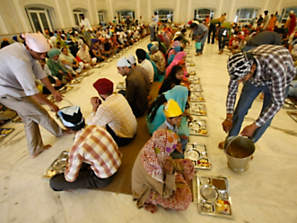
Each day, more than 30,000 people—regardless of religion or caste—are welcomed for a meal at Bangla Sahib.
Nature and the Environment
Sikhism offers a unique perspective on the environment and sustainability. Though there are debates on the matter, most Sikhs practice a vegetarian lifestyle. This is due to teachings in the Adi Granth and compassion for other living creatures. Individuals and certain gurdwaras may practice differently, however. Sikhs who do eat meat typically only eat jhatka meat, from an animal slain with a single decapitating strike. This, too, is out of respect for the creature.
At the heart of Sikhism, there is the idea of interconnectedness between all living beings. This is woven into the core values of the religion. Furthermore, the Earth is treated as a living being, something to be respected and revered as humanity is. Just as seva promotes service to one another, it promotes service for the Earth—and due to this, Sikhs find themselves as caretakers of the environment. Because of this responsibility, Sikh people reject exploitation and the overuse of natural resources. In both their personal lives and when at gurdwaras, the Sikh community sticks to low-waste, high-sustainable practices.
Furthermore, Sikhism practices the idea of environmental activism. On top of living eco-friendly lives, Sikhs strive to upkeep the wellbeing of their communities—in alignment with kirat kharni. This means that when the world’s communities are facing oppression, Sikh people speak up and work hard. As temperatures and tensions rise, the Sikh community continues to be activists against climate change. From individuals planting trees, especially around gurdwaras, to taking stands against carbon emissions, to supporting different political movements and environmental education, the Sikh people are contributing to environmental movements and natural justice around the world.
Though there are barriers to the environmental justice Sikhism seeks, the community never gives up, as they are motivated by sarbat da bhala, their commitment to one another. Evident in multiple of the Gurus’ lives and in Sikh history, these spiritual teachers and learners have always been advocates for the wellbeing of their communities through the wellbeing of the Earth. Action against injustice has always been rooted in this earthly equality. Just as the caste system is disregarded in Sikh practices, humanity is seen as an equal with the Earth, and thus both the Earth and humanity care for one another. Overall, Sikhs believe strongly in resilience and compassion in the face of injustice and continue to fight for our environment.
Learn about the Sikh religion and the interplay of faiths on the subcontinent during Heart of India.
The End—and Influence—of the British Raj: Exploring India's Path to Independence
A professional artist shares paintings inspired by what she found most beautiful in Japan.
Dogs in Hindu Mythology: Loyal Companions and Divine Messengers
Discover the divine and surprising roles of dogs in Hindu mythology—from loyal companions of gods to embodiments of cosmic principles.
Where it Counts: Mathematical Achievements in Ancient India
From the use of numerals to the concept of zero, Indian mathematicians were true pioneers.
Get The Inside Scoop On...
Like what you see here? Receive weekly updates right in your inbox.
inside-scoopArticles In This Edition

A Compassionate Nature: Sikhism & the Environment

A Connection Across Continents

Boston Community Service: The Healing Power of Music

Read the Beads

Rent Control

Top 10 Adventures for Winter 2026