
As you’ll discover during Safari Serengeti: Tanzania Lodge & Tented Safari, elephants are endlessly fascinating to observe in the wild—especially if you’re aware of their remarkable intelligence.
Save $500 on ANY 2027 departure
As you’ll discover during Safari Serengeti: Tanzania Lodge & Tented Safari, elephants are endlessly fascinating to observe in the wild—especially if you’re aware of their remarkable intelligence.
How many of us go into a panic because we can’t remember where we left our keys? If elephants ever observed this behavior, they would probably break out in hysterics. Their phenomenal memory isn’t just a meaningless cliché—it’s backed by hard science. In fact, elephants truly possess one of the most remarkable memories in the entire animal kingdom.
In just one of countless documented cases, a herd of elephants in Tanzania was observed returning to a specific location where they remembered finding water once before during a drought—12 years earlier. This isn’t just some parlor trick, either. Elephants have an uncanny ability to retain and recall vital survival information like that over a vast span of both distance and years. Most animals—and people, too—rarely stray from a familiar migration path or set of roadways. Elephants, on the other hand, will alter a long-established migration route in response to environmental changes, behavior that shows a capacity for adaptability and foresight.
Elephants don’t just remember waterholes and food sources, either. Their phenomenal memory extends to interactions with humans. Elephants remember individual people and their behavior towards them. So, in areas where elephants are protected and treated kindly, they will exhibit trust and genuine curiosity towards any humans they encounter. But in regions where they had once been hunted or had not been welcomed, they will be wary or even act aggressively towards people. They also recognize and greet humans they have not seen in many years. So be nice to elephants, because they’ll always remember a kindness—and never forget a slight.
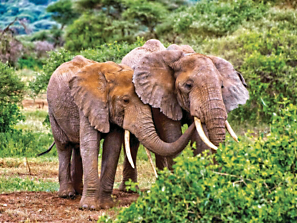
Elephants’ off-the-charts memory also plays a significant role in a range of emotional behaviors that have been widely observed—things like joy, grief, and empathy. They will mourn the loss of a herd member, return to the site of their death, and have been observed gently nudging the bones of the dead. Scientists have suggested that these deep emotional connections are triggered by long-term memories of a fallen companion. Elephants also use their trunks in a reassuring manner to comfort each other in times of distress. What is especially remarkable is that the range of emotions they display is not just limited to their own species—they have been known to show empathy towards other animals as well as humans. If you remain skeptical about the intelligence and emotional depth of elephants, here are a couple of illustrations that may convince you otherwise.
One very big happy family
Lawrence Anthony was a South African environmentalist and conservationist who owned Thula Thula, a small game reserve in the savanna of Zululand. He found out about a herd of nine "delinquent" wild African elephants that were going to be killed due to behavioral issues—they had been rampaging through populated areas and were considered quite dangerous. Thinking he could somehow rehabilitate them and spare them their cruel fate, Anthony took all of them in. At first, the elephants wanted nothing to do with their new human caregiver. But night after night Anthony camped out with the herd to earn their trust—which almost got him trampled on more than one occasion. But little by little, they took him in. First the matriarch, Nana, followed by the rest of the herd. Anthony ended up forging deep bonds with the herd, based on trust and respect.
Anthony also used a combination of body language, eye contact, and vocalizations (or "whispering") that he believed gave him a deeper understanding of the elephants’ communication patterns and social structures. The original nine "delinquent" elephants, now content and at peace in their new home, increased to 21 elephants. They became part of his family—and Anthony became part of theirs.
When it gets really interesting is what happened after Anthony died. His wife, Françoise Malby, documents how two days after his unexpected death, a procession of 21 elephants with Nana in the lead came out of the bush and right up to Anthony’s house. They stood there staring at her with their huge eyes while making grief-stricken moans. This lasted for more than an hour. Then the solemn procession slowly turned around and disappeared into the bush, one by one.
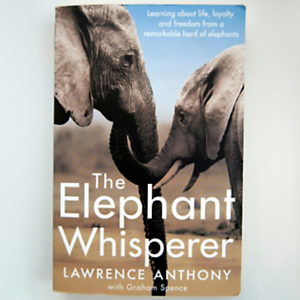
Françoise believed it was a way for the animals that had been given safe haven by Anthony to say goodbye. Then again, perhaps she was reading too much into it. But on the exact same day one year later, the elephants returned. All 21, led by Nana, in the same procession. And the year after that, they were back. Again and again, the elephants returned to mourn Anthony like one of the herd. (You can read about Anthony’s experiences with his elephants in his 2009 book, The Elephant Whisperer: My Life with the Herd in the African Wild.)
Saved by the bull …
Some of you may remember the classic TV show Lassie, and how the clever collie was always ready to get help when Timmy fell down the well. In a documented incident in Kruger National Park in 2017, an elephant one-upped anything Lassie could have pulled off. When a young calf slipped and fell into a man-made water hole, the youngster quickly found itself in serious trouble. Seeing what was going on, a wild elephant came rushing over the waterhole and began pushing, pulling, and half kicking the little calf onto high ground and out of danger. Basically, saving its life.
You’re probably thinking, oh, that’s sweet, but what’s the big deal? The elephant was just acting on instinct and protecting its young. But the thing is, the animal that was struggling for its life in the watering hole wasn’t an elephant calf—it was an impala calf. How does one interpret watching an elephant display distress and urgency for a creature of another species in distress—and then taking action to rescue it? Even Lassie must be scratching her head …
Grey matter—the secret behind elephant intelligence
An elephant’s superior memory and highly developed intelligence all boils down to one thing—a very large brain. One with a large temporal lobe that is linked to memory, and a large hippocampus that is responsible for emotions and spatial awareness. Weighing up to eleven pounds, the supersized brain (not all that different from a human brain, actually) has a sophisticated architecture that enables elephants to remember everything from complex social networks and migration routes to individual humans and other animals they may have encountered decades ago. It also contributes to their cognitive abilities—allowing them to perform tasks that require advanced problem-solving skills. Even after expending a lot of that brain power on survival, they have plenty leftover to engage in play, experiment with the use of tools, and even exhibit behaviors that suggest self-awareness.
A few more fascinating examples of elephant intelligence
An elephant researcher in Kenya’s Amboseli National Park witnessed a particularly notable example of elephant cooperation several years ago. One day an impetuous juvenile named Ebony, daughter of the herd’s matriarch, Echo, bounded over and found herself smack-dab in the middle of a clan that was not her own. As a show of dominance, the rival clan decided to keep her captive with their trunks and legs. Echo went over with some of her elder daughters to rescue Ebony but they failed—they needed reinforcements. So they turned around, gathered all the members of their extended family, and charged into the clan of kidnappers and rescued Ebony. Sounds pretty straightforward, but what makes this truly remarkable animal behavior is the combination of forethought, teamwork, and problem-solving that was necessary to facilitate the rescue—something rarely seen in the animal world. And not very often in the human world, come to think of it …
Observe the fascinating behavior of elephants in the wild during Safari Serengeti: Tanzania Lodge & Tented Safari.
A Day in the Wild: Inside Life at an African Safari Camp
What does a typical day on safari really look like? We sat down with Blessing Dzikamai Muchenje—the top Trip Experience Leader for our Ultimate Africa: Botswana, Zambia & Zimbabwe Safari adventure—to get an insider's perspective on life in the bush.
Observing Life, Death, and Survival in the African Savannah
While witnessing animals in the wild, this traveler drew parallels to her own human experience.
Animal House
The cooling strategy of what creatures inspired engineers to develop more energy-efficient buildings in hot climates?
Get The Inside Scoop On...
Like what you see here? Receive weekly updates right in your inbox.
inside-scoopArticles In This Edition

Africa, Primordial: A Journey Back to the Beginning

Animal Attraction

Herd Mentality: Elephants at the Apex of Animal Intelligence

Into Africa: Top Adventures for Safari … and More

Nana’s Dream Realized: The Lewis Family Safari

Running Wild