By Bonnie Mack, 10-time traveler from Clearwater, FL
Whenever I think of China, I think of beauty and grace. Strange thoughts, no? Looking at the treasures from past trips that are displayed in my home, I see cloisonne vases with beautiful flowers embedded in the metal, stunning brocaded jackets in red and gold silk, embroidered wall hangings, and lamps with graceful goddesses and silk lampshades fashioned after the lotus flower.
China's beauty and grace also emanate in her high rolling mountains cloaked with green trees for as far as the eye can see; rivers like the Yangtze, winding their way through steep gorges; and monumental temples and huge squares, high pagodas, and peaceful parks that invite locals to perform Tai Chi or engage in a game of checkers or chess.
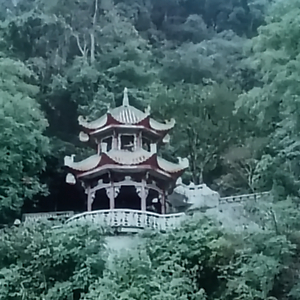
China’s tree-covered mountains and pagodas embodied “beauty and grace.”
I'll never forget my introduction to China in 1987, about fifteen years after President Nixon opened China to Americans. I'd been to the Soviet Union and other Communist countries since 1977, so I wasn't completely surprised at how bleak life was for the country's inhabitants. I was intrigued when I saw thousands of bicycles crowding streets—many of them with chickens (some dead, others alive) dangling from their handlebars. Automobiles were still scarce, so it was pretty safe for the women sweeping the streets and intersections with brooms made from twigs. At the Ming tombs, every leaf that fell on the grass and walkway was meticulously removed by other women and their rustic brooms.
We were invited into factories where artisans carefully carved figurines from jade and ivory, or stamped trees or houses on cheap nylon fans exported around the world. Just like workers in the fan factory, where one's “skill” was stamping trees or houses over and over again, day after day, men at the shirt factory either sewed collars or cuffs all day, every day. No “cross-training” here, either.
I began searching for something that wasn't bleak about China. For the most part, it was clean. Streets and grass were swept, as were sidewalks. My pockets were stuffed with candy wrappers, until I discovered that the cute stone pandas on sidewalks actually held trash. Factories provided childcare for their workers, which was a relief.

Bonnie while cruising the Li River in 1987.
A country that was once a magnificent kingdom, with incredible advancements, was worn and tired. I thoroughly enjoyed all the incredible sites China had to offer, among which was our boat ride on Guilin's Li River. We were surrounded by the karst limestone mountains that took our breath away, even on a gray, rainy day. They looked like giant gumdrops. Guilin was a place I'll never forget. I left China thinking that nothing would change, even if I returned in 25 years.
WRONG! I found myself back in 2000, and there was little of the “old China” left to see. Shanghai's dirty port was a site to behold, with tall skyscrapers flanking its riverbank. The old broken stone sidewalk along the waterfront (known as the Bund) had been turned into a huge park with lots of green grass. Skyscrapers filled the city, and their lights sparkled like diamonds on a place that was once dark and gloomy. The museum, that was housed in an old colonial brownstone building, had been replaced by one of the most fabulous museums I've seen anywhere in the world and, believe me, I've had my share of museums around the world.
What I found of great interest was books like Life and Death in Shanghai and Wild Swans were now available in the museum's gift shop. Both books honestly portrayed how brutal life was under Chairman Mao. I was equally surprised by our guide, who said that the government now admitted that “Mao made some mistakes.”
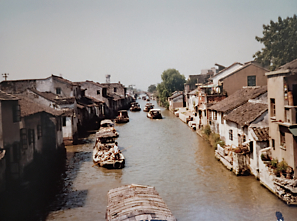
In 1987, Suzhou’s beauty was overshadowed by poor living conditions.
Suzhou's waterway, with tired old buildings atop its banks, also had a face lift, since my first visit. Modern apartment buildings replaced old shacks. I was impressed, because it actually looked like a good deal of planning went into the apartment communities. There were paved streets, parking lots, and playgrounds—even landscaping. In places like Bangkok, one might find a beautiful 5-star hotel sitting next to an undeveloped lot that looked like a giant trash bin. No, China, indeed, had come a very long way in a relatively short time
But problems also come with progress. Chengdu offered beautiful pagodas, and a wonderful panda sanctuary, but they were buried beneath skies laden with pollution, so the sun couldn't break through. Nonetheless, the pandas made the visit truly unforgettable.
In 2000, our guide informed us that photos weren't allowed in Xian's museum that housed the famous warriors. When I pressed him further about how safe it would be to take photos, he smiled, and cautioned me to keep a watchful eye for the guards.
We arrived in Xian at the conclusion of our cruise on the Yangtze, and it was long after the museum's closing hours. Not to worry—the authorities wanted to keep tourists happy, so they didn't mind opening the museum at 11:00 pm, and waking the man who discovered the warriors, so he could come for photos and autographs—at a price.
It was a wonderful experience, because we were afraid we'd have to miss the museum altogether, since our arrival was delayed due to the Yangtze's floods. Once again, the government aimed for happy tourists, so they gave us priority on the flight out of Xian the following morning—to the dismay of the poor Chinese, whose seats we occupied.
I was so impressed by the improvements in China—not to mention its interesting history, temples, and monuments, that I returned in 2005. Xian now had two additional museums, with still more warriors. The museums were fabulous, and most touching was that each warrior's face depicted that of an actual person. Talk about a look back into history!
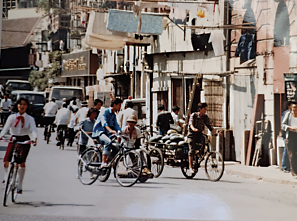
Bicycles dominated city streets in 1987.
Beijing, like Shanghai, was now crowded with modern office buildings and 5-star hotels. Wide streets and new highways were filled with cars, and bicycles had decreased immeasurably. Old housing had been replaced by new apartments—with indoor plumbing. Of course, the everyday man probably couldn't afford to live in them. It was getting more difficult to find neighborhoods featuring traditional Chinese architecture, with tile roofs and round doorways.
I was so happy to see that Overseas Adventure Travel has introduced all the beautiful and exciting places in China that I love so much. It's one of my favorite destinations, and I'm certain that others will agree. The Chinese people have always been welcoming and friendly, and I hold the experiences I've shared with them close to my heart.
See how ancient traditions coexist with modern innovation during our New! China’s Imperial Cities, Natural Splendor & Modern Marvels adventure.


