
Every Moai statue on Easter Island is unique, as Maureen learned during the optional pre-trip extension to The Wilderness Beyond: Patagonia, Tierra del Fuego & the Chilean Fjords.
By Maureen Rauscher, 28-time traveler from St. Louis, MO
Travel is a passion of mine. I've been fortunate enough to visit all seven continents and almost 100 countries, some more than once. My interests have changed over the years. Initially I visited the places most people want to visit abroad, European cities and antiquities like the pyramids of Egypt. As I became older, I became more interested in different cultures and nature, especially those cultures different than my own.
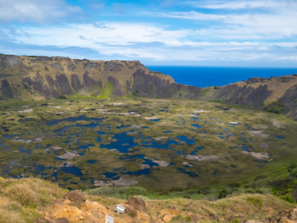
A freshwater lake formed in the crater of Rano Kao Volcano.
Of all the places I've visited, I would say Easter Island is the most remote place I have ever been, including Antarctica, partially due to its size and distance from any large land mass. I have an app on my phone that shows where I am in the world. It showed where I was on Easter Island, literally in the middle of the ocean, almost five hours by plane from South America, and a small dot barely detected. Even the islands of Indonesia showed a land mass. Amazing!
Lessons in Local Life
One of the reasons I love to travel with O.A.T. is that the Trip Experience Leaders initiate interactions with locals, and I have the opportunity to interact in the free time allowed. Tourism on Easter Island is an obvious major source of funding, taxis, restaurants, hotels, boating. There are also some small farms and fishing.
There are several issues driving the young people to leave the island even though they love the area. There were only about 300 people reportedly left on the island after the Europeans arrived and disease and other factors caused the population to shrink. Therefore, most of the people are somehow related; we were told they don't want to marry distant cousins.
The internet is sporadic at best. One young man told me he had to get on his computer at about 5am to take a class online in order to get a degree—and even then it was often not working. Other than tourism and small, primarily non-professional jobs in restaurants, etc., opportunities for jobs are quite limited.
We attended a local show with traditional dances and the history of Rapi Nui. The next day I encountered two of the young women who were dancers in the show. They were both saving money to leave the island to get schooling and better jobs in South America. We had a home visit to a woman who had a garden of native plants as part of her yard. She grew much of the food which we were then given for lunch. Her home was quite nice but lacked things taken for granted in the U.S., such as air conditioning. She was expanding the home she inherited from her parents to try to provide rooms for guests and do more for tourists. I also spoke with the driver who gave me a ride back to the hotel. "Taxis" are really just private cars, which someone calls for you to get a ride wherever you want to go.
We were told by our local guide Teva that there were currently about 5,000 people on the island. Most of them live in Hanga Roa on the western coast. The views from our hotel were fantastic, right on the ocean. Several restaurants were also on the ocean and offered excellent food and drinks and modest prices.
Mysteries of the Moai
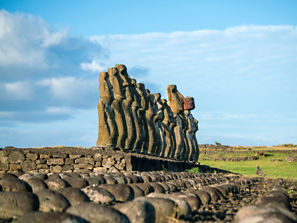
The Moai at Ahu Tongariki.
There are many theories on why the Moai were built. They face inland, not outward to scare invaders, which is what I would have thought. One theory suggests they were built to honor ancestors, which is predictable. Another is that they were built looking inland at the people so that the people would be aware that they were being watched. They were expected to give a certain portion of their income to the ruler. The Moai were watching to be sure they didn't cheat on what they were giving. That was more surprising.
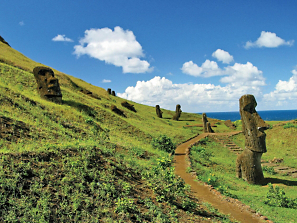
The Moai on the slopes of Rano Raraku.
The Moai are not all alike. The hairstyles are different as are sizes, arm placement, etc. We were told many were painted and had shells for eyes, which wore off or broke over the years. We also saw several that obviously fell when being removed from the quarry where they were carved. I had watched a movie before going theorizing how the Moai were moved from place to place. The locals seemed to concur with what I had seen in the movie.
I was surprised by how touched I was by the Moai—their size, differences, and how much their basic features mirrored the features of the local people. The people were very friendly, the seafood tasty, and I managed to get a pisco sour, one of my favorite drinks previously tasted in Peru. It definitely was a very memorable experience.
Discover the enduring mysteries and modern-day life of Easter Island during the optional pre-trip extension to The Wilderness Beyond: Patagonia, Tierra del Fuego & the Chilean Fjords.
Five Dollars a Day
Join this traveler on her year-long adventure through Central and South America.
One Small Personal Victory in Patagonia
Despite a recent illness, one traveler was determined to conquer Torres del Paine.
Sailing Through History
This traveler visited Cape Horn, a pivotal location for his ancestors who rounded the same tip en route to California.
Get The Inside Scoop On...
Like what you see here? Receive weekly updates right in your inbox.
inside-scoopArticles In This Edition

10 O.A.T. Adventures into the Great Wide Open

Finding Balance: Must-See Sights and Hidden Gems in the Adriatic

Finding Family in Sicily: Behind the Scenes of a Remarkable Reunion

Lessons from Easter Island: Legends & Local Life

Sea Shells

Three Busy Months in East Africa: A Look Back with Sandra Vaughan

Where Sheep Outnumber Selfies: Scotland's Secret Medieval Marvel