Question: What winter sport—and mainstay of the Olympic Winter Games—made its Olympic debut at the Summer Games held in London in 1908?
Answer: Figure Skating
When figure skating debuted at the 1908 Summer Olympics in London, it would be the first ever winter sport to appear in the Olympic program—but bear in mind that back then there were no “Winter” Olympics, just one all-encompassing “Games of the Olympiad.” Figure skating would make one more guest appearance at the 1920 “Summer” Olympics in Antwerp before the birth of the official “Winter” Games in 1924 in Chamonix, France. At the time, however, the event was called the Chamonix International Winter Sports Week, but in 1926, the International Olympic Committee (IOC) decided to retroactively name it the first official “Winter Games.”
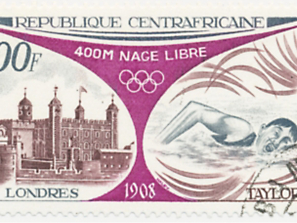
A postage stamp commemorating the 1908 Summer Games, where figure skating appeared as an exhibition sport.
In that same year, the IOC decided that the Winter Games would be held every four years in the same year as the Summer Games—and the sports granted Olympic status would be figure skating, skiing, ice hockey, bobsleigh, and tobogganing. They also decided that the Winter Games should be staged in the same country as the corresponding Summer Games, which caused a problem right out of the gate. The 1928 Olympic Summer Games had already been awarded to the Dutch capital of Amsterdam back in 1921. But last time we checked, there aren’t too many mountains in the “Low Countries,” so that wasn’t going to make much sense.
To the satisfaction of all the athletes competing on skis, St. Moritz, Switzerland, would end up hosting the second Winter Games in 1928—although we’re not sure how it went down with those competing in skijoring (skiers with horse-drawn harnesses), which made its first and last Olympic appearance in St. Moritz in 1928.
None of those decisions by the IOC about the Winter and Summer Games—holding them in the same year, the winter sports that would be included, and having them staged in the same country—would last long. It’s also doubtful that anyone in those early days of the modern Olympics could have anticipated the rather unusual circumstances around the venue for the 2026 Winter Games about to unfold in Italy ….
The Milano-Cortina 2026 Winter Olympics—Let the Games Begin …
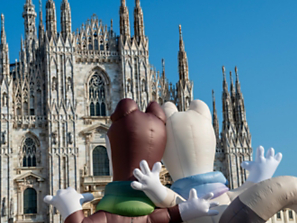
The 2026 Winter Games mascots in front of Milan’s Duomo.
You may want to freshen up your Italian if you’re planning to attend this year’s Winter Games—in case you have to hail a cab. Not only is this the first Olympics co-hosted by two cities—Milan and Cortina d'Ampezzo—but it will be the most geographically spread-out Winter Games in Olympic history. The two primary competition sites are more than 250 miles from each other, plus the closing ceremony will be in Verona, which is another 100 miles east of Milan—a total of 14 different venues scattered over more than 8,500 square miles. Madonna mia! If you’re thinking, “Oh well, I’ll just to stick to Cortina to catch all the skiing events,” guess again. Athletes will also be competing in three other mountain clusters quite a distance from Cortina d’Ampezzo. There will be shuttles and enhanced train service available, but still ...
Italy actually had good reasons for such a wide distribution of events. As you’re probably aware, this isn’t their first rodeo. Italy has hosted the Olympic Games three times already—the 1960 Summer Games in Rome, the 2006 Winter Games in Turin, and the 1956 Winter Games in … Cortina d’Ampezzo. For their third Winter Games, Italy decided to take a sustainable approach, with 93% of the sports venues either existing ones or temporary structures. This will be especially beneficial for the tiny resort town of Cortina d’Ampezzo, which would be greatly harmed by a slew of major construction projects. This more environmentally friendly event distribution also aligns with the 2020 Olympic Agenda’s vision for cities to consider sustainability when they host the Games.
Cortina—Then and Now …
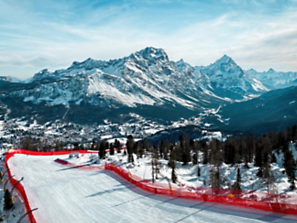
A ski slope in Cortina d’Ampezzo.
So, this is the second time around for Cortina d’Ampezzo. The sleepy ski resort nestled in a valley surrounded by the jagged spires of the Dolomites hosted the Winter Games in 1956—and finds itself in the global spotlight once again. The ski slopes and dramatic mountain scenery of Cortina may not have changed all that much over the past 70 years, but some things have …
Skis were longer in 1956, TVs were big and clunky, and it would be decades before the Internet and smart phones started ruling our lives. But the 1956 Winter Games in Cortina were the first games that people in the United States (and much of North America) could watch on that big, clunky TV. However, they had to be watched on tape delay. Broadcast satellites didn’t exist yet, so recordings of the events had to be shipped to the U.S. first. The 1956 Winter Games were also the last ones where all competitive sporting events—including figure skating—were held outdoors.
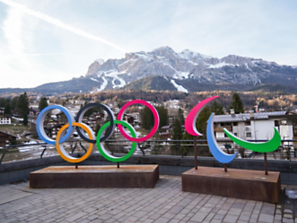
The logos for the 2026 Olympics and Winter Games in Cortina.
In 1956, Cortina’s open-air Olympic Ice Stadium was the venue for the Opening and Closing Ceremonies, men’s ice hockey competition, and figure skating competitions. For the 2026 Milan Cortina Winter Games, the modernized and now-enclosed stadium will be dedicated to hosting just one event—curling.
At the 1956 Cortina Winter Games, 821 athletes from 32 countries competed in 8 sports and 24 events. In the 2026 Games, there will be 2,900 athletes from more than 90 nations competing in 16 sports and 116 events. Women represented 16% of the competitors at the 1956 Games. At Milano Cortina 2026, 47% of participating athletes will be women, making them the most gender-balanced Olympic Games to date.
11 fascinating facts you may not know about the Olympic Games
- As old as the ice age—Figure skating may have emerged as an official Olympic sport in Chamonix, France, in 1924, but it was hardly a novel activity at the time. The roots of skating go back at least 5,000 years, when northern Europeans would strap animal bones to their feet and glide across frozen surfaces. They weren’t performing any triple axels, but still …
- Figure skating tragedy—The sport of figure skating suffered a devastating setback in 1961, when a plane carrying the entire U.S. figure skating team on its way to the World Championships in Prague crashed near Brussels, leaving no survivors on board.
- Bravi, Italia!—Along with being among the top 10 all-time medal-winning nations, Italy is the world’s leading fencing nation, with more Olympic medals in the sport than any other country.
- Blue Man Group—Have you ever noticed that every Italian sports team—not just in the Olympics—are always sporting blue uniforms? Italian athletes are affectionally known as the “Azzurri,” or “the Blues.” The origins go back to 1366 when a member of the House of Savoy displayed a large blue flag in tribute to the Madonna on his flagship. The “Azzurri” was adopted as the official color of athletic jerseys for all Italian national teams more than a century ago—the only exception was in 1938, when Benito Mussolini demanded that Italy’s national football team wear black shirts.
- Not even a fig leaf?—If you think outfits worn by Olympic athletes have occasionally bordered on the inappropriate in recent years, keep in mind what athletes wore in the original Olympic games—nothing. They competed naked.
- Nyuk, nyuk, nyuk—There may not be any more chariot racing, but events like sprinting and wrestling from the ancient Olympics are still part of the modern games. One event that didn’t make it was the pankration. Considered the ultimate fighting sport, the event had no weight class or time limit, just an all-out brawl until one competitor surrendered—or died. There were only two rules for athletes competing in the pankration: no biting and no eye gouging, which was probably a deal breaker for The Three Stooges …
- What the puck?!—You could say that the ice hockey competition at the first Winter Games in Chamonix was a bit one-sided. The Canadian team scored 85 times without conceding a single goal in its first three matches. They went on to win the tournament by scoring 122 goals—and giving up just three. So, it wasn’t a complete blow-out.
- Is the podium still up?—Because of a marking error, there was a bit of a delay in awarding American Anders Haugen his bronze ski jumping medal at the first Winter Games in Chamonix. It wasn’t until 1974—50 years later—that he finally received the medal he earned for his third-place finish. He was 83.
- Fans still carried a torch for Guido—An Italian speed skater, Guido Caroli, was the final torchbearer at the Cortina Winter Games in 1956. Before he lit the cauldron at Olympic Stadium, he tripped on a cable and came within a hairsbreadth of accidentally extinguishing the flame.
- Same time, next year—From 1924 to 1992, the Summer and Winter Games were held in the same year, every four years—the four-year period referred to as the “Olympiad.” But at its 1986 Session in Lausanne, the IOC decided to introduce a change. The last Summer and Winter Games held in the same year were in Barcelona (Summer Games) and Albertville (Winter Games) in 1992. Since then, the Summer and Winter Games are each still held every four years—but the Winter Games are held two years after each Summer Games.
- We’re number one!—There is one thing that hasn’t changed since the first known Olympics in 776 B.C. in Greece to the 2026 Milano Cortina Winter Games. Whether it’s medals around your neck or a crown of olive leaves, athletes still compete for the same thing: Bragging rights for the home country.
Witness the dramatic scenery of Chamonix, home of the first official Winter Games, during Alpine Europe: France, Italy's Dolomites, Switzerland & Austria.


