
In 1913, National Geographic published Hiram Bingham’s photographs documenting the excavation of Machu Picchu—an expedition funded by the National Geographic Society. See the wonder in all its glory during Machu Picchu & the Galápagos.
In 1913, National Geographic published Hiram Bingham’s photographs documenting the excavation of Machu Picchu—an expedition funded by the National Geographic Society. See the wonder in all its glory during Machu Picchu & the Galápagos.
Question: When the National Geographic Society began in the late 19th century, its first two presidents were co-founders of what storied American brand?
Answer: AT&T
When the National Geographic Society was formed more than a century ago, its first president was Gardiner Greene Hubbard, co-founder of American Telephone & Telegraph (AT&T). If you don’t recognize the name, perhaps the second president of National Geographic, who was Hubbard’s son-in-law and co-founder of “Ma Bell,” has a more familiar ring to it—Alexander Graham Bell, who invented the telephone in Boston in 1876.
The founders of National Geographic wanted to start some type of private club for wealthy patrons interested in travel and exploration. So early in January of 1888, a group of 33 prestigious explorers and scientists gathered at a venue called the Cosmos Club in Washington, D.C. with a stated goal of organizing “a society for the increase and diffusion of geographical knowledge.” After two weeks hammering out the details and establishing bylaws, the National Geographic Society was officially born on January 27, 1888.
In October of that same year, National Geographic Magazine began publication as the official journal of the National Geographic Society, a nonprofit organization dedicated to funding science and exploration across the planet. The magazine started out as a dry, scholarly journal with text and graphs, however, and wasn’t doing much to spread the society’s “geographical knowledge” to a broad audience. That began to change in 1905, when the magazine pivoted to embrace vivid narratives and black and white photography. Color photography—along with the magazine’s iconic yellow border—began appearing in the 1910s and helped to propel National Geographic Magazine into one of the most recognized and respected brands in the world.
Picture perfect—a few of National Geographic’s most memorable covers
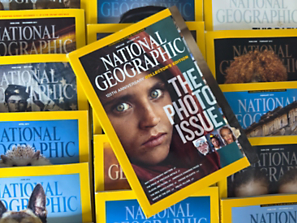
Initially appearing in 1985, the photo of “The Afghan Girl” remains one of the magazine’s most famous covers.
For more than a century, photography has been the hallmark of National Geographic Magazine—and many of their covers have achieved near legendary status. Arguably, the most famous one may be the June 1985 cover called “The Afghan Girl,” a portrait of a 12-year-old girl with haunting green eyes in a refugee camp near Peshawar, Pakistan. The girl’s identity remained an unsolved mystery for 17 years until National Geographic Magazine tracked her down living in the mountainous Tora Bora region of Afghanistan—and Sharbat Gula appeared again on the magazine’s April 2002 cover.
Other famous photos include the October 1978 cover “Conversations with a Gorilla,” with “Koko,” a female western lowland gorilla that had been taught sign language, holding a camera and taking her own picture. One of the most iconic photos in recent world history, Neil Armstrong’s shot of “Buzz” Aldrin walking across the surface of the moon, appeared on the December 1969 cover, “First Explorers on the Moon.” National Geographic Magazine had sent a photographer to California’s redwood forest for an entire year to capture the majesty of the world’s tallest trees—one of his shots, a 1,500-year-old, 300-foot-tall redwood, appears on the December 2009 cover, called “The Tallest Trees.”
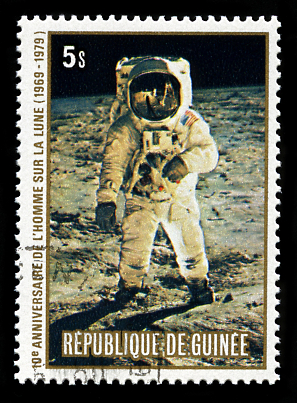
In addition to appearing on a cover, Neil Armstrong’s photo of Buzz Aldrin has also graced postage stamps around the world.
With more than 1,500 covers to choose from, it’s difficult to narrow them down. For “cute,” it’s hard to top the July 2006 cover “Panda Inc.,” of a baby panda celebrating its first birthday at the Smithsonian National Zoo in Washington, D.C. Or “The Smart Dog,” a scruffy looking black and white Border Collie that turned out to know more than 200 words. Many people love “Three Irish Boys with a Horse,” an iconic image of three Dublin boys hugging a pony from September 1994.
But National Geographic is a lot more than just pretty pictures
The first National Geographic Society-sponsored project was a two-year expedition beginning in 1890 that mapped Alaska’s Mount St. Elias region, a team that also discovered Mount Logan, Canada’s highest peak. Since then, National Geographic has funded more than 15,000 scientific research, exploration, and conservation projects around the world, ranging everywhere from the deepest oceans to the far reaches of outer space.
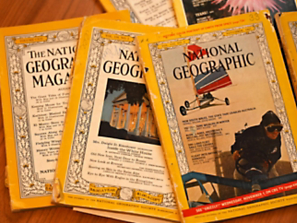
Vintage covers show how the magazine’s design has evolved over the years.
Robert E. Peary’s successful 1909 expedition to the North Pole was supported by National Geographic, as was Richard E. Byrd’s 1929 flight over the South Pole. So were Jane Goodall’s studies of chimpanzees in Tanzania that began in 1961, and Dian Fossey’s study of mountain gorillas in Rwanda that began in 1967. There aren’t too many important twentieth-century exploration milestones that National Geographic didn’t have a hand in.
National Geographic also played a big part in introducing Machu Picchu to the world. When a young Yale professor named Hiram Bingham “rediscovered” Machu Picchu in 1911, he couldn’t wait to share his discovery. But untouched for more than 300 years, the site was overrun with vegetation and required further excavations. He got his chance when the National Geographic Society joined Yale University in funding a return expedition to the site, then dedicated the entirety of the April 1913 issue of National Geographic Magazine to showcasing Machu Picchu, referring to the “citadel above the clouds” and the Inca’s “wonderful city of refuge on the mountain top.”
Even National Geographic’s headquarters has stories to tell
When the National Geographic Society was founded in 1888, they didn’t have their own building and continued to meet at places like the Cosmos Club in Washington D.C. In 1904, they opened their own building in D.C., Hubbard Memorial Hall, naming it after its first president. They quickly outgrew their shiny new headquarters as membership soared, however, and had to erect an entirely new building in 1912, with further expansions taking place in the 1960s and 1980s. And the complex of buildings that make up the current headquarters of National Geographic in Washington D.C. certainly has a few rather unusual surprises from its past …
The National Geographic Society was located close to the Soviet embassy, so when the Cold War started heating up in the mid-60s the FBI decided to operate a clandestine surveillance office inside the Society’s headquarters—which they would use as a base to spy on the Soviets until the early 1970s. The story the FBI used to cover its tracks was that the office was their “Mid-Atlantic Research Committee.”

The National Geographic Society headquarters in Washington, D.C.
With the threat of nuclear war at its height, many buildings in Washington, D.C. had fallout shelters built in the 1960s. Most of these shelters scattered through the city were quite spartan, but not the one at the National Geographic Society headquarters. With comfy cots, showers, medical supplies, toiletries, and other amenities, waiting out a nuclear war wouldn’t have been that much different than a stay at the Ritz. Oh, and the shelter even had its own morgue.
The headquarters didn’t just house a large staff of 9-to-5 workers, either. It’s also served as the literal home for explorers for more than a century. Explorers near and far stayed at the complex while attending receptions and regaling members of tales of their adventures. And people are still buzzing about another group of regular guests at the National Geographic Society’s headquarters. Bees, lots of bees. Large bee colonies (each of 50,000 or more) have been returning to a balcony of the Society’s 16th Street building since 2011. Why? They are attracted to the 18 acres of flowering trees at the White House, which is less than a mile away. A staff member performs volunteer beekeeping duties and as much as 500 pounds of honey have been harvested in some years.
So, is National Geographic just one more endangered species?
While the National Geographic Society remains a global media and educational powerhouse with few peers, it has found it increasingly difficult to keep pace in the digital age. A strange partnership with Fox in 2015 turned the venerable non-profit to a for-profit, then Disney took over Fox and ownership shifted once again. However it pans out, the National Geographic Society continues to inspire and educate millions of people around the world while promoting a deeper understanding of the natural world.
A few more fascinating facts about National Geographic
Explore Machu Picchu, whose excavation was famously funded by the National Geographic Society, during Machu Picchu & the Galápagos.
Heavenly Valley
What did the ancient Incas see reflected in the waters of the Urubamba River in Peru’s Sacred Valley?
Hoppy Hour
What is used to activate the fermentation process in "chicha," a traditional corn-based beer made in Peru?
String Theory
What ancient civilization with no written language used "quipus," an intricate system of knotted strings, as a form of communication to rule over their vast empire?
Get The Inside Scoop On...
Like what you see here? Receive weekly updates right in your inbox.
inside-scoopArticles In This Edition

Always More to See: Top 10 Most Popular Optional Extensions

Announcing O.A.T.’s NEW YouTube Channel

High Society

On the Road Okonomiyaki

Out of the Rain

Sailing Through History

Teeth, Thorns & Tap-Dancing Birds: Australia’s Remarkable Wildlife

The White Wonderment of Antarctica