
Explore the legacy and enduring mysteries of the Inca civilization—including their unique system of communication—during Machu Picchu & the Galápagos.
Explore the legacy and enduring mysteries of the Inca civilization—including their unique system of communication—during Machu Picchu & the Galápagos.
Question: What ancient civilization with no written language used “quipus,” an intricate system of knotted strings, as a form of communication to rule over their vast empire?
Answer: The Inca
Anthropologists and archaeologists are always arguing about how we should define “civilization.” They usually cite things like the wheel, draft animals, and a written language as minimum requirements to be classified as an “advanced” civilization.
Well, the Incas had none of those.
Yet by the time the Spanish arrived at their borders in 1528, they had established the largest and most technologically advanced society in the Americas—an empire that stretched for more than 2,500 miles from modern-day Colombia all the way down to Chile. From a single valley, the Inca governed a vast realm of some 12 million people of various cultures and languages living in some of the most mountainous terrain on Earth. And they didn’t know how to write. Or did they?
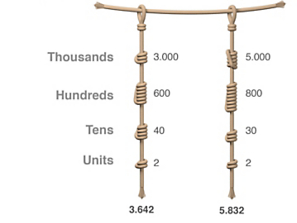
Archaeologists have deciphered the numerical values encoded in quipus.
The Incas adopted a unique system of recording information called “quipus” (“knots” in Quechua), a system of knotted strings that stored data and communicated information. They weren’t the first to adopt this method. Cultures across the ancient Andean world used this system for thousands of years. And for the Incas, quipus were a necessary and effective universal method of communication with people who spoke different languages in the vast empire they ruled over.
The quipu allowed the Inca to carefully track and keep records of everything from the amounts of troops to stores of food and other goods that moved through their vast empire.
It may have looked like a meaningless tangle of strings and knots, but the arrangement of quipu was extremely precise and quite sophisticated, communicating everything from accounting figures to field measurements to genealogy. When the Inca were expanding their empire, the first thing they did was send down their “accountants” to take inventory of a newly conquered territory’s resources—streams, fields, fishing, mining, population census, and more—all carefully recorded on a quipu and brought back to Cusco. Now they could make an informed decision on how best to administer their new land.
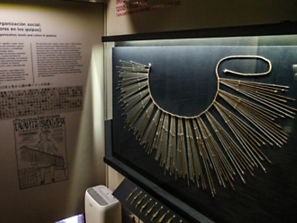
A rare surviving quipu on display at the Amano Museum of textiles in Lima.
So important was the information that was to be gathered by the quipu, those “accountants” the Incas relied on were actually a specially trained caste called quipumayuq, or the “keepers of the quipus,” whose responsibility was tying and translating the quipus. And it certainly sure worked out well for them. Even Francisco Pizarro and his Spanish conquistadors were impressed. While it was the gold and treasure they were after, once they began to impose their own customs on the crumbling Inca empire, they were said to be simply awestruck at how efficient their society had been organized.
So were quipus just a primitive counting tool to store numerical data, or were they something more? Unfortunately, after the Spanish took over, just a tiny percentage of Incan quipus survived. And in a century of study, while no one has been able make them “talk,” it’s looking more and more like quipus do hold a lot more information than a bunch of numbers—in fact, they may be encoding long lost stories, Incan myths and legends, songs, and more.
The first hint that a quipu wasn’t just some dressed-up abacus came from a 1609 account by Garcilaso de la Vega, son of an Inca princess and a Spanish conquistador. He wrote how the Inca had “an admirable method of counting everything in the Inca’s kingdom, including all taxes and tributes, both paid and due, which they did with knots in strings of different colors.” But what followed is the important part. He went on to say that the Incas “recorded on knots everything that could be counted, even mentioning battles and fights, all the embassies that had come to visit the Inca, and all the speeches and arguments they had uttered.”
De la Vega may have been embellishing, but what he was saying is that quipus contained similar narrative information that other cultures write down—and that’s a written language. It doesn’t really matter, though. Enough new information has come to light in recent years to make us reconsider everything we know about Incan history and culture.
So, the Inca may have had a written language after all. But they definitely didn’t have the wheel.
Wait, they really didn’t have something as basic as the wheel?
It had long been assumed that Incas—and a few other ancient civilizations—didn’t use wheels because they didn’t know how to make them. But that’s simply not true. Archaeologists have unearthed plenty of examples of wheeled toys across Mesoamerica. We’re sure you’re familiar with the expression “necessity is the mother of invention.” Well, the Inca had no need for wheels or wheeled carts. They certainly had the technical savvy to invent them, but why bother? What were they going to use to pull something on wheels? All the horses, cows, and oxen were across the Atlantic.
Another factor was geography. Draft animals or not, no wheeled wagons were going to traverse up and down the steep terrain of the Andes, along narrow footpaths, and across suspension bridges swaying in the wind. The wheel may have been responsible for dramatically accelerating the progress of civilizations across Eurasia—making it easier to travel long distances—but it was impractical for the Inca.
They had no trouble maintaining communications along a stretch of more than two thousand miles without wheels. Human couriers and llamas did the job just fine. It’s the same for the ancient Polynesians, who didn’t have the wheel either. Most of the traveling they did was across the water—which was much easier in canoes.
A few more fascinating facts about quipus and the Inca
Explore the legendary lands of the Inca during Machu Picchu & The Galápagos.
Heavenly Valley
What did the ancient Incas see reflected in the waters of the Urubamba River in Peru’s Sacred Valley?
Heavenly Valley
What did the ancient Incas see reflected in the waters of the Urubamba River in Peru’s Sacred Valley?
Hairless Heirlooms
What country's hairless canine is both an ancient breed and living national treasure?
Get The Inside Scoop On...
Like what you see here? Receive weekly updates right in your inbox.
inside-scoopArticles In This Edition

Frozen Feuds

Memories Across Generations: Private Family Adventures

Newest of the New: O.A.T. Adventures for 2026

String Theory

The Surprising History of the Panama Canal