
Ernest Hemingway in Tanzania in 1953, before not one, but two plane crashes derailed the adventure. We assure you that you’ll be in good hands with O.A.T. during Safari Serengeti: Tanzania Lodge & Tented Safari.
Ernest Hemingway in Tanzania in 1953, before not one, but two plane crashes derailed the adventure. We assure you that you’ll be in good hands with O.A.T. during Safari Serengeti: Tanzania Lodge & Tented Safari.
Question: What famous literary figure walked away from two separate airplane crashes just hours apart while vacationing in Africa?
Answer: Ernest Hemingway
“Every man’s life ends the same way,” Ernest Hemingway once observed. “It is only the details of how he lived and how he died that distinguish one man from another.” Well, the details of Hemingway’s exploits throughout his turbulent life put him in a whole different league than the rest of mankind. Few individuals have lived a more colorful life—or lived a more accident prone one, also—than this literary icon who remains one of the greatest and most influential writers America has ever produced.
He had so many brushes with death during his lifetime, one has to wonder how he found the time to win both the Pulitzer Prize and Nobel Prize for Literature for his novels. A partial list of the maladies and physical injuries he suffered would be anthrax, malaria, dysentery, hepatitis, anemia, high blood pressure, ruptured kidney, ruptured spleen, ruptured liver, pneumonia, crushed vertebra, fractured skull, and let’s not forget skin cancer. Oh, and he also survived three serious car crashes, including one that propelled him right through the windshield.
But the strangest and most “odds-defying” brush with death had to be walking away from two separate airplane crashes over a two-day period in Africa in the summer of 1953. If Hemingway had used the incident as a plot point in one of his novels, the Pulitzer board would have asked for their prize back. And who walks away from one plane crash, never mind two?! Here’s how it all played out ...
Hemingway was vacationing in Uganda with his fourth wife, Mary Welsh, an accomplished journalist and war correspondent who married Hemingway in 1946. One morning, he chartered a sightseeing plane to take them to Murchison Falls, a dramatic waterfall on the White Nile. Flying low over the trees, the plane clipped a utility pole and plunged into the crocodile-infested shores of the Nile. Mary was knocked unconscious and broke two ribs and Hemingway suffered a concussion, but otherwise they weren’t too badly injured. A distress call was sent and the pilot and his two passengers camped in the jungle to wait for a rescue flight.
Early the next morning, a tourist boat spotted the three survivors and ferried them to a nearby town, where they boarded a second plane. Just after takeoff, it crashed and burst into flames. The pilot kicked out the window and was able to pull Mary through, but the opening was too small for Hemingway. Forced to slam his upper body and head against the exit door to escape, he made it out but suffered extensive injuries, including serious burns, a concussion, and a skull fracture.
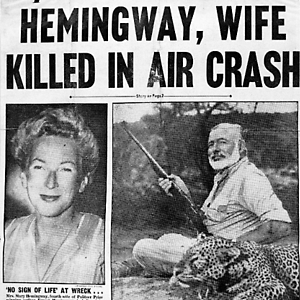
Not interested in taking any more airplanes, the couple traveled by car to a hospital in Entebbe. In spite of his serious injuries, Hemingway remained in high spirits. Carrying “a bunch of bananas and a bottle of gin,” his first words to waiting journalist were: “My luck, she is running very good.” With his head covered in bandages, he gleefully recounted their ordeal, even joking how Mary’s loud snoring had alerted elephants to their presence while they were stranded in the jungle. Meanwhile, the couple were unaware that a search plane had spotted the wreckage of their first crash and had seen no survivors. So, newspapers around the world had reported on Hemingway’s death. During his recovery in the hospital, Hemingway took great pleasure in reading his own obituaries.
Writing to his lawyer few months later, Hemingway casually mentioned the injuries he and Mary suffered after those two harrowing plane crashes. His right arm was “burned to the bone,” he wrote, his right kidney, ruptured; liver and spleen, injured. Mary could have suffered a head injury. Her memory was “not too hot yet.” The recently resurfaced letter, which was handwritten by Hemingway since his fingers were too badly burned to type, fetched $237,000 at auction.
While Hemingway remained upbeat in the immediate aftermath of this misadventure, head injuries in the years that followed took a toll. He reportedly suffered “at least nine major concussions during his life.” But it was the second plane crash that seemed to mark the real beginning of his cognitive decline and conditions that led to the novelist’s suicide in 1961.
But two days doesn’t even begin to cover the adventures from Hemingway’s uniquely action-packed life—which began when he was just three years old ...
It may be too simplistic an explanation, but his parents sure look responsible for Hemingway’s lifelong love of hunting and all things masculine. His mother, Grace, had wanted a girl so badly, she made little Ernest look like one—including his hair and dressing him in lacy white frocks. When Ernest was just three years old, his father introduced him to guns and hunting by having the lad shoot a porcupine—and then making him eat it.
After we assume he recovered from these childhood traumas, Hemingway served as an ambulance driver in Italy during World War I. While being badly wounded by mortar fire, he helped drag an Italian soldier to safety, earning Hemingway an Italian Silver Medal of Valor. He would spend six months recovering from his injuries. Thirty years later, the U.S. awarded him a Bronze Star for courage displayed while covering the European theater in World War II as a journalist.
While honeymooning in France in 1927 with his second wife Pauline Pfeiffer, Hemingway contracted anthrax. A few months later in Paris, he thought he was yanking a toilet chain, but it was a skylight, which crashed down onto his forehead, leaving him with a permanent scar. In the early 1930s, Hemingway took the writer John Dos Passos elk hunting in Montana. After dropping him off at the train station, Hemingway crashed his car, breaking several bones leaving him hospitalized for two months. The nerves in his writing hand would take two years to heal.
In a 1935 dispatch for Esquire, Hemingway advised readers on the best way to kill a large animal: Shoot it in the brain if it’s close, in the heart if it’s far, or the spine if you need to stop it instantly. Then, he sharing with his audience the inspiration for these instructions: “on account of just having shot himself in the calves of both legs” while attempting to gaff a shark on a fishing trip off Key West.
His hunting exploits are legendary. Out strolling a meadow with his wife and two of his children in 1940, Hemingway shot and killed four hundred jackrabbits in a single day. On countless hunting trips, he bagged lions, leopards, hyenas, and more. He established several fishing records including catching seven marlins in one day. After spotting a group of sharks that were scavenging a huge tuna that he was trying to land while deep sea fishing one day, he did what we assume any fisherman would do—pulled out a Thompson submachine gun and opened fire on them. It was a bloodbath, but he got his tuna!
He even tried hunting German subs. In 1942 and 1943, Hemingway spent far more time aboard his 38-foot wooden fishing boat than he did with his writing—looking for German U-boats to bring down armed with grenades and submachine guns.
Whether it was at the hands of an enemy soldier or the horns of a bull, the idea of facing down death had captivated Hemingway his entire life and infused all of his works. His brilliantly concise writing style and vivid prose were commented upon by Time magazine in 1961: “Everything in Hemingway is seen as it might be looked at by a man on the day he knew he would die.”
“I spent a lot of time killing animals and fish,” he once told Ava Gardner, “so I won’t kill myself.” Unfortunately, we all know how that turned out ...
Leave the drama to the wildlife when you join O.A.T. for Safari Serengeti: Tanzania Lodge & Tented Safari.
Nana’s Dream Realized: The Lewis Family Safari
Harriet Lewis reflects on why visiting Tanzania with her children and grandchildren was “a dream come true.”
Animal House
The cooling strategy of what creatures inspired engineers to develop more energy-efficient buildings in hot climates?
Soaring Above the Serengeti with Elieza Ikamba
From African safaris to Asian adventures, O.A.T. Trip Experience Leaders share heartwarming stories of unexpected reunions and cultural exchanges that last long after the journey ends.
Get The Inside Scoop On...
Like what you see here? Receive weekly updates right in your inbox.
inside-scoopArticles In This Edition

Great Elephant Migration Comes to Boston

Literary Mishaps

Spring Awakenings: Top 10 Journeys for March-June 2027

These Books Take You Places: Reading Recs from our Resident Expert

Writing on the Walls: Languages and Stories Engraved in Time