
Fireworks over the colonial cathedral in Cuenca, which you can visit on the optional post-trip extension to Ultimate Galápagos Exploration & Ecuador’s Amazon Wilds,are among Ecuador’s more familiar New Year’s traditions.
Fireworks over the colonial cathedral in Cuenca, which you can visit on the optional post-trip extension to Ultimate Galápagos Exploration & Ecuador’s Amazon Wilds,are among Ecuador’s more familiar New Year’s traditions.
Question: One of Ecuador’s many quirky New Year’s Eve traditions includes running around the neighborhood at midnight with what?
Answer: A suitcase
Forget the Times Square ball drop, a kiss at midnight, and a few resolutions—when it comes to going all out for New Year’s Eve celebrations, few countries are more passionate than Ecuador. Steeped in tradition, the day is marked with everything from street partying, pyrotechnics, and cross-dressing to the burning of effigies, magical underwear, and—running around the block with a suitcase.
That’s right, as the clock nears midnight, you’ll see people dashing along the streets hauling empty suitcases. Can you guess why? The reason for this lighthearted “suitcase sprint” is that it ensures that participants hoping to travel that they will have globetrotting adventures to look forward to in the upcoming year. But that’s just a fraction of what goes on in the streets of Ecuador on New Year’s Eve—which isn’t even called “New Year’s” by Ecuadorians.
Año Viejo—Happy “Old” Year!!
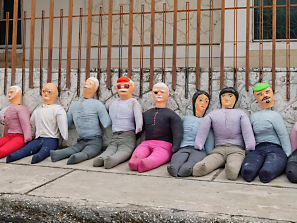
The monigotes await their fate.
In Ecuador, New Year's is called Año Viejo (Old Year), a celebration that starts early on December 31st and goes on all day and night until dawn on New Year’s Day. The whole point of Año Viejo is to celebrate the farewell of the old year before greeting the arrival of the new one, and preparations begin weeks before the big day. The centerpiece of Año Viejo is the creation and burning of Año Viejo dolls—life-sized effigies crafted by families and friends using old clothes stuffed with newspaper or sawdust by families and friends. Called monigotes, the dolls have masks that depict cartoon characters, public figures, or politicians—or even to resemble people they dislike.
As midnight approaches, the monigotes are placed on sidewalks and streets throughout the country and during the final countdown, they’re set ablaze in giant bonfires. Lighting up neighborhoods nationwide, the burning of the monigotes is a powerful symbol of “forgiving and forgetting,” and letting go of the hardships of the previous year and creating a purified space for a year of new beginnings. And, of course, the burning is accompanied by festive partying with music, drinking, and dancing through the night. Good luck for the upcoming year is supposed to come for those that choose to jump over the Año Viejo puppet while it is ablaze—but to ensure your happiness and prosperity in the coming year, you’re supposed to jump over it twelve times.
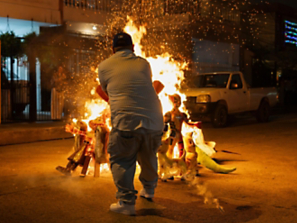
We hope he didn’t attempt this jump.
For such a festive holiday tradition, the origins of Año Viejo sprang from a tragic event in Ecuador’s history. In 1895, a yellow fever epidemic devastated Guayaquil, Ecuador’s most populous city. In an attempt to stop the spread of the disease, those not afflicted stuffed coffins with the clothes of the dead and then set everything ablaze—a similar symbol of purification and new beginnings that is celebrated during modern-day Año Viejo.
But setting puppets on fire is still just scratching the surface of Ecuador’s Año Viejo festivities.
This part of Año Viejo is kind of a drag …
To represent the grieving widows left behind by the burned puppets, men throw on a pair of high heels and a sexy dress and roam the streets begging for money. They really do. If you’re driving through the streets of Ecuador late on New Year’s Eve, you better be carrying plenty of change with you. If not, you may be pulled out of your car by one of these sexy “widows” and forced to dance with them in the streets until you cough up some coins.
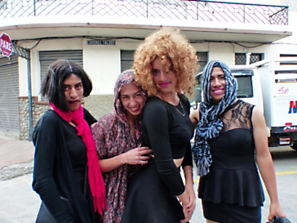
Better pay up, or these merry widows will have the last dance.
Between the men in drag and people running around with suitcases, things can get a little crazy. But as long as you’re wearing your magic underwear, everything won’t seem so strange—because when the clock strikes 12, the color of your underwear will determine what the New Year will bring. Wearing red or pink means love is coming your way; yellow will bring good fortune and wealth; white for peace and harmony; green or blue foretells a year of good health; and black, unsurprisingly, means bad luck. Not sure what no underwear means … but it makes no difference. No one’s getting any sleep with all the fires, laughter, drinking, music, and dancing that go on until dawn.
You have to admit, trying to stay awake until midnight to watch the ball drop on TV now seems rather dull, doesn’t it? You could always try running around the block with your suitcase …
More Wacky Traditions Around the World—A New Year’s Eve Countdown
TEN …
NINE …
EIGHT …
SEVEN …
SIX …
FIVE …
FOUR …
THREE …
TWO …
ONE …
While you may not participate in a New Year’s suitcase sprint, you’ll discover rich Ecuadorian traditions at any time of year during Ultimate Galápagos Exploration & Ecuador’s Amazon Wilds.
Get The Inside Scoop On...
Like what you see here? Receive weekly updates right in your inbox.
inside-scoopArticles In This Edition

"I Am Not Alone": Help for a Student Who Lost Everything

"Reading" Lessons

By the Dozen

Drumming and Dancing into the New Year

Midnight Run

Top 15: Adventures with FREE Single Space Still Available in 2026

You’re in Good Hands… With O.A.T.