In the video above, discover the highlights of the Seine River with The Seine: Paris to Normandy Program Director Ludivine Journaux, from the legendary museums of Paris, to the Gothic architecture and unique cultural traditions of Normandy’s capital city of Rouen..
On April 15, 2019, the world watched in horror as fire engulfed the magnificent spire of Paris’s Notre Dame cathedral—and the people of France mourned the near-loss of a monument as beloved as it is iconic.
We chatted with Trip Experience Leader Kerry Chirinos about what makes this festival so special to the Quechua people of Peru—and what it means to her and her family.
On December 7, the bells rang at Notre Dame once more, commemorating the completion of a massive restoration effort involving thousands of experts and millions (upon millions) of euros. We chatted with Ludivine Journaux, Program Director for The Seine: Paris to Normandy, about what the reopening means to her, and to the people of France.
Grand Circle: Do you remember where you were when you learned about the fire?
K.C.: The Inti Raymi was celebrated until 1571 by the last Incas of Vilcabamba, with Felipe Túpac Amaru being the last to celebrate it before his execution ordered by Viceroy Francisco de Toledo. During the colonial period, cultural and religious clashes occurred. Indigenous people were evangelized, and their Andean festivals were replaced with Catholic ones. They were divided into nobles and commoners but always remained subordinate to the Spanish and Creole elites.
Ludivine Journaux: It is hard to imagine it was five years ago! It seems like yesterday. At that time I was living and working in Paris. But that day I was in the countryside at my parents’ house. I remember first I did not really pay attention to the news because I did not realize how huge the fire was. When I understood, I stood in front of the TV for hours with my family, watching the news. We were so amazed, we could not believe it.
Grand Circle: What went through your mind?
L.J.: Disaster. Like if it was Paris itself burning.
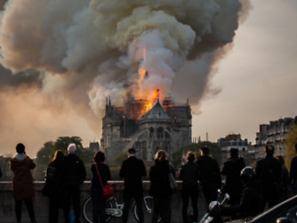
The people of Paris looked on in shock as their beloved monument burned.
Grand Circle: What is the energy like in France now that the cathedral has reopened?
L.J.: It is a very special moment. On one hand, we are very excited to discover the restoration, fascinated by how quick it was and the incredible know-how of the workers involved. On another hand, the country is going through an important economic and political crisis. The prime minister and his government were censored and dissolved. You can hear some people say, "Now that we restored Notre-Dame, can we restore the public hospital?" Or, "There is no more money for education but the president organizes big receptions." I think we can definitely say it is a very French energy!
Grand Circle: Can you talk about the significance of Notre Dame to the people of Paris and France?
L.J.: Notre-Dame represents so many things. It is the most iconic monument of Paris, in the middle of the city island, where Paris was born. The gargoyles were immortalized by France’s most famous writer, Victor Hugo, and are still very popular through the musical it inspired. I would say it is the most famous religious monument we have in France in our collective memory.
Grand Circle: Architecturally, what elements do you find most impressive?
L.J.: Of course, the gargoyles come to me first, even if they are not that old, only from the 19th century. These fantastic creatures overlooking Paris give the city such a romantic and mystic aura.
Grand Circle: Do you have any insights on the restoration and why it was so successful?
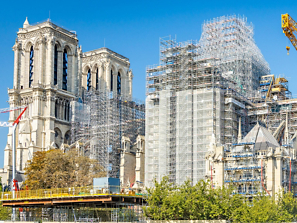
Scaffolding nearly covered the entire façade in the fall of 2023.
L.J.: I think it was successful because, for each specialty, it gathered the best workers. Mason, marble, frame, etc.—more than 2,000 workers were on the project. And, of course, they had almost an unlimited budget as it was the biggest fundraising in history. It was kind of a competition between billionaires to see who would give the most. Finally four billionaires gave 600 million euros out of the total fundraising of 840 million euros.
Grand Circle: What happened to Notre Dame during the French Revolution? How long did restoration take back then?
L.J.: It was transformed into the Temple of Reason, like many other Catholic churches that became secular during the Revolution. As a strong symbol of power and monarchy, the cathedral was ransacked. It even became a wine storage for a time. Then two events really changed everything. First, Napoléon choose Notre Dame to crown himself (instead of the traditional Reims Cathedral) and secondly, the novel of Victor Hugo brought a new insight and fame on Notre-Dame. That’s how in the 19th century, it was reshaped by Viollet Le Duc, the one who created the gargoyles … and the spire!
Grand Circle: Do you have any special personal memories about the cathedral?
L.J.: Yes, many years ago I did a photography class in the garden behind Notre-Dame. It was such a great playground, trying to catch the dramatic view of the cold grey gothic architecture with a winter tormented sky!
Grand Circle: You mention in your video that you live in Rouen. How does that cathedral compare to Notre-Dame?
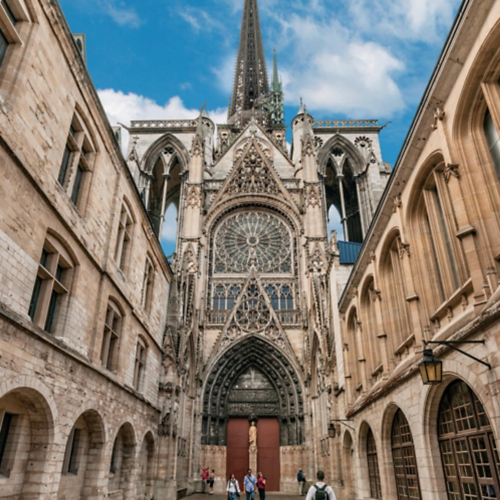
Built and rebuilt over hundreds of years, Rouen Cathedral showcases an evolution of architectural styles.
L.J.: We had a big fear here in Rouen this year because a fire also started from the spire! I could smell the smoke in the street and the sky was dark. Fortunately, it stopped in few hours with no big damage. Otherwise it would have been even more traumatic for me, as Rouen Cathedral is even more personal for me—and also, I have to say, more beautiful! This is mainly because it is part of a whole city full of architecture from the Middle Ages, which is not the case for Paris. So it creates a special atmosphere. You have to come here to see it.
See both Notre Dame and Rouen cathedrals—and decide for yourself which is most beautiful—during The Seine: Paris to Normandy.


