
Seek out the highly adaptable oryx amidst the Sossusvlei Dunes during New! South Africa & Namibia: Cape Town’s Winelands to the Skeleton Coast.
Seek out the highly adaptable oryx amidst the Sossusvlei Dunes during New! South Africa & Namibia: Cape Town’s Winelands to the Skeleton Coast.
The San bushmen of Namibia call the Namib Desert “the land God created in anger”—an opinion that any human would understandably share if they tried to eke out an existence in one of the driest places on earth. But while humans weren’t designed to live in such a desolate place, a menagerie of fascinating species has evolved specifically to do just that. After all, this is quite possibly the oldest desert on earth. Life has had 80 million years to figure out how to survive—by any bizarre means necessary.
Fortunately, the ever-thirsting inhabitants of the Namib do have a little something to work with, thanks to the desert’s proximity to the Atlantic Ocean. For approximately 60 days each year, an icy current flowing northward from the Antarctic meets the warm, moist air over the Atlantic, condensing it into a thick fog. This precious moisture then blows over the sands of the Namib—where desert inhabitants are prepared for a feast.
Leave it to beetles
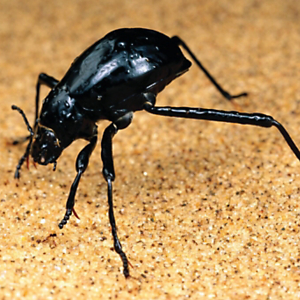
The fog collector beetle sports a shell covered with bumps that attract water and a waxy coating that repels it. When fog rolls in, the beetle assumes a position similar to a headstand and waits patiently for moisture to condense onto its shell. Once substantial droplets form, they funnel straight down the waxy surface and into the beetle’s mouthparts. Scientists have turned to this ingenious design as inspiration for inventions that might someday convert fog into drinking water in arid climates.
The hardworking button beetle, while not physically adapted like the fog collector, has adapted its behavior instead. It digs tiny furrows in the sand that catch the fog as the wind passes over them; the beetle then absorbs the moisture by creeping over the damp ridges.
A desert plant to be reckoned with
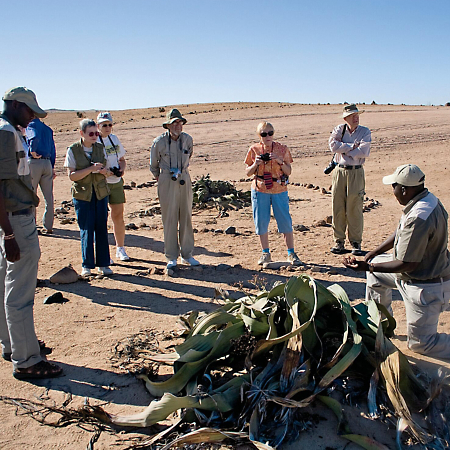
Perhaps the strangest fog harvester of all in the Namib—or the strangest specimen, period—is the welwitschia, Namibia’s national plant. The leathery leaves of the welwitschia capture condensed fog and direct the moisture down toward its roots—so in effect, the plant waters itself. The leaves are also able to absorb moisture directly, and the roots are long enough to reach underground water nearly 100 feet away. Though a welwitschia can grow to over six feet long, it never consists of more than two leaves, which split and spread into curling tatters with age—and we do mean age! Moderate sized plants have been carbon dated at 1,000 years, and the largest specimens are believed to be twice as old. Talk about a desert survivor.
How to not sweat it
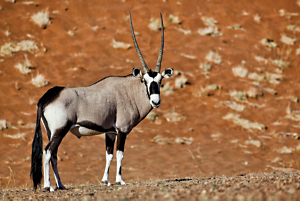
Unlike Namib denizens that survive by harvesting what little water they can find, the oryx survives because of its ability to go without—for weeks on end, as a matter of fact. When deprived of water, the oryx simply stops sweating to prevent loss of moisture. Its body temperature rises to a staggering 113 degrees during these times—which would cause serious brain damage if it weren’t for a network of blood vessels at the base of the oryx’s brain that open and shut as needed to safely distribute heat. It also stores its urine as a potential source for water during especially dry spells.
So if you’ve never considered the Namib a wildlife destination, we encourage you to think again. Life does exist in those beautifully desolate dunes—angry though their creator may appear to have been—and it’s certainly some of the wildest you’ll find anywhere in the world.
Explore the arid dunes of the Namib Desert and learn about the species that survive there during New! South Africa & Namibia: Cape Town’s Winelands to the Skeleton Coast.
Deadly Paradise
What is the name of this unforgiving coastline littered with the ghostly remains of shipwrecks and the sun-bleached bones of whales, seals—and humans, too?
The Mystique of the Skeleton Coast
Dive into this traveler’s firsthand account of the beauty that awaits on Namibia’s Skeleton Coast.
NEW Trip: From Vines to Dunes—Africa's Wild Southwest
Explore South Africa's winelands and Namibia's deserts on an 18-day adventure from Cape Town to the Skeleton Coast.
Get The Inside Scoop On...
Like what you see here? Receive weekly updates right in your inbox.
inside-scoopArticles In This Edition

Animal House

Announcing 2027 Summer Sailings on 4 Small Ship Adventures

Gelato! And Other Frozen Italian Delights

Keep Your Cool on These 10 Summer Journeys

Losing Sleep

Of Sand and Fog: Namibia’s Desert Survivors

Beat the Heat: Advice from O.A.T. Associates