
A statue of King Sejong the Great, creator of the Hangul language, proudly stands in Seoul—which you can explore during South Korea & Japan: Temples, Shrines & Seaside Treasures.
Written languages typically develop over a long period of time, evolving as amalgamations of oral tradition, modifications of existing alphabets, and social custom. In every corner of the world, you’ll find a different style of communication, and though there are some overlaps, all languages seem to have their own unique style and story. The Korean language, for example, has an interesting history…
Korean Hangul
Up until the mid-15th century, Koreans wrote in Chinese, the language of their dominant neighbor. But the Chinese characters did not entirely translate all of the Korean cultural understandings. King Sejong the Great decided his nation needed a language of its own. He turned to top scholars for advice before beginning a two-year process to create Hangul, which gives every symbol its own sound and meaning, so that anyone—scholar or pauper—could sound it out once they memorized each symbol. The shape of each consonant even resembles the shape of the speaker’s mouth, for easier memorization.
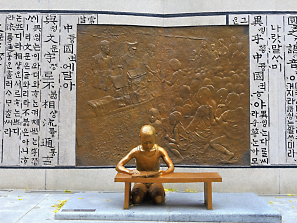
Street art depicting the Korean alphabet.
This democratization was popular with the people, but it took a while to become the norm: Chinese remained the official language for generations. Even after Hangul was universally adopted, it was deemed a threat: Japan banned its use while occupying Korea during World Wars I and II. But, in the end, Hangul has prevailed, used in both North and South Korea, yielding near 100% literacy.
Hangul has 14 consonants and 10 vowels that are grouped into syllabic blocks and arranged both vertically and horizontally. It was traditionally written from top to bottom, and from right to left, but today it mimics Western-style orientation and punctuation.
Fun Facts about Other Language and Writing Systems
Experience the culture of South Korea and its relationship with neighboring China during South Korea & Japan: Temples, Shrines & Seaside Treasures.
Where in the World?
Where in the world can you explore a sprawling 14th-century palace complex, once frequented by a "Great" king who personally invented his nation's alphabet?
Parting Shots: The Art of Japanese Death Poems
The Japanese tradition of "Death Poems"—or jisei—were a creative means of accepting death and often beautiful reminders to cherish life.
Grand Circle Foundation Update: Saving Abandoned Babies in South Korea
See how a pastor’s own disabled son inspired his life’s work to save unwanted babies.
Get The Inside Scoop On...
Like what you see here? Receive weekly updates right in your inbox.
inside-scoopArticles In This Edition

From Scientist to Activist: Remembering Jane Goodall

Go Your Own Way: Top 10 Solo Adventures for 2026

Language Lessons: Writing Systems of the World

Women of their Words