Hike the volcanic slopes of Mount Etna with Sicily’s Ancient Landscapes & Timeless Traditions Trip Experience Leader Vera Leotta, encountering craters, forests, and lava caves, and learning about the reverence that Sicilians have for their "Mama Etna."
Would you live on the slopes of an active volcano? Not some dormant relic belching up a puff of smoke every thousand years or so, but one with a history of spewing steam and ash miles into the sky and sending rivers of molten lava down its flanks capable of swallowing everything in their path—vineyards, forests, cars, homes, and even entire villages.
Yet about a million Sicilians—a quarter of the island’s entire population—choose to make their home on the slopes of one of the world’s most active volcanoes. Are they crazy? Admittedly, all that shouting with dramatic hand gestures at fish markets in Catania doesn’t help their case, but Sicilians are most assuredly not crazy. And they have two very solid reasons for living in the shadow of Mount Etna.
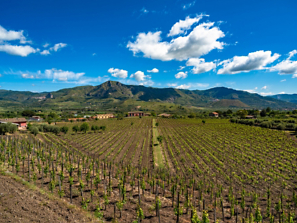
Vineyards and orchards thrive upon Etna’s fertile volcanic soil.
You probably know the first one. It’s the fertile soil. About a half million years of uninterrupted spewing of volcanic ash has enriched the soil to such an extent that everything from terraced vineyards and citrus orchards to olives, hazelnuts, and pistachios are cultivated on Etna’s lush lower slopes. It is thought that close to three-quarters of Sicily’s crops are grown in the vicinity of the massive volcano—whose area covers more than 450 square miles. Due to the richness of its soil, no mountain slopes in the world are blanketed with as many vineyards, orchards, farms, and villages as Mount Etna.
We’ll get to the second reason shortly. But first a little background on one of the world’s most iconic volcanoes—even recognized by UNESCO as a World Heritage Site.
Mount Etna’s many names—Nom de plumes (of ash)
Since Roman times, Sicily’s "gentle giant" has been known as Mount Etna (or Aetna, in Latin), likely from the Greek word Aitne, which translates to "I burn." The Arabs then called it Gibel Utlamat, or "Mountain of Fire," which led to Mons (Latin for "mountain") Gibel (Arabic for "mountain" so, "mountain of mountains"), and then to Mongibello, Italian for "Beautiful Mountain" and its Sicilian equivalent Mungibeddu. It’s all rather confusing, which is probably why most Sicilians simply call it "A’ Muntagna," or "The Mountain."
And in case you’re wondering, Aetna Insurance is indeed named for Mount Etna. When a group of local businessmen and merchants gathered in Hartford, CT, in 1819 to incorporate their new Fire Insurance Company, they chose to name it after the Sicilian volcano, because "though surrounded by flame and smoke," Aetna "is itself never consumed."
The myths and legends associated with Mount Etna could fill a book (and in fact have filled several). The volcano was immortalized by Virgil in The Aeneid and was believed to be everything from the underground forge of Vulcan to the lair of the Cyclops. But there’s one tale too good to pass up.
There’s Greek fire—but Greeks leaping into fire?

Empedocles should have stuck to exploring collapsed volcanic cones like this one.
In about 430 BC, a famous pre-Socratic Greek philosopher from Agrigento named Empedocles said: "We do not what we ought, What we ought not, we do, And lean upon the thought that Chance will bring us through."
The learned Empedocles, who was living near the volcano’s summit to study it more closely, decided that the best way to prove that Etna’s volcanic gases would support his body weight was to throw himself into the crater—something (to state the obvious) he ought not to have done.
Whether true or not, it seems the Roman poet Virgil, writing in about 20 BC, had a much better grasp of the volcano’s destructive power, observing how "By turns hot embers from her entrails fly, And flakes of mounting flames, that lick the sky … Oft liquid lakes of burning sulphur flow, Fed from the fiery springs that boil below."
So while Etna’s volcanic ash is responsible for some of the most fertile soil in the Mediterranean, even Virgil had sense enough to know that its beauty was best viewed from afar. But maybe he was wrong.
Etna giveth, and Etna taketh away
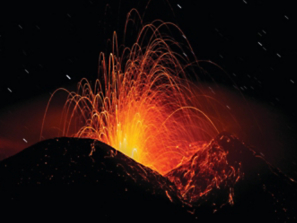
The frequency of Etna’s eruptions actually prevent them from building enough power to be catastrophic.
The second reason Sicilians choose to live within a lava stone’s throw of an active volcano may surprise you. It’s because Etna is very unlikely to kill you.
Despite the pressures of modernization, many Yagua communities strive to maintain their traditional social structures and spiritual beliefs. For example, the cocamera (or ceremonial meeting house) remains a central part of community life, serving as a gathering place for important discussions, rituals, and celebrations.
While lava flows can ruin your crops and perhaps your home, Mount Etna rarely kills anyone. Since the first recorded eruption in 475 BC, there have been at least 250 eruptions of the 11,000-foot-tall stratovolcano dominating Sicily’s eastern coast. The most catastrophic one took place in 1669, when a great blast tore the mountain apart, shooting ash into the sky and releasing a river of molten lava that destroyed the nearby city of Catania and caused the deaths of up to 20,000 of its residents. Wait a minute, didn’t you just say Etna wouldn’t kill you?
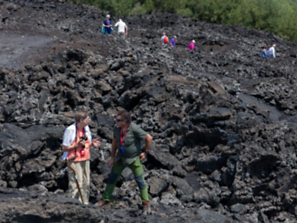
While Etna’s lava fields look dramatic, they were not responsible for the destruction of Catania in 1669.
That oft-repeated story of Etna’s 1669 eruption is not what happened. It took the lava flow five weeks to reach Catania—enough time to get out of the way. In fact, when the encroaching lava flow finally did reach Catania, the city walls held it back for another two weeks. It was only when the walls were finally breached that parts of the city were destroyed. The complete destruction of Catania (along with the deaths of most of its residents) didn’t happen until 24 years later. And it had nothing to do with Etna—it was an earthquake. While 15 small villages were destroyed in addition to the damage to Catania, the number of physical deaths attributed to the 1669 eruption is actually zero. But the version that still gets picked up leaves one with the impression that when Etna erupts, it’s time to flee in panic. And nothing could be further from the truth.
Etna’s lava flows—more like lava slows

O.A.T. travelers hike near Etna’s caldera.
Thick, extremely slow-moving lava flows are typical of all Etna eruptions. Picture outrunning an advancing glacier. In fact, Etna’s eruptions alone have rarely caused human deaths. Since 1500 BC, the number of confirmed deaths that can be directly attributed to Mount Etna is 77, with 13 of those occurring in the 20th century—and most of those when people were in areas where they should not have been.
Ironically, Etna’s constant activity is the very thing that keeps those on its slopes relatively safe. Rather than building up pressure for years before erupting violently like Vesuvius in AD 79, Etna continually emits gases that relieve the pressure. Etna’s frequent eruptions are classified by volcanologists as "effusive" (an outpouring of lava on the ground) rather than "explosive" (self-explanatory).
Anything can happen, of course. By their very nature volcanoes are unpredictable. Can anything be done when a lava flow is heading to a populated area?
We can deflect an asteroid—what about diverting lava flows?
How hard could it be to divert a lava flow? Actually, it’s quite difficult. People living in the shadow of Etna have been trying to redirect lava flows since that 1669 Catania eruption, when the townspeople constructed a barrier to direct it away from the city. It worked, too—except the lava’s new path pointed it to the nearby town of Paterno, whose residents weren’t very pleased. A battle ensued, and the flow was redirected back to Catania. Since then, everything from digging trenches and building concrete barriers to using explosives in attempts to keep lava away from towns has been tried—with various degrees of success.
Aerial bombing to divert a lava flow was even tried, first in Hawaii, though, not Sicily. When lava from the Mauna Loa volcano threatened the seaside town of Hilo in 1935, island volcanologists asked the U.S. Army to drop bombs directly into the lava flow—a mission led by none other than the future General George S. Patton. While Patton would go on to achieve battlefield victories in World War II, including the Allied invasion of Sicily, he lost this one against Mother Nature.
In recent times, all manner of concrete dams and explosives have been deployed to divert flows away from towns and villages on the slopes of Etna. But it’s very difficult to predict where a redirected flow will go. And as far as where the lava stops, that’s up to the volcano.
Look for Etna in Sicily’s smoking section
Thanks to the volcano’s unique geology, Sicilians continue to live quite comfortably on Mount Etna’s fertile slopes. From viewing the otherworldly volcanic landscapes of its upper slopes to visiting the quaint villages, olive and citrus groves, apiaries and vineyards blanketing the lower slopes, you’ll love Mongibello, Sicily’s "beautiful mountain." Just don’t go leaping into the fiery crater.
Hike the dramatic slopes of Mt. Etna during Sicily’s Ancient Landscapes & Timeless Traditions.


